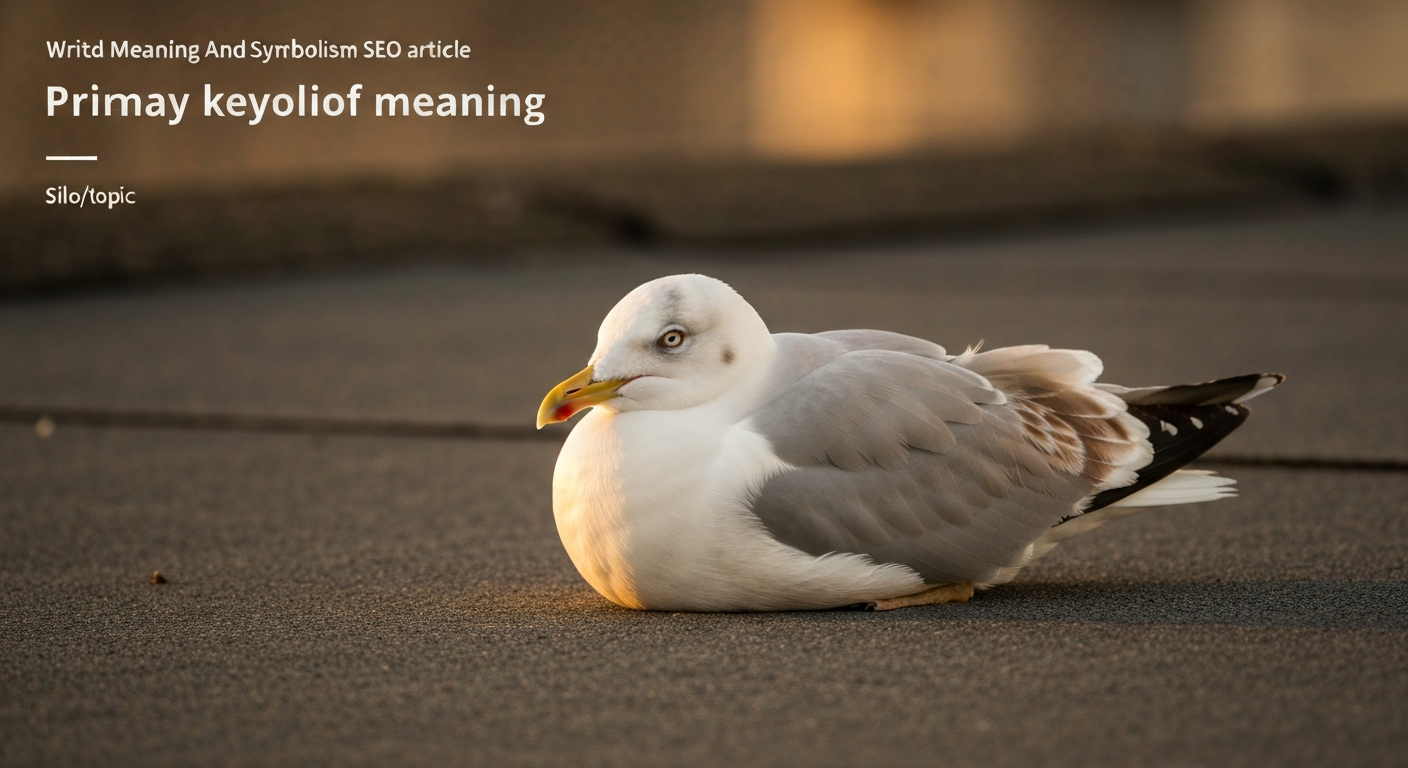
"Bird loaf" refers to a bird sitting in a compact, rounded posture while resting quietly, not feeding, not flying, just existing. Ornithologists call this behavior "loafing," and it is one of the most common, well-documented things birds do. The phrase itself is not a fixed dictionary idiom, but it draws on the English verb "to loaf" (to idle or linger without purpose), which fits perfectly. When you see a gull hunched on a rooftop with one leg tucked up and its feathers slightly puffed out, that is a bird loafing, and increasingly, people call it a bird loaf.
Bird Loaf Meaning: What Loafing Birds Signal and Why

Marcus Holloway
11 Aug 2026
Where the phrase comes from
The noun "loaf" (as in bread) comes from Old English hlāf, with deep Germanic roots. The verb "to loaf" meaning to be idle or linger is a separate development, well-established in modern English and recorded in Merriam-Webster and Oxford dictionaries as meaning to loiter or pass time without purpose. Merriam‑Webster’s entry for "loaf" documents the verb sense 'to loiter or be idle' and provides etymological information linking the noun to Old English hlāf (see Loaf, Merriam‑Webster (definition and etymology)) Loaf — Merriam‑Webster (definition and etymology). That verb sense is what connects to birds: a bird that is not foraging, breeding, or in active flight is effectively idling, and researchers adopted "loafing" as a behavioral label for exactly that state.
The two-word phrase "bird loaf" is not a headword in major dictionaries, and it does not carry a fixed idiomatic meaning the way "birdbrained" or "bird-dogging" do. Its current life is mostly informal: image captions, social media posts, and communities like the subreddit r/BirdLoaf, where people share photos of birds sitting in that characteristic round, bread-loaf shape. Think of it as a piece of folk ornithology that captures something real without yet being formalized.
What loafing actually looks like
The visual signature of a loafing bird is hard to miss once you know what to look for. The body appears compact and rounded, with feathers slightly relaxed or fluffed to retain warmth. The bird is largely still, with slow or absent head movements. One leg is often tucked up against the body. The head may be held low or turned and tucked under a wing. Eyes may be half-closed, or one eye may be open while the other is closed, that is not an injury, it is a real neurological feature called unihemispheric sleep, which allows one brain hemisphere to rest while the other stays alert enough to detect predators.
Loafing bouts can last anywhere from a few minutes to several hours depending on species, weather, and the time of day. Gulls and waterfowl are documented spending long stretches in loafing aggregations between feeding periods. You will often see multiple birds loafing together, which also serves a social vigilance function: more eyes scanning means less individual attention any one bird needs to pay.
Common loafing locations vary by species but follow a shared logic: safe, open spots with good sight lines and minimal disturbance. Shorebirds favor sandbars and high-tide wrack lines. Gulls and pigeons use flat rooftops and parking lot edges. Ducks rest on calm pond margins or partially submerged logs. Cormorants and pelicans loaf on marina pilings and rocks. Many species return to the same loafing sites repeatedly, which field researchers note as habitual behavior worth factoring into bird surveys.
Why birds loaf, the real reasons
Loafing is not laziness in any meaningful sense. It is an energy management strategy. Birds have high metabolic rates and burning energy unnecessarily between foraging bouts is wasteful. Resting conserves calories, supports digestion after a meal, and allows muscles to recover. Researchers who track time budgets in seabird and waterfowl studies consistently find loafing as a major category of daily activity, often grouped alongside sleeping and comfort behaviors like stretching and preening.
- Energy conservation: resting between foraging bouts reduces unnecessary caloric expenditure
- Thermoregulation: fluffed feathers trap warm air; tucking one leg and the head minimizes heat loss from exposed surfaces
- Digestion: birds often loaf after a large meal while food is processed
- Predator vigilance: communal loafing sites let individuals monitor threats with lower individual cost, aided by unihemispheric sleep
- Social aggregation: loafing groups can facilitate pair bonding, information sharing about food sources, and safety in numbers
Timing follows predictable patterns. Shorebird loafing spikes at high tide, when mudflats are submerged and foraging is impossible. Gulls loaf in higher numbers during midday calms and after productive feeding periods. Gull loafing dynamics, The Auk (correlation with tide and time of day) reports that gull loafing patch occupancy correlates strongly with tide stage and time of day Gull loafing dynamics — The Auk (correlation with tide and time of day). Waterfowl like ducks and geese concentrate loafing in the early afternoon after morning feeding. Season matters too: loafing time typically increases in winter when food is harder to find and every calorie of rest is worth something.
How to tell loafing apart from other bird activities
The tricky part for casual observers is that birds do several things while sitting still, and the differences matter for understanding what you are actually watching. Here is how loafing stacks up against the behaviors most likely to be confused with it.
- Preening: the bird is actively working its bill through its feathers in repetitive, deliberate movements. You can see the bill touching specific feather tracts, sometimes spreading oil from the preen gland at the base of the tail. The bird is busy. Loafing has none of that active manipulation — feathers are just resting where they are.
- Nesting: a bird at a nest is attached to a specific site with reproductive intent. It will incubate eggs, accept food from a mate, or brood chicks. There is directional behavior and context. A loafing bird has no such attachment to the spot and will leave without drama when disturbed.
- Roosting: roosting is the nightly communal or individual sleeping behavior, typically at a fixed location. Loafing is daytime resting and is generally more transient. Many bird management documents treat these as separate categories even though they can overlap.
- Soaring: a bird soaring is airborne, using rising air currents with minimal active wingbeats. It is energetically active in a different sense and visually unmistakable — the bird is in the sky, not on a surface. Loafing is always stationary.
- Hovering: hovering requires sustained, rapid wingbeats to maintain position in the air. It is one of the most energetically expensive things a bird can do. It is the opposite of loafing in almost every measurable way.
Loafing vs other bird behaviors at a glance
| Behavior | Location | Energy use | Bird is moving? | Purpose | Duration |
|---|---|---|---|---|---|
| Loafing | Ground, ledge, water edge, rooftop | Very low | Minimal — mostly still | Rest, thermoregulation, vigilance, digestion | Minutes to several hours |
| Preening | Same perch as loafing, often | Low-moderate | Bill and feathers actively moving | Feather maintenance, parasite removal, waterproofing | Minutes to ~30 min bouts |
| Nesting | At nest site only | Low-moderate | Incubation movements, provisioning trips | Reproduction: incubating eggs, brooding chicks | Weeks across breeding season |
| Soaring | Airborne, open sky or thermals | Low-moderate (passive lift) | Continuous gliding flight | Travel, foraging, territory patrol | Minutes to hours aloft |
| Hovering | Airborne, fixed position | Very high | Rapid continuous wingbeats | Hunting (kestrels, kingfishers), inspection | Seconds to a few minutes |
Field notes for birdwatchers
Loafing birds are genuinely excellent subjects for beginners because they hold still. That patience is worth taking advantage of. Here is what works well in the field.
- Time your visit around predictable loafing windows: high tide for coastal shorebirds, mid-morning to early afternoon for gulls and waterfowl, and dusk for communal roost arrivals in species like starlings or crows.
- Choose locations where disturbance is minimal. Known loafing sites — calm sheltered bays, quiet pond margins, flat rooftops visible from a safe distance — produce more sustained observations than active foraging areas.
- Use binoculars at 8x or 10x magnification. Keep at least 30 to 50 meters between you and a loafing group to avoid flushing them. If birds start bobbing their heads, stretching their necks, or shuffling, you are too close.
- Watch for the one-leg tuck, the head-under-wing posture, and asymmetric eye states (one open, one closed) — these are confirmation that the bird is genuinely resting rather than alert-perching.
- Note the substrate and time of day in your field notebook. Returning to the same site at similar times often reveals whether that location is a habitual loafing site, which is useful data for anyone tracking local bird populations.
- Photograph loafing birds from a stable position with a fast shutter speed despite the stillness — wind and heat shimmer can blur distant subjects.
One important ethical note: never approach a loafing group to get a better photo. Flushing resting birds forces them to use energy they were conserving, and repeated disturbances at habitual sites can cause birds to abandon them entirely. The best loafing observation is the one the bird never notices.
Alarming sky events, and why they are nothing like loafing
Readers searching for bird behaviors sometimes land on loafing when they are actually troubled by something they witnessed in the sky: a bird appearing to freeze mid-flight, a bird dropping suddenly from the air, or a mass die-off of birds falling to the ground. These events have almost nothing to do with loafing. A bird frozen in the sky is typically a hovering raptor like a kestrel holding position in wind, a normal and energetically demanding hunting behavior. For cultural or symbolic interpretations, see bird soaring meaning for how soaring differs from loafing. For a detailed explanation of why some birds appear frozen in the sky, see bird frozen in sky explained. Birds dropping dead from the sky or falling in numbers are documented phenomena linked to specific causes: collisions with structures or vehicles, rapid weather changes, disease events, or occasionally acute poisoning. None of those are routine behaviors. If you witness birds dropping dead or a sudden mass mortality event, the appropriate step is to contact your regional wildlife authority or a wildlife rehabilitation organization, not to search for spiritual meaning first. For readers wondering about bird drop dead from sky meaning, see our guide on the causes and appropriate responses to such die-off events.
The contrast with loafing could not be more complete. A loafing bird is calm, composed, and doing exactly what its biology requires. A bird dropping from the sky is in crisis. Knowing the difference prevents unnecessary alarm about ordinary resting birds and ensures that genuine die-off events get the attention they need.
Cultural and spiritual dimensions of bird rest
The symbolic life of the bird in human culture almost always centers on flight: freedom, transcendence, divine messengers. Rest, by contrast, barely registers in classical bird symbolism. That absence is itself interesting. When a bird sits still, it often gets read through a human lens, either as tranquility and patience, or as idleness and missed potential. Neither interpretation maps cleanly onto what the bird is actually doing.
Rest as meaning in folklore and spiritual traditions
In some spiritual frameworks, a bird that comes to rest near you is interpreted as a message to slow down, to conserve your own energy, or to be present rather than always in motion. This reading has genuine resonance with the behavior itself: loafing birds are demonstrating exactly that kind of efficient stillness. Ducks Unlimited and similar conservation-oriented sources describe loafing as a critical part of a healthy bird's daily routine, not a failure to be productive. That framing translates reasonably well into a spiritual metaphor for deliberate rest.
In dream interpretation traditions, birds that are still rather than flying are sometimes read as representing a pause in life's journey, unresolved potential, or a period of waiting before transformation. Some traditions assign specific meaning based on the species: a resting eagle might signify patience before decisive action, while a resting dove might reinforce themes of peace or emotional recovery. These interpretations are culturally variable and not standardized, so any reading should be taken as one possible lens rather than a fixed meaning.
The rest vs. laziness tension
English idioms involving loafing almost always carry a negative charge. "Loafing around" means wasting time. "Loafer" as a label for a lazy person dates back at least to the 19th century. That cultural baggage sits awkwardly against what ornithology tells us: loafing in birds is adaptive, purposeful, and essential. The gap between the human idiom and the animal reality is actually one of the more interesting things about the phrase "bird loaf." It invites you to examine what the word "idle" means when applied to a living creature managing its energy budget with precision.
Some folklore traditions do pick up this tension. A bird that sits too long in one place can be read as a warning against inaction or a symbol of opportunity passing by, while in other traditions the same image becomes a reminder that not all stillness is stagnation. As with most bird symbolism, the honest answer is that the meaning depends on who is doing the interpreting, what tradition they are drawing from, and what question they are bringing to the encounter. I would be cautious about any source that insists there is one correct spiritual meaning for a bird sitting still.
Bird idioms in the wider picture
"Bird loaf" sits within a broader family of bird-related expressions in English. Terms like "bird-brained" (scatter-headed or impulsive), "bird-dogging" (tracking or pursuing aggressively), and the notorious "bird law" reference from popular culture each attach specific human behaviors or concepts to bird associations. What almost all of these idioms share is that they use birds as a mirror for human conduct, and they frequently get the actual bird wrong. Birdbrained parrots are demonstrably intelligent. Loafing birds are demonstrably efficient. The idioms tell us more about human anxieties and projections than about avian biology, which is exactly why the behavioral science is worth knowing alongside the folklore.
FAQ
What does “bird loaf” mean in natural‑history terms?
In birdwatching and ornithology, “loaf” or “loafing” describes birds that are resting or inactive—sitting, standing, preening briefly, tucking a leg, or sleeping—outside of active foraging or breeding. Field guides and species accounts (e.g., Cornell Lab) use loafing as a behavioral label for low‑activity states often grouped with sleeping and comfort behaviors.
How can I recognize a loafing bird in the field?
Typical signs: compact or rounded posture; minimal locomotion; slow or few head movements; feathers relaxed or slightly fluffed; one leg tucked up when standing; head sometimes tucked under a wing or held low. Birds may be awake and vigilantly half‑open‑eyed (unihemispheric sleep lets one eye remain alert) or fully asleep with very limited movement.
Why do birds loaf—what functions does it serve?
Loafing serves energy conservation between feeding bouts, thermoregulation (fluffing feathers, tucking a leg), digestion/rest after feeding, social aggregation or communal resting, and maintaining vigilance while resting (including via unihemispheric sleep). Duration and timing depend on species, tide/weather, and energetic state.
Which species and habitats commonly show loafing behavior?
Common loafers include gulls (beaches, roofs), ducks and geese (calm ponds/edges), pigeons/rock doves (ledges, urban perches), pelicans and cormorants (marinas, logs), and raptors (perches, poles). Habitats: sandbars, pond edges, calm bays, flat rooftops, fences and power lines, and communal roost logs or rocks.
How does loafing differ from preening, nesting/roosting, soaring and hovering?
Loafing vs similar behaviors: - Preening: active maintenance with repetitive bill/feather manipulation; loafing may include occasional preening but is primarily low‑activity rest. - Nesting/roosting: nesting involves attachment to a nest and reproductive duties; roosting is the regular night sleep site—loafing is usually daytime, transient resting. - Soaring/hovering: active flight modes with wing activity and altitude change; loafing is stationary with minimal wing movement.
Is “bird loaf” a dictionary idiom or just informal language?
The verb “to loaf” (to be idle) is established in English dictionaries (Merriam‑Webster, Oxford). The exact two‑word phrase “bird loaf” is not a traditional dictionary idiom; it appears mainly in informal online contexts (image captions, social media, subreddit r/BirdLoaf) rather than as a lexicalized entry in major dictionaries.