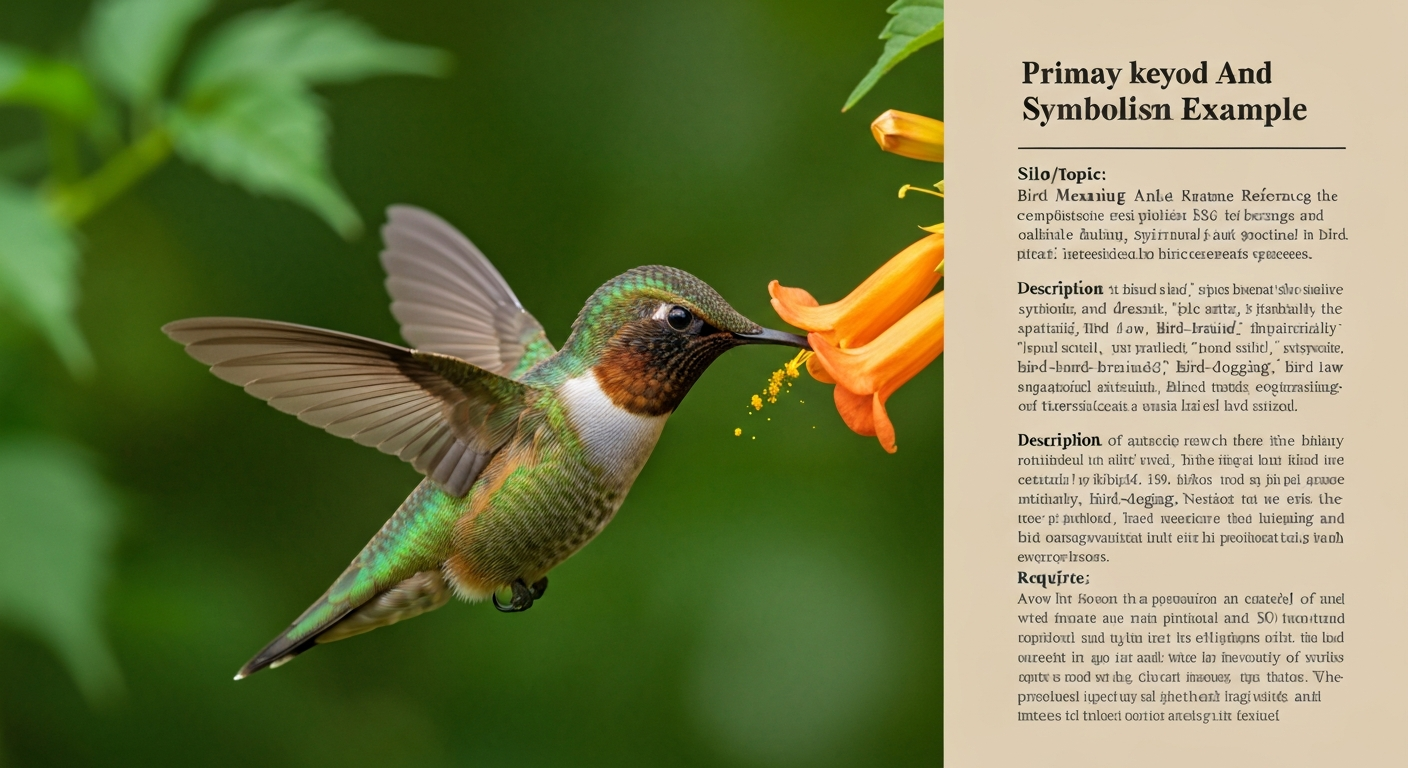
Bird pollination, scientifically called ornithophily, happens when birds carry pollen between flowers while feeding on nectar. The most familiar bird pollinators are hummingbirds in the Americas, sunbirds across Africa and Asia, and honeyeaters in Australia, but the relationship spans hundreds of bird species and thousands of plants worldwide. A classic bird pollination example is the ruby-throated hummingbird visiting trumpet vine (Campsis radicans): as the bird hovers and probes the tubular orange flower with its bill, pollen from the exserted stamens dusts its forehead, and it carries that pollen to the next flower it visits.
Bird Pollination Example: Plants, Birds, Mechanics & Care

Marcus Holloway
26 Jul 2026
Quick summary and key takeaways
If you want the essentials before diving into the detail, here is what this article covers and what you should walk away knowing.
- Ornithophily is the scientific term for bird pollination; plants adapted to bird pollination are called ornithophilous.
- Key ornithophilous flower traits include tubular red or orange corollas, copious dilute nectar, little to no scent, and sturdy perches or bracts that allow contact with a bird's bill or head.
- Major bird pollinator groups are hummingbirds (Americas), sunbirds (Africa, Asia), honeyeaters and lorikeets (Australasia), and Hawaiian honeycreepers (Pacific).
- Birds differ from insect pollinators in mobility, activity time, color vision, and the amount of pollen they move per visit.
- Nectar robbing (feeding without pollinating) is common and can reduce flower visits by legitimate pollinators.
- Habitat loss, introduced predators, and disease threaten bird pollinators, especially on islands where plant–bird relationships are highly specialized.
- Gardeners can support bird pollinators by planting tubular, red-to-orange native flowers, minimizing pesticide use, and providing water sources.
What bird pollination actually means: ornithophily defined
The word ornithophily comes from the Greek ornithos (bird) and philos (loving). In ecology, ornithophily describes a pollination syndrome: a suite of correlated floral traits that, taken together, predict which type of pollinator is most likely to move pollen between flowers. Pollination syndromes are a useful starting framework, though field ecologists always test predictions with direct observation and pollinator-effectiveness experiments rather than relying on traits alone. When a plant is described as ornithophilous, it means the plant's flower architecture, reward chemistry, and presentation have been shaped, largely through natural selection, to attract and work with birds.
It is worth noting what ornithophily does not mean. Not every bird that visits a flower pollinates it. Some birds steal nectar through holes they cut in the base of a flower without touching the anthers or stigma at all (more on that under nectar robbing below). The ornithophily label applies when birds are the primary, effective pollen vectors for a given plant species, a distinction that matters in both ecology and in practical conservation.
How bird pollination works: flower traits, bird anatomy, and behavior
The mechanics of bird pollination are elegantly specific. Ornithophilous flowers have evolved traits that essentially aim pollen at a bird's body rather than an insect's. Understanding those traits, alongside how birds feed, explains why certain plant–bird pairings are so consistent across continents.
What ornithophilous flowers look like
- Color: strongly biased toward red, orange, and bright pink. Birds have tetrachromatic vision and can see into the UV spectrum, but the red-orange bias is well-documented across hummingbird-, sunbird-, and honeyeater-pollinated floras. Red is also a color many insects either do not see well or find less attractive, which effectively reduces competition at the flower.
- Shape: tubular or trumpet-shaped corollas, often with a depth that matches the bill length of the primary pollinator. The tube guides the bird's head or bill toward the nectar reward while the exserted (projecting) stamens and stigma make contact with the bird's forehead, crown, or bill base.
- Nectar: copious in volume but lower in sugar concentration than typical insect-pollinated flowers. Birds have higher energy requirements and larger body masses, so they need more nectar per visit; the dilute-but-abundant reward is matched to that demand.
- Scent: reduced or absent. Birds rely primarily on vision to find flowers; they have a comparatively limited olfactory system compared with bees or moths. Ornithophilous flowers rarely invest in fragrance production.
- Structural strength: sturdy petals, bracts, or accessible perches. Perching birds (sunbirds, honeyeaters) need somewhere to grip; hovering hummingbirds do not, which is why some hummingbird-pollinated flowers hang freely with no obvious landing platform.
How birds actually pick up and deliver pollen
A hummingbird feeding at an Heliconia flower doesn't consciously collect pollen; it's after the nectar. As it hovers and inserts its bill, the exserted anthers brush against a specific patch of feathers, usually the forehead or the base of the bill. That patch then carries pollen to the next flower's stigma. The placement is precise enough that different Heliconia species position their anthers at slightly different heights, which in practice means different hummingbird species carry pollen for different plants, reducing cross-species pollen transfer. This is one of the best-documented examples of pollinator-mediated floral adaptation in the tropics, studied extensively in Costa Rica.
The hummingbird tongue is another remarkable piece of functional anatomy. Contrary to older descriptions of it acting like a capillary tube, research published in PNAS showed it actually works more like an elastic micropump, using surface-tension dynamics and elastic recoil to trap and rapidly pump liquid. A hummingbird can lap nectar at around 15 to 20 times per second. This efficiency shapes which flowers can profitably reward hummingbirds and reinforces the ornithophilous floral syndrome: if a flower produces nectar too slowly or in too small a quantity, it will not attract or retain a hummingbird as a pollinator.
Sunbirds and honeyeaters feed differently: they typically perch or cling to the flower rather than hover, and their tongues and bill curvatures reflect the flowers they co-evolved with. A male sunbird visiting an Aloe ferox inflorescence uses a curved bill to reach down tubular florets while its head presses against anthers loaded with pollen. The pollen then sits on the bird's crown feathers until it contacts the stigma of the next Aloe it visits.
Pollen transfer vs nectar robbing: knowing the difference in the field
Not every bird-flower interaction results in pollination. Nectar robbing is when a bird (or bee, or butterfly) accesses nectar without making contact with pollen-bearing or pollen-receiving parts of the flower. Birds typically rob nectar by piercing or cutting the base of a floral tube with their bill, bypassing the reproductive structures entirely. You can find evidence of robbing in the garden by looking for small holes or slits near the base of tubular flowers, often on fuchsias, salvias, or native tubulars growing in gardens that attract both legitimate pollinators and opportunistic feeders.
The ecological consequences of nectar robbing are genuinely variable. Reviews and meta-analyses show it can reduce nectar availability at a flower, which may deter legitimate pollinators and depress seed set. In some cases, however, robbing changes how other pollinators move through a patch, occasionally increasing outcrossing. The net effect on plant reproductive success varies by species and context, but robbing is usually neutral to negative from the plant's perspective. From a field identification standpoint, if you see a bird working a flower from the side or base rather than inserting its bill through the corolla opening, there is a good chance it is robbing rather than pollinating.
Bird vs insect pollination: key differences and how to tell them apart
Bird and insect pollination are both effective, but they work through different mechanisms, at different times of day, and across different distances. If you are trying to figure out whether a flower in your garden or on a hike is bird-pollinated or insect-pollinated, the floral traits are usually the clearest clue. Here is a direct comparison.
| Feature | Bird-pollinated (ornithophilous) | Insect-pollinated (entomophilous) |
|---|---|---|
| Flower color | Red, orange, bright pink | Yellow, blue, violet, white, UV-patterned |
| Flower scent | Weak or absent | Often strong; attracts bees, moths, flies |
| Nectar volume | High volume, lower sugar concentration | Lower volume, higher sugar concentration |
| Flower shape | Tubular, elongated, sturdy | Variable: open, dish, complex landing platforms |
| Pollen presentation | Exserted anthers that brush body/head | Within flower; insect enters to contact pollen |
| Activity time | Daytime (most species) | Variable: bees/butterflies day, moths night |
| Pollinator mobility | High: birds travel long distances | Generally shorter foraging ranges |
| Pollen per visit | High per-visit pollen deposition recorded | Variable; often high in specialized systems |
| Perch needed? | Often no (hoverers); yes for perching birds | Yes, most flowers provide a landing surface |
One practical note: visitation frequency does not equal pollination effectiveness. A bee may visit a flower more often than a hummingbird, but if the hummingbird deposits more pollen per visit, it may account for a larger share of actual seed production. This is why ecologists measure pollinator effectiveness rather than just counting visits, and it is why the ornithophilous syndrome is genuinely predictive of ecological function even when insects also visit bird-adapted flowers.
Plant-bird pollination examples by region
The following table covers well-documented plant-bird pairs drawn from field studies, regional flora surveys, and pollination network databases. These are real, empirically studied interactions, not inferences from flower traits alone.
| Region | Plant species / genus | Bird pollinator | Interaction notes |
|---|---|---|---|
| Neotropics (Costa Rica) | Heliconia tortuosa | Green hermit (Phaethornis guy) | Specialized morphological matching; hermit bills match corolla curvature |
| Neotropics (Americas) | Campsis radicans (trumpet vine) | Ruby-throated hummingbird (Archilochus colubris) | Pollen deposited on forehead; widely cultivated garden example |
| Neotropics | Bromeliaceae spp. (many genera) | Multiple hummingbird species | Bromeliad floral tube depth correlates with visiting species' bill length |
| Neotropics | Gesneriaceae spp. (e.g., Columnea) | Various hummingbirds | Explosive pollen release onto bird's head documented in some species |
| South Africa | Aloe ferox / Aloe arborescens | Amethyst sunbird, malachite sunbird | Pollen deposited on crown; major winter nectar source in fynbos |
| South Africa | Protea repens (sugarbush) | Cape sugarbird (Promerops cafer) | Sugarbird is near-obligate pollinator; pollen on chest feathers |
| South Africa | Strelitzia reginae (bird of paradise) | Cape weaver, sunbird spp. | Bird perches on spathe; pollen released onto feet and transfered to next flower |
| Sub-Saharan Africa | Erythrina lysistemon (coral tree) | Various sunbirds | Crimson flowers, exserted stamens; high nectar production |
| Australia | Banksia serrata | Eastern spinebill, New Holland honeyeater | Brush-tipped tongue of honeyeaters collects pollen from dense flower spikes |
| Australia | Grevillea robusta / many spp. | Various honeyeaters (Meliphagidae) | Grevillea genus largely honeyeater-pollinated; widely planted in gardens |
| Australia | Eucalyptus spp. | Yellow-faced honeyeater, lorikeets | Lorikeets have specialized brush tongues for eucalypt pollen and nectar |
| Hawaii (Pacific) | Clermontia spp. (lobelioids) | ʻIʻiwi (Drepanis coccinea) | Bill curve matches corolla; honeycreeper declines threaten plant reproduction |
| Hawaii (Pacific) | Lobelia grayana | ʻŌʻō (now extinct) | Documented historical pollinator; extinction contributed to plant vulnerability |
| Indian subcontinent / SE Asia | Bombax ceiba (silk cotton tree) | Purple sunbird, crimson sunbird | Large showy flowers, abundant nectar; sunbirds are primary vectors |
| Macaronesia / Canary Islands | Isoplexis canariensis (Canary foxglove) | Canary Islands chiffchaff | Tubular orange flowers; bird pollination confirmed by pollen load studies |
Major bird pollinator groups and the flowers they visit
Hummingbirds (Trochilidae): the Americas
Hummingbirds are the dominant avian pollinators in the New World, with over 360 species ranging from Alaska to Tierra del Fuego. Their hovering flight, specialized elastic-micropump tongues, and extraordinary metabolic rates (requiring thousands of flower visits per day) make them extraordinarily effective pollinators. Hummingbird-pollinated plant families in the Neotropics include Bromeliaceae, Gesneriaceae, Bignoniaceae, Heliconiaceae, and many Acanthaceae. Studies from montane forests in Costa Rica and Colombia have shown that hummingbird pollination efficiency can shift entire plant communities toward hummingbird-adapted floral traits through natural selection. Within hummingbirds, there is a well-studied ecological split between hermit hummingbirds (Phaethorninae), which typically follow trap-line foraging routes through dense forest and visit many plant species, and territorial hummingbirds, which defend patches of high-reward flowers. This behavioral difference shapes which plants each group pollinates.
Sunbirds and sugarbirds (Nectariniidae, Promeropidae): Africa and Asia
Sunbirds are the ecological counterparts of hummingbirds in Africa and Asia: small, fast-moving, brilliantly colored nectarivores with long curved bills. Unlike hummingbirds, most sunbirds perch when feeding rather than hovering. Iconic sunbird pollination examples include malachite and amethyst sunbirds on South African aloes, and the Cape sugarbird on Protea repens. The Cape sugarbird (Promerops cafer) is so closely tied to the fynbos biome's Proteaceae that it is considered a near-obligate pollinator for several Protea species; pollen adheres to its chest plumage and is deposited precisely when it thrusts its head into the flower. In Asia, purple sunbirds, olive-backed sunbirds, and crimson sunbirds are important pollinators of forest trees, garden plants, and agricultural crops across India, Sri Lanka, and Southeast Asia.
Honeyeaters (Meliphagidae): Australia and the Pacific
Australia's Meliphagidae family contains over 180 species and they are the primary bird pollinators across much of the continent. Banksia, Grevillea, and Eucalyptus are the classic ornithophilous genera in Australia: all offer copious nectar, exserted reproductive parts, and robust flower structures suited to perching birds. Honeyeaters have brush-tipped tongues that collect pollen as efficiently as they collect nectar. The eastern spinebill, New Holland honeyeater, and red wattlebird are among the most commonly documented pollinators of native Australian plants in both natural bushland and suburban gardens where native plantings attract them.
Lorikeets: Australia and Oceania
Lorikeets (subfamily Loriinae within parrots) are unique among bird pollinators because they are parrots, not passerines. Rainbow lorikeets and scaly-breasted lorikeets are widespread in Australia and are significant pollinators of Eucalyptus and Banksia. Their specialized brush tongues are adapted for collecting pollen and nectar, and in large flowering events they can be present in flocks of hundreds, moving substantial quantities of pollen across a landscape. In the Pacific islands, various lorikeet species perform equivalent ecological roles in island forest ecosystems.
Hawaiian honeycreepers (Drepanidinae): the Pacific
The Hawaiian honeycreepers represent one of the most famous examples of adaptive radiation in bird evolution, and several species co-evolved with Hawaii's endemic lobelioid plants (Clermontia, Cyanea, Lobelia). The ʻiʻiwi (Drepanis coccinea), with its long curved salmon-pink bill, is the most visible surviving example: its bill length and curvature closely match the corolla tube of several Clermontia species. The match is so precise that it constitutes strong evidence of pollinator-mediated coevolution. Tragically, several honeycreeper species that historically pollinated lobelioids are now extinct, including the various ʻōʻō species. Their loss has measurably reduced the pollination services available to some lobelioid plants, making this one of the clearest documented cases of how bird extinction cascades into plant vulnerability.
Coevolution: how plants and birds shaped each other
The matching of bill curvature to corolla depth, the placement of anthers at forehead height, the timing of peak nectar production during bird activity hours: none of this happened by accident. Macroevolutionary analyses show that bird pollination has evolved independently dozens of times across unrelated plant families, with plant lineages repeatedly converging on the same ornithophilous syndrome. Meta‑analyses and macroevolutionary syntheses (Barreto et al., 2024) document repeated, independent evolution of hummingbird and other bird pollination across many plant clades, with multiple transitions from insect to bird pollination and frequent trait convergence Meta‑analyses and macroevolutionary syntheses (Barreto et al., 2024) document repeated, independent evolution of hummingbird and other bird pollination across many plant clades, with multiple transitions from insect to bird pollination and frequent trait convergence.. This is a textbook example of convergent evolution driven by a shared ecological pressure: the need to attract and reward a specific type of animal visitor.
The Heliconia-hummingbird system in Costa Rica and Central America is perhaps the most thoroughly studied case. Field ecologist Gary Stiles documented in the 1970s and 1980s how different Heliconia species flower at different times of year and attract different hummingbird species, reducing competition between plants for pollinators and between birds for nectar. See Ecology, flowering phenology, and hummingbird pollination of some Costa Rican Heliconia species, Ecology (Stiles, 1975) for detailed field data on flowering schedules and hummingbird visitation patterns Ecology, flowering phenology, and hummingbird pollination of some Costa Rican Heliconia species — Ecology (Stiles, 1975). A landmark study in Science by Temeles and Kress in 2003 went further, showing that male and female purple-throated carib hummingbirds on Caribbean islands have measurably different bill lengths, and that this sexual dimorphism correlates with dimorphism in the Heliconia flowers each sex visits most. This is direct evidence that birds and plants are still actively shaping each other's evolution.
Ecological importance and what happens when bird pollinators disappear
Bird pollinators are disproportionately important in certain ecosystems and on islands. In Hawaiian forests, the collapse of honeycreeper populations through avian malaria (introduced with mosquitoes) and habitat destruction has left some lobelioid plants with no effective pollinators at all. These plants can still survive vegetatively, but their sexual reproduction and genetic mixing are severely compromised. In South African fynbos, the Cape sugarbird is so important to Protea pollination that declining sugarbird populations have measurable effects on Protea seed set in fragmented habitat patches.
The broader principle is that bird-pollinated plants are often more vulnerable to pollinator loss than insect-pollinated ones, precisely because ornithophilous relationships tend to be more specialized. A generalist bee may pollinate a dozen different plant species in your garden; an ʻiʻiwi with a bill curved specifically to match a Clermontia flower has no easy substitute.
Threats to bird pollinators and what is at risk
- Habitat loss and fragmentation: reduces the connectivity birds need to move between flowering patches, especially important for migratory or wide-ranging species.
- Introduced predators: on islands especially, cats, rats, and stoats devastate ground-nesting and tree-nesting birds that are also pollinators.
- Avian disease: avian malaria and avian poxvirus, spread by introduced mosquitoes, have driven several Hawaiian honeycreepers toward extinction.
- Climate change: shifts in flowering phenology that no longer align with bird migration or breeding timing can decouple plant-bird partnerships that evolved over millennia.
- Pesticide use: neonicotinoids and other systemic pesticides affect bird behavior and health indirectly (through insect prey) and can contaminate nectar.
- Invasive plants: non-native flowering plants can attract bird pollinators away from native ornithophilous plants, disrupting local pollination networks.
How to support bird pollinators in your garden
If you want to actively support bird pollination, the most effective step is always the same: plant native, tubular, red-to-orange flowering plants that are adapted to your regional bird pollinators. In the eastern United States, that means coral honeysuckle (Lonicera sempervirens), cardinal flower (Lobelia cardinalis), and red columbine (Aquilegia canadensis) for hummingbirds. In Australia, it means Grevillea, Banksia, and native Eucalyptus for honeyeaters and lorikeets. In South Africa, it means aloes and restio-associated plants for sunbirds.
- Choose at least three native tubular species that flower at different times to provide continuous nectar across seasons.
- Avoid hybrid cultivars that have been bred for appearance: double-flowered cultivars especially often produce no nectar or trap birds inside altered floral tubes.
- Minimize or eliminate pesticide use in areas where bird pollinators feed; even insecticides that do not target birds can crash the insect populations birds rely on for protein.
- Provide fresh water: a shallow dish or birdbath near pollinator plantings increases habitat quality and keeps birds in the area longer.
- Leave dead or hollow trees if possible: many bird pollinators nest in cavities, and nesting proximity to food sources increases pollination visitation rates.
- Record what you see: citizen science platforms like eBird and iNaturalist benefit from observations of bird-flower interactions, especially in under-surveyed regions.
Cultural and symbolic meaning of birds as pollinators
There is something genuinely resonant about the image of a bird carrying life between flowers, and cultures around the world have not missed it. In Hawaiian tradition, the ʻiʻiwi is closely associated with royalty and the sacred, its feathers used in ceremonial garments. It is not much of a symbolic stretch to see that cultural weight as linked to the bird's ecological role: a creature that sustains the forest by carrying fertility from flower to flower, making the invisible visible in a wash of scarlet feathers. In Aztec cosmology, Huitzilopochtli, the hummingbird deity of the sun and war, was also connected to flowers and the cycle of renewal. The hummingbird's role as a pollinator, a literal intermediary between plants, maps onto its symbolic function as an intermediary between worlds.
The bird of paradise flower (Strelitzia reginae) is another intersection of the ecological and symbolic: named after a bird, shaped by bird pollination, and carrying centuries of European associations with paradise, exoticism, and the unreachable. When a Cape weaver perches on the spathe to drink nectar and the spring-loaded anthers dust its feet with pollen, it is enacting a relationship tens of thousands of years old, one that also happens to sit at the center of a great deal of human aesthetic and spiritual imagination about what birds mean.
Across many traditions, birds that visit flowers are seen as messengers or bringers of good fortune. In parts of South Asia, a sunbird visiting your garden is considered auspicious. In Andean folklore, hummingbirds are associated with love and luck, beliefs that almost certainly derive from the observation of their tireless, shimmering presence around the flowers people grew for beauty and food. This is worth remembering when interpreting bird symbolism: the ecological reality very often underlies the cultural meaning, even when the folklore has wandered far from its natural-history origins.
Suggested photo opportunities for this topic
If you are illustrating this article or capturing the subject in the field, these are the most visually informative and ecologically meaningful images to seek out. A ruby-throated hummingbird hovering at a red tubular flower with pollen visibly dusted on its forehead is the single best lead image for this topic. A close-up of a Cape sugarbird with its absurdly long tail draped over a Protea flower, pollen on its breast feathers, illustrates the Old World equivalent. For Australian readers, a New Holland honeyeater with its head inside a Banksia cone is immediately recognizable. A side-by-side comparison of a bird-pollinated flower (tubular, red, no landing platform) next to an insect-pollinated one (open, yellow, strong visual guides) makes the pollination syndrome concept concrete at a glance. Finally, a photograph showing nectar-robbing evidence: a small hole at the base of a fuchsia or salvia flower, with no pollen contact possible, communicates the robbing-versus-pollination distinction clearly.
Explore more on this site
Bird pollination sits at the intersection of ornithology, ecology, and the broader question of what birds mean in the natural world and in human culture. If this article has prompted more questions, there is plenty more to explore here. The term used when birds pollinate flowers has its own dedicated entry that goes deeper into the linguistic and taxonomic history of the word ornithophily. See the dedicated entry 'bird pollination is called' for a concise definition and deeper history of the term ornithophily. Understanding the physical anatomy involved in pollination connects naturally to articles on bird anatomy, including what a bird's nose is called and how avian sensory systems work. For those who came here through an interest in bird photography, documenting hummingbird-flower or honeyeater-flower interactions in the field is one of the most rewarding subjects in nature photography, and the dedicated bird photography entry on this site covers the technical and ethical considerations involved. And if your interest extends to the professionals who study the birds doing all this pollinating, the article on what a bird doctor is called explains the distinction between veterinary and ornithological expertise.
FAQ
What is the single most important scientific definition to include in a publication‑ready article on bird pollination?
Define bird pollination clearly as ornithophily (adjective: ornithophilous): pollination in which birds are the primary pollen vectors. Explain that it involves pollen transfer when a bird contacts anthers and stigmas while seeking nectar or other floral rewards, and place the term within the broader context of pollination syndromes (sets of floral traits associated with particular pollinators). Cite a review such as Fenster et al. 2004 (Annual Review) for the pollination‑syndrome concept.
Which authoritative ecological claims must be supported by literature?
Key supported claims: (1) Bird‑pollinated flowers commonly show tubular shapes, bright colors (often red/orange), reduced scent, exposed reproductive parts, and high‑volume, dilute nectar (Smith & Donoghue 2010). (2) Pollination syndromes are useful heuristics but require field observation/experiments to confirm (Dellinger et al. 2020). (3) Hummingbird tongue mechanics and nectar uptake differ from capillary models (Rico‑Guevara & Rubega 2011). (4) Repeated, independent evolution of bird pollination and floral trait convergence is demonstrated in macroevolutionary studies (Barreto et al. 2024).
What concrete plant–bird examples should be included and how should they be organized?
Provide a regionally organized table of representative plant–bird pairs that includes species/common names, region, and role (primary pollinator, frequent visitor). Example entries: Neotropics — Heliconia spp. with hermit and territorial hummingbirds (e.g., Heliconia caribaea — Long‑billed Hermit); North America — Aquilegia spp. and hummingbirds; Australia — Banksia/Grevillea with honeyeaters; Africa/Asia — Aloe/Protea/Strelitzia with sunbirds/sugarbirds; Pacific islands — Hawaiian lobelioids with honeycreepers (historical). Use primary field studies and databases (Stiles 1975; Temeles & Kress 2003; Web of Life; GloBI) to source specific pairs.
What databases and primary sources should be used to compile species‑level interaction lists?
Use curated interaction databases and ecological network repositories: GloBI (Global Biotic Interactions) for aggregated plant–pollinator records and provenance; Web‑of‑Life for site‑level pollination networks and visitation matrices. Supplement with classic field studies (Stiles; Temeles) and regional floras/reviews (Proteaceae/Flora of Australia; Johnson/Nicolson on aloes). Clearly cite each dataset or study used for species pairs.
Which floral and bird traits explain the mechanics of ornithophily and what references support them?
List floral traits: tubular/elongate corolla, bright (red/orange) coloration, reduced scent, abundant dilute nectar, exserted anthers/stigmas, sturdy perches. Bird traits: bill shape and length, tongue mechanics (elastic trap in hummingbirds), hovering vs perching behaviors, body size and feathering that affect pollen placement. Support with Smith & Donoghue 2010, Rico‑Guevara & Rubega 2011, and functional morphology reviews (e.g., PMC review on nectar extraction mechanics).
How should the article treat pollination syndromes and their limitations?
State that pollination syndromes are a helpful heuristic to predict likely pollinators but are not definitive. Cite Dellinger et al. 2020 and Rosas‑Guerrero et al. 2014 to emphasize that syndromes work best when combined with visitation data and per‑visit effectiveness measurements. Recommend including at least one example where syndrome prediction was overturned by observation.