
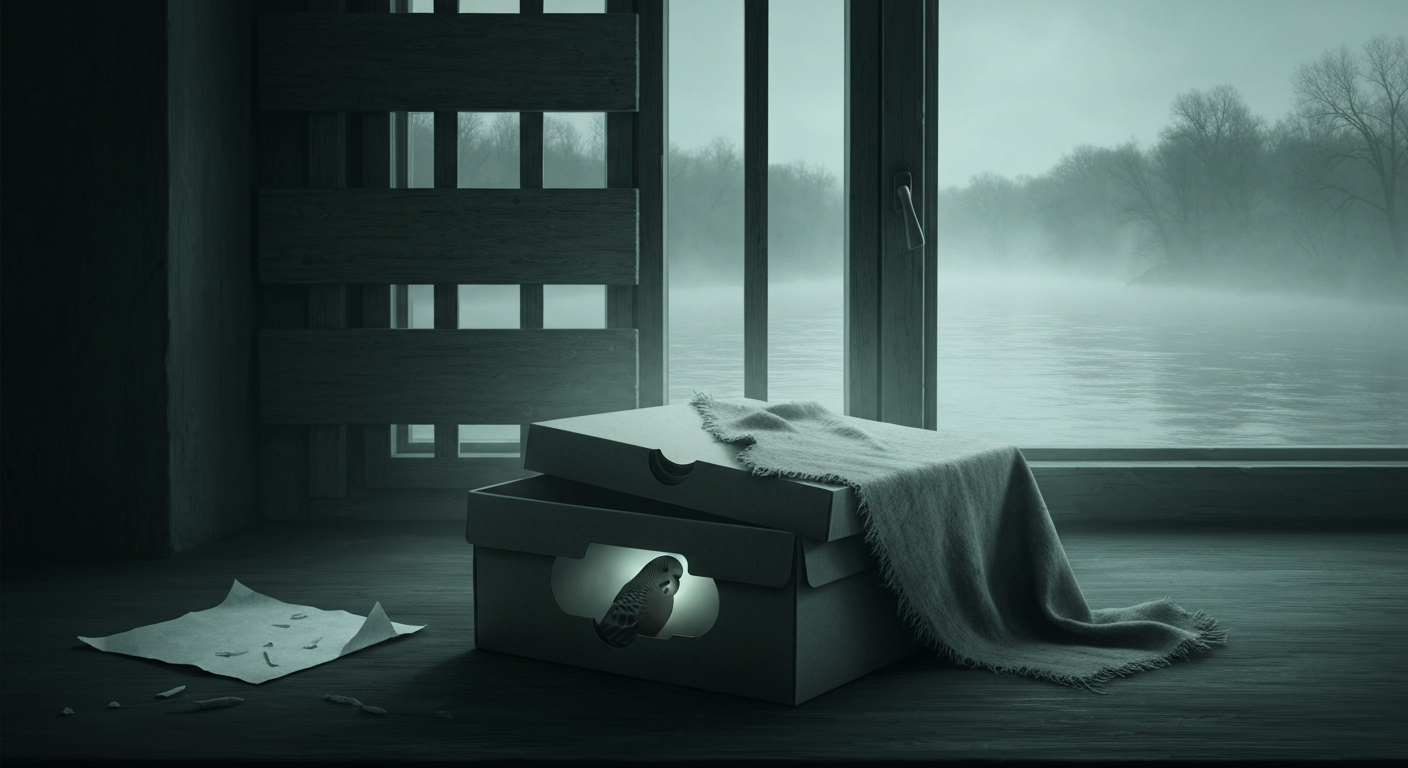
The title 'Bird Box' refers to a literal object in Josh Malerman's 2014 novel: a cardboard box containing live birds that the survivors use as a primitive alarm system, because the birds react with audible panic when one of the novel's unseen entities draws near. That's the in-text, mechanical explanation. But the phrase does a lot more symbolic work across the story, touching on sight and blindness, containment versus freedom, and the cost of protecting the people you love, which is why it keeps coming up in book clubs and lit classes years after the novel and its 2018 Netflix adaptation came out.
Bird Box Book Meaning: Title, Symbols, and Film Comparison

Marcus Holloway
13 Jul 2026
Who this guide is for and what you'll get from it
This article is aimed at anyone who wants a thorough, grounded reading of what the title means, whether you've just finished the novel, watched the film first and are curious about the source material, or are putting together notes for a book club or class. It covers the literal device in the story, the main symbolic interpretations tied to actual scenes and passages, what Malerman has said publicly about his intentions, and a clear breakdown of how the Netflix film handles the same material differently. For a very plainspoken, step-by-step primer on the title, see bird box explained by an idiot. Interpretive claims are flagged as such throughout, so you can distinguish between what the text actually says and what readers and critics have read into it.
The short version: what 'Bird Box' means
Tom and Jules, two survivors in Malerman's novel, find a box of birds and bring them back to the house where Malorie's group is sheltering. The birds serve as a detection device: when an entity approaches, the birds go loud and frantic inside their box, giving the survivors a few seconds of warning. That's the direct, plot-level answer. The deeper answer is that the title compresses the novel's central tension into two words, a living creature trapped in a container, alert and reactive but unable to escape, functioning as an instrument of survival for someone else. That image maps pretty cleanly onto Malorie's own situation, and onto the children she's raising blindfolded in a boarded-up house.
Plot summary: what actually happens and why the title matters
Bird Box runs on two parallel timelines that Malerman splices together throughout the novel. In the present-day thread, Malorie is on a river with two young children, referred to only as Boy and Girl, all three of them blindfolded, paddling twenty miles toward a rumored safe place. In the flashback thread, the novel traces the months leading up to that journey: a mysterious mass-hysteria event is sweeping the globe, apparently triggered by seeing something. Anyone who catches a glimpse of whatever is out there is compelled to kill themselves or others almost immediately. Survivors board up their windows, go outside only blindfolded, and communicate largely through sound and touch.
The Ecco edition runs about 272 pages and moves at a thriller's pace despite its relatively quiet domestic setting. Most of the horror is atmospheric, creaking outside the covered windows, sounds in the yard at night, the slow breakdown of the small group sharing the house. Malorie trains Boy and Girl from infancy to develop extraordinary hearing, essentially weaponizing their senses for a world they cannot look at. The title matters to the plot because the bird box is both a practical tool (an alarm) and a recurring image that appears at two key structural moments: when the device is first introduced and when Malorie carries the box with her on the river. It is one of the few named, tangible objects in a novel that deliberately withholds visual detail.
The bird box as a literal device in the novel
According to the novel's plot, Tom and Jules leave the house on a supply run and return with birds they've found in a box. The birds become the household's early-warning system: positioned near the door or in the foyer, they react with audible agitation, chirping, fluttering, scraping against the inside of the box, when something approaches. Malerman's published excerpt and the Reactor preview passages (April 17, 2014) describe the foyer as the space where Cheryl used to prepare bird food, which grounds the birds as a recurring domestic feature of the survivors' life rather than a one-off plot device.
The screenplay Eric Heisserer drafted in March 2014 translates this directly into a scripted visual beat: Malorie finds a bird cage in the foyer, transfers the bird to a shoebox, covers the box, and carries it. The stage direction specifically notes 'the budgie CHIRPS… its wings scrape against the box lid,' which is about as close as you can get to a literal film description of the novel's title image. In both the book and the screenplay, the box is a closed, covered container, the bird inside cannot see out and the outside world cannot be seen through it, which sets up the novel's dominant symbolic logic before the story even explains it.
The creatures: what the book says and why the vagueness is the point
Malerman never describes the creatures. For a focused discussion of the creatures and why their vagueness matters, see bird box creatures explained. That is a deliberate authorial choice, not an oversight. He said in his 2014 Publishers Weekly interview that the seed image for the entire novel was 'blank" rel="noopener noreferrer">a woman traveling down a river blindfolded,' and that the creatures existed primarily to make looking dangerous, not to be monsters with physical features. What the novel establishes is behavioral: seeing one causes immediate, violent psychological breakdown. The narrative tracks the consequences of sight rather than the thing being seen. Survivors communicate via sound and touch; windows are covered with black paint and nailed boards; outdoor travel requires blindfolds.
What the text does not do is give the creatures a name, an origin, a biology, or a motive. Various characters speculate, are they interdimensional? Demonic? Psychological? The novel treats those questions as unanswerable and, more importantly, beside the point. Malerman has said in multiple interviews (including in Esquire coverage of the sequel Malorie) that the ambiguity was intentional: a single description would close off the reader's imagination and reduce the horror to something manageable. The creatures in Bird Box function less as monsters and more as a condition of the world, like weather, except lethal if witnessed.
This is worth flagging as an interpretive note: some readers and critics read the creatures as psychological metaphors (depression, trauma, the unseen forces that compel self-destruction). Others read them as straight horror-genre antagonists. The novel supports both readings precisely because it withholds the description. The Los Angeles Review of Books reported that Malerman expressed concern when a filmed creature-reveal sequence was shot during film production, because he felt a single visual would fix viewers' mental image in a way that closes down the interpretive space the novel deliberately leaves open. That sequence was cut before the theatrical release of the Netflix film.
What the title symbolizes: four readings rooted in the text
Sight and blindness
The most direct symbolic layer is the inversion of sight as survival tool. In nearly every cultural tradition, vision equals knowledge and safety, blindness equals vulnerability. Malerman flips this. Sight is lethal; blindness is protection. The bird box participates in this inversion because the birds themselves cannot see out of the covered box, yet they are the most reliable sensory instrument the group has. Malorie's training of Boy and Girl to hear with extraordinary precision is another instance of the same logic: remove one sense, sharpen another. The novel is structured around what cannot and must not be seen, which makes the title's image (a living thing sealed inside a box, unable to look out) a compressed version of the whole premise.
Containment versus freedom
Birds in cultural and literary tradition are almost universally associated with freedom, they are the animals that can leave the ground and go anywhere. Putting a bird in a box is a deliberate reversal of that symbol. In the novel, containment is survival: the boarded house, the covered windows, the blindfolds, the box with the bird inside. But containment also has costs that the story tracks carefully. The children are being raised in near-total sensory restriction. Malorie herself is emotionally sealed off, her protective instincts have crowded out almost everything else. The bird box as an object holds both meanings simultaneously: the bird is alive and useful precisely because it is contained, but it is also a bird in a box, which is a fairly stark image of a life that cannot be lived normally.
Motherhood and protection
Malorie's arc is centrally about what a parent will do to keep children alive in an environment that is trying to kill them. The novel begins with her pregnant and ends, in the present-day timeline, with her on that river, responsible for two small children who are not biologically related to each other and who she has raised under conditions that border on traumatizing. The bird box is a maternal object in the story: it holds vulnerable living things, it is carried carefully, and its survival depends on the person transporting it maintaining control. Readers and critics have noted (and it is worth flagging as interpretive) that the box functions as a stand-in for Malorie's own internal state, tightly covered, reactive, something fragile kept alive through vigilance and restriction.
Community and isolation
The house-group dynamic in Bird Box is one of the novel's strongest elements. A small, mismatched group of survivors tries to build a functional community under conditions that are profoundly isolating, they cannot go outside freely, they cannot communicate with the outside world reliably, and every new person who enters the group is a potential risk. The birds, introduced by Tom and Jules after a dangerous supply run, are one of the few things the group adds to their domestic setup that comes from outside and proves genuinely useful. They represent a kind of shared resource: everyone in the house benefits from the alarm system. That dynamic shifts as the group shrinks. By the time Malorie is on the river alone with the children, the bird box is one of the last remnants of the collective survival effort, she is carrying it solo, which is a significant shift from how it was used.
Why the ambiguity in the title's meaning is itself part of the meaning
One of the things that makes Bird Box work as a title is that it doesn't explain itself. A 'bird box' is a real object (it's also a common British English term for a nest box or birdhouse, which adds an additional layer of domesticity and shelter), but in the context of the novel it is also a specific improvised device, and also a symbolic image, and also the thing Malorie physically carries to safety. The title refuses to signal which of these is primary, in the same way the novel refuses to describe the creatures. That structural consistency, withholding the definitive explanation, is one of the reasons the title has stayed discussable. Readers keep returning to it because the answer keeps being 'yes, and also.'
Malerman confirmed in his Esquire interview that he had actual pet birds while writing the novel in a third-floor rented space, and that those birds were 'flying around' during the writing process, directly influencing the imagery. That's useful context for the natural history angle: the birds in the novel behave like real birds, reactive, vocal, sensitive to environmental changes. The alarm-system use is grounded in actual bird behavior (birds have long been used as environmental sentinels, from the canary-in-the-coal-mine practice to keeping chickens that will alert to predators). The symbolic readings emerge from that realistic behavioral detail, not the other way around.
How the Netflix film compares to the book
The 2018 Netflix film directed by Susanne Bier and written by Eric Heisserer keeps the central premise and several key structural elements, the blindfolded river journey, the boarded house, the group of survivors, the children. Download Bird Box (2018) English Subtitles, SUBDL (subtitle listing / SRT downloads) hosts SRT subtitle files for the 2018 Netflix film that can be used to extract film timecodes for scenes such as the river journey and bird-box moments blank" rel="noopener noreferrer">Download Bird Box (2018) English Subtitles — SUBDL (subtitle listing / SRT downloads). But it handles the title object, the creatures, and several thematic threads in ways that are meaningfully different from the novel. Here's a practical comparison. For a concise, film-focused overview, see the bird film explained resource.
| Element | The Novel (Malerman, 2014) | The Film (Bier / Heisserer, 2018) |
|---|---|---|
| The bird box device | Introduced mid-novel by Tom and Jules; used as a household alarm system throughout the survivors' time in the house; Malorie carries it on the river | Appears as a scripted visual beat — Malorie transfers a budgie from a cage to a shoebox; the box and its chirping are present during the river sequence |
| The creatures | Completely undescribed; their nature is never resolved; ambiguity is total and intentional | Also not fully shown in the theatrical cut; a creature-reveal sequence was filmed and then cut before release; some scenes suggest mimicry of voices |
| Creature behavior detail | Primarily behavioral consequences only (sight causes violence); no sensory tricks beyond visual contact | The film adds audio mimicry — the entities can replicate voices of loved ones to lure survivors into removing blindfolds |
| Malorie's character arc | Emotionally closed off, militaristic in her parenting; morally ambiguous throughout; children remain named Boy and Girl at the novel's end | Sandra Bullock's Malorie is more conventionally sympathetic; children are given names by the end of the film; emotional arc is more resolved |
| Ending | Malorie and the children reach the safe community; the bird box birds are freed into the trees — a symbolically loaded final image | The film ends at the safe community (a school for the blind); Malorie names the children; the birds are released in a similar gesture, though the emotional register is warmer and more conclusive |
| Added plot elements | No roaming bands of hostile survivors in the novel | The film adds a faction of people who have been exposed and survived but force others to look — a significant thriller escalation not in the source material |
| Timeline structure | Alternating present/past chapters throughout, creating sustained tension | The film uses a similar dual-timeline structure but streamlines the flashback sequences for pacing |
The most consequential difference for readers interpreting the title is probably the ending. In the novel, Malorie releases the birds when she arrives at the safe community, they fly up into the trees. That image closes the loop on the containment-versus-freedom theme in a way that is deliberately understated: the box that kept them alive, the birds that served as instruments of survival, are let go when survival no longer requires their confinement. The film replicates this beat but frames it as a warmer emotional release, which shifts the symbolic weight. The novel's version is more ambivalent, freedom is possible now, but the cost of getting here was significant.
Heisserer has discussed in interviews (including a January 2019 Q&A with Taylor Holmes) how the adaptation had to solve novel-to-screen problems, particularly around the creatures. On the page, Malerman can simply withhold description. On screen, a camera has to point somewhere. The decision to cut the filmed creature sequence was, by multiple accounts, the right call for preserving the ambiguity that makes the story work, and it aligns with what Malerman told the Los Angeles Review of Books about not wanting a single visual to close down the interpretive space. Readers interested in a deeper dive into the film's specific differences and what they mean will find that topic covered in more detail in the bird movie explained and bird box creatures explained articles on this site.
A note on the 'bird box' as a real-world term
Outside Malerman's novel, 'bird box' is ordinary British and Australian English for a nest box, a small wooden box fixed to a tree or wall to provide a nesting cavity for garden birds. That meaning adds a faint layer of irony to the title: a nest box is a shelter that enables new life and protects the vulnerable, which is exactly what the boarded house and the covered river journey are doing for Malorie and the children. Whether Malerman had that meaning in mind is not documented, but it's a legitimate cultural-context note rather than speculation, because the word 'box' in bird contexts carries that domestic-shelter meaning in English-language tradition. The site's coverage of bird behaviors and idioms (including nesting behavior and related metaphors) touches on this territory for readers who want to follow that thread further.
What to read or watch next
If the symbolism in Bird Box interests you from a broader birds-in-culture angle, several threads are worth pursuing. The canary-in-the-coal-mine idiom is the most direct real-world parallel to the alarm-bird function in the novel, it's a case where bird behavior (sensitivity to environmental toxins) became a literal life-saving practice and then a metaphor in everyday language. Nesting behavior in birds, and the cultural meanings attached to it, connects directly to the novel's use of a boarded house as a survival shelter. Dream symbolism around caged birds appears in folklore traditions across multiple cultures and almost always involves tension between protection and captivity, the same tension the novel exploits. For the film-specific questions (how the sequel Malorie develops these themes, what the creatures might represent, and how the bird box meaning shifts in the Netflix version), the bird box meaning, bird box creatures explained, and bird film explained articles on this site pick up where this one leaves off.
Malerman's sequel, Malorie (2020, also from Del Rey), continues the story with the children now teenagers and develops some of the symbolic threads further, particularly the question of what kind of person a blindfolded childhood produces. It doesn't resolve the creature mystery either, which is consistent with the authorial approach. For readers who came to the novel through the film and want to understand why the book feels tonally different, the single biggest factor is probably Malorie herself: the novel's version of her is harder, less emotionally legible, and more morally complicated, and the bird box in her hands carries that quality. It's an alarm, a burden, and a symbol of everything she gave up to keep two children alive, and Malerman trusts the reader to hold all of that without having it spelled out.
FAQ
What is a plain-language summary of Bird Box (the book) and why does the title matter?
Bird Box follows Malorie, a woman surviving in a post-apocalyptic world where people who see a mysterious presence go insane and often kill themselves. To survive, people cover windows and wear blindfolds; key scenes include training two young children to navigate without sight and a tense blindfolded river journey to a supposed sanctuary. The title matters because 'bird' and 'box' are recurring, literal objects in the story (caged birds used as alarms, boxes used to carry them) and compressed images that connect the novel’s practical survival tactics (containment, early-warning) with its larger themes about sight, safety, and how people try to manage what they can’t understand.
What is the book’s literal, in-text explanation of the title — what is the 'bird box' device and how does it function in the story?
Literally, survivors keep birds in cages/boxes inside safe houses. The birds react (become agitated, quiet, or noisy) when the unseen entity is near; their behavior thus functions as an alarm. The novel includes scenes where household birds are fed, caged, and moved (the foyer/feeding setup and a bird moved into a shoebox are shown in published excerpts and the screenplay). The 'box' is both a physical container for birds and a portable alarm that characters can carry while blindfolded to detect danger.
How can I read the title symbolically — which grounded symbolic interpretations are most defensible, and where in the text are they anchored?
Grounded symbolic readings tied to the text include: 1) Sight and blindness: The book centers on vision as a lethal vulnerability and blindness (literal and learned) as survival; anchor: early training scenes, covered windows, and the river escape image (author interviews confirm the blindfolded river was a seed image). 2) Containment vs. freedom: Birds in cages suggest control and loss of freedom; passages describing feeding and caging (foyer/feeding scenes in the published excerpt) tie this to survivor life. 3) Motherhood and protection: Malorie’s fierce caregiving and training of the children make the title read as a maternal attempt to 'box' danger away; anchor: parenting scenes and the boat journey structure. 4) Community and isolation: The need to isolate visually and the way survivors rely on small, improvised signals (birds/boxes) comment on how societies contract under threat; anchor: the safe-house routines and the communal alarms. These are interpretive claims grounded in recurring motifs and specific scenes (see published excerpt, novel passages, and interviews with Malerman indicating the author’s focus on these images).
How does the novel’s use of ambiguity about the creatures affect the meaning of the title?
Malerman keeps the creatures largely offstage and undefined; this ambiguity makes the birds/boxes stand in for the unknown threat itself and for human responses to the ungraspable. Because readers never receive a definitive description, the 'bird box' functions symbolically as a heuristic: a simple, human-invented tool to manage an inexplicable danger. Author interviews and production notes confirm Malerman deliberately avoided explicit creature descriptions to preserve fear and reader imagination; that restraint amplifies the title’s resonance as a human countermeasure to the unknowable.
Does the Netflix film treat the title and related themes differently than the novel?
Yes. The 2018 Netflix film (dir. Susanne Bier, screenplay by Eric Heisserer) retains the basic premise — blindness as safety, household birds as alarms, and the river journey — but makes concrete adaptation choices: it adds or expands characters and external threats (roving bands), emphasizes visual and auditory cinematic beats, and staged certain scenes (the film’s script includes a bird moved into a shoebox as a visual device). The film preserves ambiguity about the creatures, and production choices (including a cut creature reveal) show an intention to avoid fixing a single visual image. Interviews with screenwriter Eric Heisserer and press coverage document these changes; the film’s emphasis and pacing make some themes (community breakdown, immediate terror) more explicit, while some interior aspects of Malorie’s inner life from the novel are compressed.
What concrete passages, interviews, and secondary sources should I cite to support these claims?
Useful, citable primary and secondary sources include: 1) The novel itself (Ecco/HarperCollins 2014 edition; bibliographic metadata on Google Books). 2) Official excerpt/published passages (e.g., Reactor excerpt showing the foyer/feeding and training scenes). 3) Josh Malerman interviews where he describes the seed image (Publishers Weekly: river/blindfold), and mentions keeping birds while writing (Esquire). 4) The Eric Heisserer Bird Box screenplay (scripts PDF) for scripted bird-in-box stage directions. 5) Interviews with Heisserer about adaptation choices (e.g., Taylor Holmes Q&A). 6) Production reporting noting a filmed creature reveal cut from the theatrical release (LA Review of Books coverage). 7) Scholarly articles or theses on Bird Box symbolism for academic perspectives (example thesis on parental strategies). Use SRT/transcripts for precise film scene timecodes when citing the movie. Flag interpretive claims as interpretation and avoid presenting speculation about the creatures as fact.