
Finding a bird nest with eggs most commonly signals new beginnings, fertility, home, and protected potential. Across cultures, spiritual traditions, and everyday observation, a nest cradling eggs is one of the oldest and most consistent symbols of life held in careful balance: something precious, fragile, and full of what comes next. Whether you stumbled across a robin's nest in your backyard, saw one in a dream, or are looking up what folklore says, the meaning tends to orbit the same core ideas: a safe space has been built, life is being prepared, and something significant is about to hatch.
Bird Nest With Eggs Meaning: Symbolism, Dreams & Safety

Marcus Holloway
5 Aug 2026
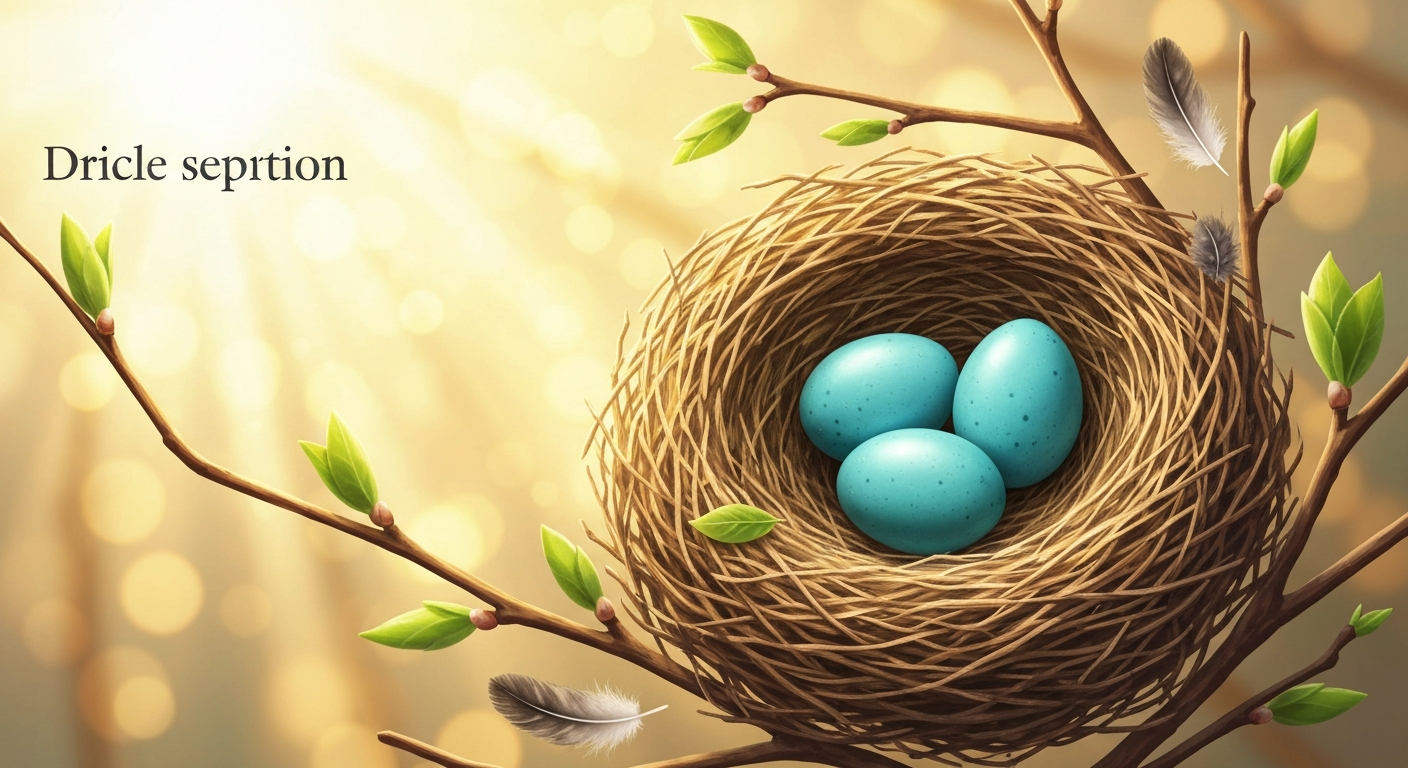
What a bird nest with eggs commonly means: a quick summary
The symbolism is remarkably consistent whether you encounter it in a garden, a story, a scripture, or a dream. A nest with eggs almost universally points to some combination of the following ideas:
- New life and potential: eggs that have not yet hatched represent possibility, latent energy, and things not yet fully realized.
- Home and security: the nest itself is a constructed refuge, built with effort and care, making it a symbol of domestic stability and belonging.
- Fertility and abundance: clutches of multiple eggs amplify the sense of generative abundance, linked in many traditions to prosperity and creative output.
- Protection and nurturing: an adult bird brooding eggs or guarding a nest signals devoted, active care of something vulnerable.
- Transition and timing: a nest in active use marks a specific, temporary window in the cycle of life, reinforcing themes of seasonality and right timing.
These meanings are not arbitrary or invented by one tradition. They arise from direct observation: nests really are built with effort, eggs really do require protection, and hatching really is an irreversible threshold. The symbolism is grounded in natural history, which is part of why it travels so well across cultures.
The core symbolic meanings unpacked
Home and belonging
The nest is, by definition, a home built from scratch. Birds gather materials specific to their environment and weave, compact, or glue them into a structure shaped for their own bodies. That deliberate act of construction maps easily onto human experiences of homebuilding, nesting instincts in pregnancy, and the emotional weight of creating a safe space. When a nest appears in symbolic or spiritual contexts, it often speaks to the desire for rootedness, the value of effort put into making a place feel safe, or the importance of returning to your own foundation.
Fertility and abundance
Eggs are among the oldest fertility symbols in recorded human culture, pre-dating most formal religious traditions. Multiple eggs in a single nest amplify this reading. A clutch of three to five robin eggs, for instance, visually communicates generosity and reproductive vitality. In practical ornithology, clutch size is tied to environmental carrying capacity, which means a full nest also subtly signals a well-resourced environment: there is enough food, enough safety, enough time. That connection between a full nest and an abundant world shows up in folk traditions across Europe, Asia, and the Americas.
Protection and care
A nest does not just hold eggs: it insulates them, hides them, and positions them where adults can defend them. Incubating birds sit exposed and watchful. That posture of patient, committed guardianship is a powerful symbolic image for anyone or anything protecting something that cannot yet protect itself. In spiritual readings this often extends to divine protection, parental love, or the idea that what is worth nurturing is worth shielding.
Potential and new beginnings
An unhatched egg is potential in its purest form. Whatever is inside exists but has not yet declared itself. This makes the nest-with-eggs image particularly resonant for people at a threshold: starting a project, expecting a child, launching something new, or waiting for a situation to resolve. The egg does not promise a specific outcome, but it does promise transformation. Nothing that has gone through incubation emerges unchanged.
How context changes the meaning: species, condition, season, and setting
Context matters enormously here, both symbolically and practically. A nest's meaning shifts depending on who built it, where it sits, what condition it is in, and what time of year you find it.
Species and nest type
Different birds carry their own independent symbolic weight, and that layering affects interpretation. A robin's nest (neat, mud-lined, usually 3 to 5 vivid blue eggs) is associated in Western folklore with renewal and cheerfulness. A house sparrow, which can lay 1 to 8 eggs per clutch and may produce multiple broods per season using man-made cavities aggressively, carries a different energy: persistence, adaptability, and the capacity to thrive in human spaces. A raptor nest with eggs reads as power, dominance, and high-stakes care. The species context is not decoration; it shapes the reading.
Condition of the nest
An active nest with warm eggs, attentive adults, and regular food deliveries is a completely different symbol from a cold, damaged, or abandoned nest. A thriving, intact nest speaks to ongoing vitality. A destroyed or abandoned nest, by contrast, tends to represent loss, premature endings, interrupted plans, or something that could not be sustained. Field guidance from organizations like the British Trust for Ornithology notes that warm, well-insulated nests with regular adult attendance indicate an active breeding attempt; cold eggs, prolonged adult absence, or foul odors suggest failure or abandonment. This same diagnostic lens applies symbolically: the condition of the nest tells a story about whether the potential within it is still alive.
Season and timing
Finding a nest in early spring, when most backyard species begin their first brood, aligns naturally with themes of renewal and fresh starts. A nest found mid-summer might signal a second or third brood, pointing to persistence and continued growth. A nest found in late autumn, long after breeding season has ended, is almost certainly inactive and functions more as a remnant or artifact, carrying a retrospective quality: something that was, rather than something becoming.
Urban versus wild settings
A nest built in a manicured backyard, on a window ledge, or inside a building means something different from one found deep in a forest. Urban nesting suggests adaptability, resilience, and the persistence of nature within human environments. It can carry a reading about finding life and growth in unexpected or constrained circumstances. A wild nest, especially one in a remote or undisturbed location, aligns more with the untamed, the natural cycle, and things beyond human intervention.
Nesting behavior and key ornithological terms
Understanding the actual biology behind nesting adds depth to any symbolic reading and helps you make better decisions if you find a nest in person. Here are the core terms and what they mean in practice:
| Term | What it means | Why it matters |
|---|---|---|
| Clutch | The full set of eggs laid in a single nesting attempt | A complete clutch signals the nest is in active use; an American robin's clutch is typically 3 to 5 eggs |
| Incubation | The period during which a parent sits on eggs to keep them at the right temperature for development | Robin incubation lasts about 12 to 14 days; disturbing a nest during this window carries the highest risk of failure |
| Nestling | A newly hatched chick still in the nest, with few or no flight feathers | Nestlings cannot survive outside the nest and should be returned if displaced, not removed |
| Fledgling | A young bird that has left the nest but is still being fed by parents; partially feathered and mobile | Often mistaken for abandoned birds; parents are usually nearby — do not remove |
| Brood | The group of chicks hatched from one clutch | Some species (like house sparrows) raise multiple broods per season, keeping nests active for months |
| Brooding | An adult bird sitting on eggs or chicks to warm them | A brooding adult is an active nest; approach causes the adult to flush and eggs to cool |
| Fledging | The developmental milestone when a nestling leaves the nest | Robin nestlings fledge roughly 13 days after hatching; after this the nest is typically no longer active |
Knowing these terms helps you assess whether a nest you have found is active, in what stage, and how long it is likely to remain occupied. For most common backyard species, a nest with fresh eggs will be occupied for several weeks in total across incubation and nestling phases. In many common backyard species (e.g., American robin) a typical clutch is 3–5 eggs and incubation lasts about 12–14 days; nestlings fledge at roughly 13 days after hatching, so nests with eggs are usually occupied for several weeks blank" rel="noopener noreferrer">American Robin Life History, All About Birds (Cornell Lab of Ornithology) reports that a typical clutch is 3–5 eggs, incubation lasts about 12–14 days, and nestlings fledge at roughly 13 days after hatching..
Cultural readings: folklore and traditional symbolism around the world
Bird nests with eggs appear in folklore on every inhabited continent, and the interpretations, while not identical, share recognizable themes.
European folk traditions
In much of Western European folk tradition, finding a bird's nest with eggs was considered lucky, particularly if the nest was intact and undisturbed. Robins were especially favored: disturbing a robin's nest was considered to invite bad luck, sickness, or misfortune on the household. This superstition likely reinforced practical conservation behavior, since robins are insectivores that benefit gardens. In German and Scandinavian traditions, swallows nesting in or on a farmhouse were actively welcomed as omens of good luck and protection from lightning and fire. The nest-as-home metaphor was taken literally: a bird choosing your home for its own was a compliment from nature.
East Asian traditions
In Chinese symbolism, birds nesting near or on a home are generally auspicious, read as signs of peace, prosperity, and harmonious family life. The swallow in particular is associated with fidelity and the return of good fortune, partly because swallows return to the same nesting sites annually. In Japanese culture, the Japanese white-eye and other small birds nesting in domestic gardens are considered harbingers of spring blessings. The crane's nest, though rarely encountered, is symbolic of longevity and marital harmony in both Chinese and Japanese traditions.
Indigenous and Native American traditions
Across many Indigenous North American traditions, birds function as messengers between worlds, and a nest with eggs specifically speaks to the continuity of life and the responsibility of the living to protect what is entrusted to them. Different nations assign specific significance to different species: the eagle's nest, for instance, carries profound spiritual gravity tied to vision, courage, and connection to the Creator. General themes around bird nests emphasize reciprocity, the sacredness of new life, and the importance of not interfering with natural processes.
African and Middle Eastern traditions
In various African traditions, birds nesting near homes are read as signs that ancestors approve of the household and that family fortunes are protected. The weaver bird, which constructs elaborate hanging nests, is associated in several West African cultures with intelligence, community, and cooperative effort. In Middle Eastern and Arabic folklore, the hoopoe (a nest-building bird mentioned in the Quran) is associated with wisdom, loyalty, and sacred messages.
Biblical interpretations and religious readings
The Bible references bird nests directly in several key passages, and the associated meaning is consistent: nests represent God's provision, the sanctity of life, and the moral responsibility of humans toward vulnerable living things.
Deuteronomy 22:6 to 7 is one of the most specific nest-related passages in scripture. It instructs that if you find a bird's nest with eggs or young, and the mother is sitting on them, you must let the mother go before taking the young or eggs. The verse explicitly ties this act of restraint to long life and blessing: it is a commandment that frames mercy toward nesting birds as ethically required, not optional. This passage has been interpreted by Jewish and Christian theologians as an early expression of compassion for living creatures and the principle that natural cycles of life deserve respect.
Psalm 84:3 uses a nesting bird as an image of belonging and sanctuary: even the sparrow finds a home, and the swallow a nest, near God's altar. Here the nest becomes a symbol of divine welcome and the deep human longing for a place to belong. The image is intimate and tender, connecting the mundane act of bird nesting to spiritual rest.
Matthew 6:26 and Luke 12:24 do not mention nests directly but describe God's care for birds as evidence of divine providence, extending the framework: if even small birds are provided for and protected, how much more will people be cared for. This places bird nesting within a broader theological argument about trust, abundance, and the reliability of providence. For readers seeking a biblical angle on a nest with eggs, the consistent message is one of protected life, moral care, and God's attentive provision. More detail on the biblical dimension, including specific scriptural readings and theological commentary, is covered in the dedicated bird nest biblical meaning reference.
Dream interpretation: reading a nest-with-eggs dream
Dreams featuring a bird nest with eggs are among the more clearly positive dream images in cross-cultural interpretation traditions. The core reading is almost always tied to latent potential, protected hopes, or something in your life that is developing but not yet ready to be revealed or acted upon. However, the details matter, and the most useful dream readings involve asking specific questions about what you actually saw.
Questions to ask yourself after the dream
- Was the nest intact and secure, or damaged and exposed? An intact nest suggests your plans or hopes are protected; a damaged or fallen nest may point to anxieties about vulnerability or instability.
- How many eggs were in the nest, and what did they look like? A full, colorful clutch suggests abundance and creative energy. A single egg may indicate something singular and precious. Broken or empty eggs can represent missed opportunities or fears about failure.
- Were you observing the nest from a distance, or did you hold it? Observation suggests patience and awareness of something growing in your life. Holding the nest may indicate that you feel responsible for nurturing something or are in a caretaking role.
- Was there an adult bird present or absent? A present, attentive bird reinforces themes of protection and active care. An absent bird may signal feelings of inadequacy as a caregiver, or a situation that needs more attention.
- Did you feel calm, curious, anxious, or protective in the dream? Emotional tone is often the most direct indicator of what the dream is processing. Protectiveness suggests you are aware of something precious in your life; anxiety may reflect real worries about its safety.
- Did anything threaten the nest in the dream? A predator or storm near the nest may reflect external pressures on a project, relationship, or creative endeavor you feel is fragile.
- Where was the nest located? A nest in a familiar place (your home, a tree you recognize) anchors the dream in your immediate life. An unfamiliar or wild location suggests something more exploratory or unknown is being incubated.
In Jungian and psychoanalytic dream frameworks, the nest often represents the self's inner sanctuary and the eggs represent aspects of identity or potential that are not yet fully formed. In more practical folk-dream traditions, dreaming of a nest with eggs is consistently read as a good omen for new projects, family growth, or financial improvement. Neither framework needs to be accepted wholesale; the questions above are simply useful prompts for reflection regardless of your interpretive approach.
Common dream scenarios and what they tend to suggest
| Dream scenario | Common interpretation |
|---|---|
| Finding an intact nest with eggs in a tree | Discovery of hidden potential; a new opportunity becoming visible |
| Holding a nest with eggs carefully | Active caretaking role; responsibility for something fragile and valuable |
| Watching eggs hatch in the dream | A transition completing; something you have been waiting for is arriving |
| A nest falling or being destroyed | Fear of loss; anxiety about a plan or relationship feeling unsafe |
| An empty nest where eggs once were | A phase has ended; something has moved on or been released |
| A nest with broken eggs | Missed opportunity; grief over something that could not be sustained |
| A very large or unusual nest with many eggs | Abundance; creative or professional generativity; a busy, productive period ahead |
Practical and legal guidance: what to do when you find a nest
If you have found a real nest with eggs, the most important thing to know is that in most countries, active wild bird nests are legally protected. In the United States, the Migratory Bird Treaty Act makes it unlawful to take, possess, destroy, or disturb active nests of protected migratory birds without a permit. The UK's Wildlife and Countryside Act 1981 similarly makes it an offence to intentionally damage or destroy an active nest. Canada's Migratory Birds Convention Act prohibits disturbing nests containing live birds or viable eggs. Australia's Environment Protection and Biodiversity Conservation Act and associated state laws protect native birds and their active nests. Across all these jurisdictions, the default position is: leave it alone.
How to observe responsibly
- Observe from a distance using binoculars or a telephoto lens rather than approaching closely.
- Keep observations brief; repeated approaches cause adults to flush from the nest, exposing eggs to temperature fluctuations and predators.
- Avoid playback or baiting near nest sites; both attract attention that can draw predators.
- Stop and move away if the adult bird shows signs of agitation (alarm calls, distraction displays, repeated flushing).
- Do not clear vegetation, trim hedges, or conduct construction near an active nest during breeding season.
When you find a bird on the ground near a nest
The most important distinction is between a nestling and a fledgling. A nestling has few or no flight feathers, cannot move efficiently, and genuinely needs to be in the nest to survive. If you can safely reach the nest, return the nestling to it: the parent will not reject the chick based on human scent, which is a persistent myth. A fledgling, by contrast, is feathered, mobile, and able to hop and flutter. Fledglings are meant to be on the ground; their parents are almost always nearby. The appropriate response is to leave the fledgling where it is (or move it to nearby cover if it is in immediate danger) and observe from a distance. If a bird is clearly injured, or if a nestling cannot be returned to its nest, contact a licensed wildlife rehabilitator rather than attempting to care for the bird yourself: keeping wild birds without a permit is unlawful in the US, UK, Canada, and Australia, and untrained care almost always reduces survival chances.
When a nest is in an inconvenient location
If an active nest has been built somewhere genuinely problematic (inside active machinery, in a location that creates a safety hazard, or in a structure that must be accessed), the legal answer in most jurisdictions is not to remove it yourself. Contact your national wildlife agency or a licensed wildlife professional. Permitted exceptions exist for these situations, but they require authorization, not improvisation. If the nest is in your eaves, a roof space, or on your property but poses no immediate safety issue, the practical and legal advice from the RSPB and equivalents is to wait until the breeding cycle is complete (chicks fledged) before undertaking work, then seal the entry point during the off-season. More context on what a nest in your backyard specifically means, and how to handle it, is covered in the bird nest in backyard meaning reference.
Related concepts: bird set free, bird snare, and bird netting
The nest with eggs sits within a broader cluster of bird-related symbols, and it is worth distinguishing it from three closely related concepts that often come up in the same searches. Each represents a distinct relationship between birds and freedom, entrapment, or human intervention, and the symbolic meanings do not overlap as much as they might seem.
Bird set free: release and liberation
A bird set free is the symbolic opposite of confinement. It represents release from restriction, the courage to leave safety behind, or the granting of freedom to something that deserves it. Where a nest with eggs is about contained, protected potential, a bird set free is about that potential having been released into the world. The emotional register is expansive and resolved rather than anticipatory and tender. In dreams and literature, releasing a bird typically marks a transition: letting go of grief, releasing someone from an obligation, or freeing yourself from a limiting belief. The full symbolic range of this concept, including its use in songs, literature, and spiritual ceremonies, is explored in the bird set free meaning reference.
Bird snare: entrapment and constraint
A bird snare is the dark inversion of the nest. Where the nest is a self-chosen, lovingly built refuge, the snare is an imposed trap, often invisible until it is too late. Symbolically, the snare represents deception, danger disguised as safety, or circumstances that restrict freedom. Biblical and literary uses of the snare image frequently deploy it as a warning: something that appears harmless or attractive but leads to captivity. In practical birding, snares (illegal in most jurisdictions for wild birds) are the mechanism of poaching, connecting the symbol firmly to exploitation and harm. The contrast with the nest-as-home is deliberate and instructive: both involve containment, but one is chosen and the other is not. The bird snare meaning reference covers this concept in more depth.
Bird netting: the ambiguous barrier
Bird netting occupies an interesting middle ground. As a physical object, it functions as a barrier: it can protect crops or structures from birds, or it can exclude birds from nesting in inconvenient locations. Symbolically, netting is more ambiguous than either the snare or the released bird. It can represent appropriate boundaries and protective intervention, or it can represent exclusion and the denial of something natural. Context is everything: garden netting that prevents birds from nesting in active construction zones is a managed, temporary barrier. Netting deployed carelessly, without regard for entanglement risk, becomes a hazard. The ethical dimension of bird netting, including welfare considerations and legal constraints, is covered in the bird netting meaning reference.
| Concept | Core symbolic meaning | Emotional register | Relationship to the nest |
|---|---|---|---|
| Bird nest with eggs | Protected potential, home, fertility, new beginnings | Anticipatory, tender, hopeful | The origin point; where life begins under care |
| Bird set free | Liberation, release, transition, expansion | Resolved, expansive, courageous | The outcome of successful nesting: flight beyond the nest |
| Bird snare | Entrapment, deception, loss of freedom | Threatening, cautionary, dark | The antithesis: confinement without consent |
| Bird netting | Barriers, exclusion, managed protection | Neutral to ambiguous; ethical context-dependent | Adjacent: a human-imposed boundary near or around nesting spaces |
A few things worth keeping in mind
Bird nests with eggs carry meaning precisely because they represent something genuinely meaningful in the natural world: a committed act of construction, a vulnerable moment of life in preparation, and a temporary window that will close one way or another. Whether you are drawn to the symbolism, the folklore, the biblical references, or the practical biology, the consistent message is worth taking seriously. Something worth having requires protection and patience. Interference, however well-intentioned, carries real costs. A peer‑reviewed study, Human Disturbance during Early Life Impairs Nestling Growth in Birds Inhabiting a Nature Recreation Area, found that human recreation and repeated nest approaches reduced parental attendance, impaired nestling growth, and increased predation risk. And the potential inside an unhatched egg, like most potential, needs time.
If your interest is primarily spiritual or interpretive, the meaning you take from a nest with eggs will be shaped by your own context: what is waiting to hatch in your life, what you are protecting, and what kind of home you are building. If your interest is practical, the most useful thing you can do is observe carefully, stay back, and let the cycle complete. Both approaches, it turns out, point in the same direction.
FAQ
What are the core symbolic meanings of finding or seeing a bird nest with eggs?
Common symbolic meanings: home and shelter (a safe place, family, domestic life); fertility and potential (new life, pregnancy, creative projects, new beginnings); protection and care (parental responsibility, nurturing, watchfulness); potential and transition (latent possibilities that need time and care to develop). These are broad motifs found across nature writing, folklore and contemporary symbolism; specific meanings often depend on context and species.
How does natural‑history context change the 'meaning' of a nest with eggs?
Natural‑history context shifts interpretation: species — raptors, seabirds, corvids and songbirds differ in clutch size, nesting duration and parental behaviour; nest condition — warm, well‑attended nests indicate active breeding; cold, fouled or empty nests may indicate failure or abandonment; habitat — urban vs wild alters human interaction (urban nests often reuse man‑made structures and may signal adaptation); timing in season — early vs late broods carry different ecological implications. For practical decisions, treat nests with eggs as 'active' until proven otherwise.
What practical questions should I ask if I find a nest with eggs?
Ask: Is the nest occupied now? (look for adult visits, feeding, warmth). Can I observe from a distance without disturbing? Is it accessible to children/pets? Could it be a protected migratory or threatened species? Is the nest in planned work area or roof/attic? Answers guide whether to monitor, protect, or contact wildlife professionals.
What immediate backyard actions are recommended when you discover an active nest with eggs?
Do: observe quietly from a distance using binoculars or a camera with a long lens; limit visits and time near the nest; secure pets and reduce human traffic nearby; postpone yard work or tree/roof maintenance until after breeding; create a buffer and signage if needed. Don’t: touch eggs or nest, handle adult birds, use playback to attract adults, or attempt to relocate the nest yourself. If intervention seems necessary (injury, imminent danger), contact a local wildlife rehabilitator or authority.
When is it legal or ethical to remove, relocate or disturb a nest?
Generally do not remove or disturb active nests. Many countries (e.g., US, UK, Canada, Australia) legally protect wild bird nests, eggs and dependent young except under permit or licence for narrowly defined reasons. Ethical practice and statutory guidance recommend obtaining professional advice and permits for mitigation, and scheduling vegetation or building work outside the breeding season. If a nest poses a real hazard, contact local wildlife authorities or licensed contractors rather than acting unilaterally.
What signs indicate a nest may be abandoned or failed and what should I do?
Signs: no adult visits for prolonged periods, eggs persistently cold, strong foul odour, obvious predation damage, or nest collapse. However, absence alone can be misleading—some species leave nests for long stretches. If you suspect failure, consult local bird groups, wildlife agencies, or experienced rehabilitators before removing materials; do not assume abandonment and don’t handle eggs or chicks unless instructed by professionals.