A bird visit can mean a lot of different things depending on who you ask and what actually happened. Most people searching for 'bird visit meaning' are either looking for a symbolic or spiritual read on an encounter that felt significant, or they're trying to figure out why a bird showed up at their window, doorstep, or inside their home. Both are completely valid questions, and the good news is you don't have to choose one framing over the other. The trick is to use the specific details of the encounter to get to a useful answer faster.
Bird Visit Meaning: Spiritual vs Real-World Reasons

Marcus Holloway
16 May 2026
What people actually mean when they search 'bird visit meaning'
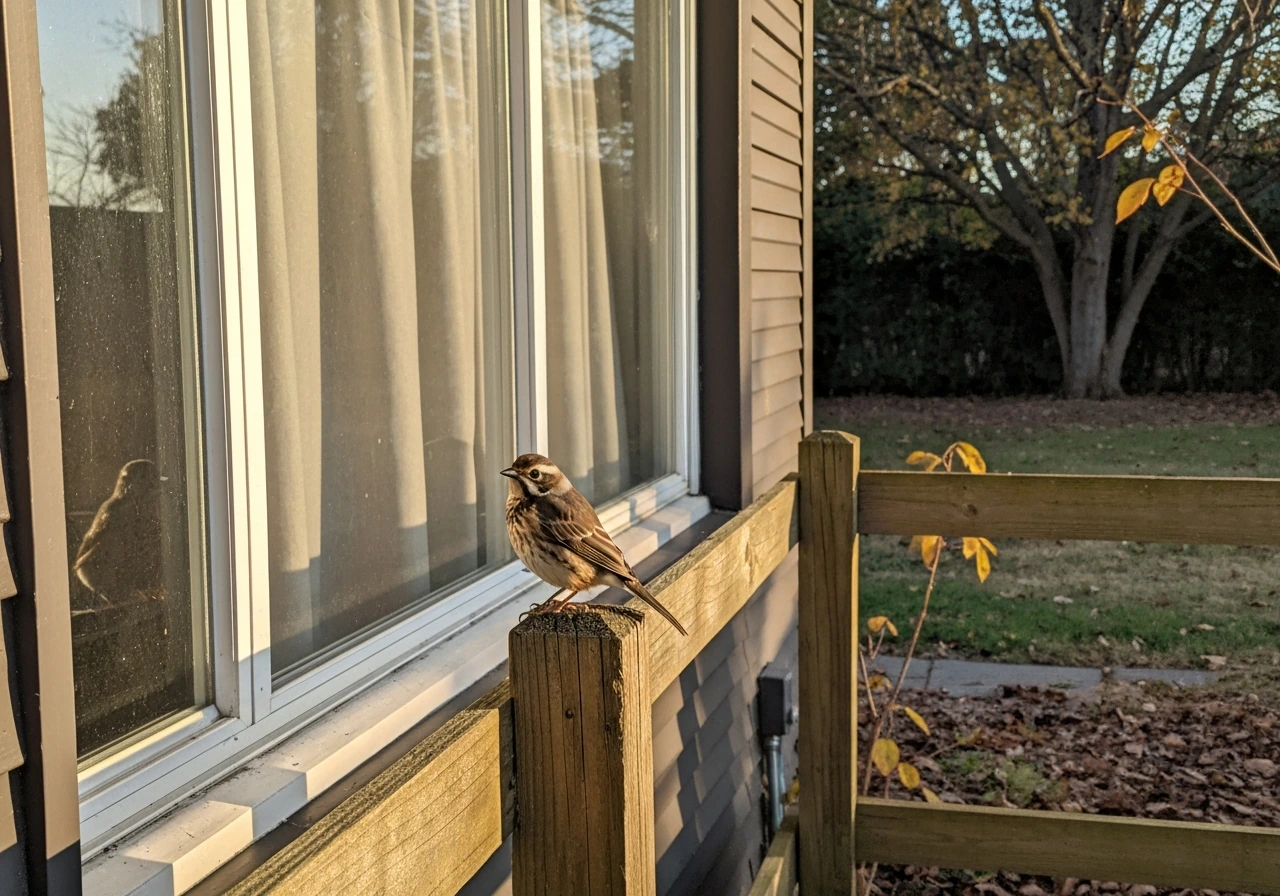
The phrase covers a surprisingly wide range of questions. Some people just had a robin land on their fence and felt something. Others watched a hawk circle overhead after a difficult day. Some found a bird indoors and want to know if it's a bad omen. And some are working through a dream where a bird appeared. The search term bundles all of these together, which is why the first useful step is figuring out which category you're actually in.
Broadly, bird visit searches fall into three buckets: spiritual or symbolic meaning (omens, signs, intuition), dream meaning (what the bird in your dream represents), and practical meaning (why a real bird behaved a certain way). This site covers all three angles, and they sometimes overlap. A bird pecking at your window repeatedly, for example, has a clear behavioral explanation and a long history of superstition attached to it. You can hold both.
It's also worth noting that questions like 'what does it mean when a bird follows you' or 'what does a bird sighting mean' are closely related to this one. Those topics go deeper into specific encounter types, but the framework here applies to all of them.
Start here: a quick checklist to decode your encounter
Before you reach for a symbolic interpretation or a wildlife rescue number, run through these questions. The answers will tell you a lot about what kind of meaning you're dealing with.
- Where did the bird appear? (Inside the house, at a window, in the yard, on your car, during a walk, in a dream)
- When did it happen? (Time of day, season, what you were doing or thinking about at the time)
- What species was it, or what did it look like? (Size, color, bill shape, behavior)
- What did the bird do? (Flew in and left, pecked at the window repeatedly, sat still and watched you, crashed into the glass, sang)
- What happened to the bird afterward? (Flew away fine, appeared stunned, stayed for a long time, returned multiple times)
- What was your emotional response in the moment? (Surprise, peace, unease, curiosity)
- Is there anything in your yard or property that might attract birds? (Feeders, water features, fruiting trees, reflective windows, nesting spots)
These details do double duty. They help wildlife experts assess what happened if the bird was injured, and they give spiritual or symbolic readings much more texture. Generic omen interpretations are pretty thin. The behavior, timing, and species are where the real meaning lives, no matter which framework you're using.
Species and behavior: how to look them up and why they matter
The species of bird matters enormously, both for practical identification and for symbolic interpretation. A crow visiting your yard carries different cultural weight than a dove, and it also behaves differently, eats different things, and visits for different reasons. Knowing what kind of bird you're dealing with is the single most useful piece of information you can have.
If you're not sure what bird you saw, start with observable field marks: size relative to common birds you know (sparrow, robin, crow), bill shape, color pattern, and the habitat where it appeared. Audubon and Cornell's All About Birds both emphasize that you can usually narrow a bird down to a few candidates using just these features, then confirm with behavior and habitat. The Merlin Photo ID app from Cornell's eBird project can identify birds from a photo taken in different postures and angles, which is genuinely useful when the bird was moving fast.
Once you know the species, behavioral context adds another layer. A male cardinal repeatedly striking a window isn't a portent: it's a territorial male attacking his own reflection, a well-documented phenomenon. A hummingbird hovering near your face is often just investigating a bright color on your clothing. Migration season (spring and fall in most of North America) brings species through that you'd never normally see, which can make an encounter feel extraordinary when it's actually a rest stop.
For symbolic lookups by species, the cultural associations are extensive and vary widely by tradition. Ravens and crows are linked to wisdom and transition in many Northern European traditions. Owls are death omens in some cultures and wisdom symbols in others. Doves carry peace and spirit messenger symbolism across many Western traditions. Robins are often associated with new beginnings in British and American folklore. The key is to note which cultural tradition resonates with you rather than treating any single interpretation as universal.
Spiritual, dream, and superstition angles versus real-world explanations
Humans have been reading meaning into bird behavior for thousands of years. The ancient practice of ornithomancy, the formal term for divination based on bird behavior, used bird flight patterns, cries, and appearances to interpret omens. That impulse to find meaning in a bird's visit is deeply wired into human culture, not a modern quirk. So if a bird's appearance felt significant to you, that's not irrational. It's a very old human response.
Contemporary spiritual framing tends to treat a bird sighting as a prompt to pay attention to intuition, trust instincts, or notice something in your inner life. The specific interpretation is usually shaped by the species, the behavior, and the emotional context of the moment. Importantly, most thoughtful spiritual readings emphasize how the bird appeared and behaved, not just that it showed up. A bird that lands calmly and looks directly at you reads differently than one that crashes into your window and flies off.
Dream appearances work slightly differently. Psychological frameworks, from Freud's idea of manifest versus latent dream content to Jung's view of dreams as symbolic expressions of the unconscious, both suggest that dream symbols aren't universal. What a bird means in your dream depends heavily on your personal associations with birds, the emotional tone of the dream, and the context of what else was happening. A bird that felt threatening in a dream carries different weight than one that felt liberating. There's no single fixed meaning, and any resource that gives you one without asking about your experience is oversimplifying.
The practical, nature-based explanations are usually more straightforward. Birds visit because they're looking for food, water, shelter, or a nesting site. Migration brings unfamiliar species through. Window strikes happen because birds misread reflections as open sky or react to their own image as a territorial rival. Feeders, birdbaths, and fruiting plants are strong attractants. These aren't less interesting than symbolic readings; they're just a different kind of meaning, rooted in ecology rather than omen.
| Encounter type | Likely practical explanation | Common symbolic framing |
|---|---|---|
| Bird appears at window repeatedly | Territorial response to reflection (common in cardinals, robins) | Message or sign being sent; visitation from spirit |
| Bird flies indoors | Followed food/light source, or entered through open door/window | Bad omen in some traditions; message from beyond in others |
| Unfamiliar bird in yard | Migrant stopping over, attracted by water or food | Sign of change, travel, or arriving news |
| Bird sits near you calmly | Habituated to humans, young bird, or seeking warmth | Spiritual visitation, comfort from a deceased loved one |
| Bird found stunned or injured | Window collision, cat encounter, or exposure | Not meaningfully omen-relevant; needs practical response |
| Bird in a dream | Normal dream imagery; may reflect recent bird encounters | Varies by species, behavior, and emotional tone of dream |
Common bird encounter scenarios and what they can indicate
A bird at your window
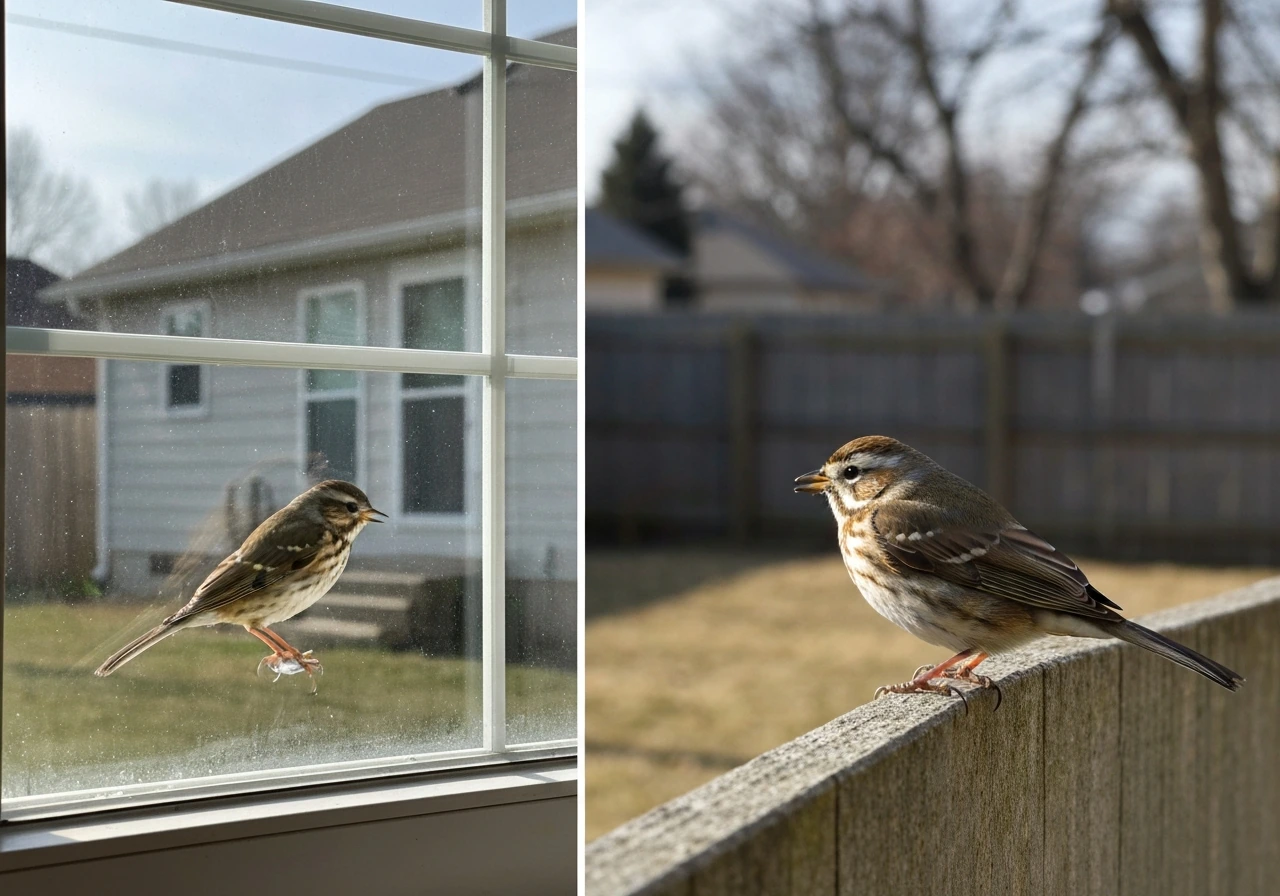
This is probably the most common scenario people search for meaning around. If the bird tapped or pecked repeatedly and then left, the most likely explanation is territorial behavior triggered by its own reflection. Male songbirds are particularly prone to this in spring breeding season. If the bird hit the glass hard and fell, that's a window strike, which needs a practical response (more on that below). If it simply perched and watched you through the glass for a while, that's often a habituated or curious bird, especially common with corvids like jays and crows.
A bird inside your home
Birds indoors are almost always there by accident. They followed light, entered through an open door or chimney, or panicked after a window confusion. The cultural superstition around a bird in the house being a death omen is widespread across European and American folklore, but the practical reality is that the bird is stressed and needs a calm, clear exit path. Open a window or door toward the light, dim or block other light sources to guide it out, and give it space to find its way.
A bird following you or staying near you
This can feel intensely meaningful, and sometimes it genuinely is unusual behavior worth noting. Corvids (crows, ravens, jays) are smart enough to recognize and follow individual humans, especially if they've been fed. Young birds that have imprinted on humans, or birds habituated to people in urban settings, will approach and stay close. In spiritual terms, a bird that follows you is often read as a message or a guide. The experience of being singled out by an animal does have real psychological resonance, even if the bird has a mundane motivation.
An unusual or rare species showing up
Seeing a species you've never encountered in your area is almost always explained by migration or weather-driven displacement. Spring and fall migration in North America moves billions of birds through regions they don't inhabit year-round, and storms can push species far outside their normal range. Water features in your yard, as Audubon Great Lakes notes, are especially effective at bringing migrating birds down from the tree canopy where you'd never otherwise see them.
Practical next steps you can take today
If a bird is inside your home
- Stay calm and move slowly. Panicked movement will stress the bird and drive it into walls.
- Close interior doors to limit the bird to one room.
- Open a window or exterior door in that room. If possible, darken other light sources so the open exit is the brightest point.
- Give the bird time and space. Most birds will find their way out within 20 to 30 minutes if not harassed.
- If the bird is clearly injured or can't fly, move to the injured bird steps below.
If a bird hit your window
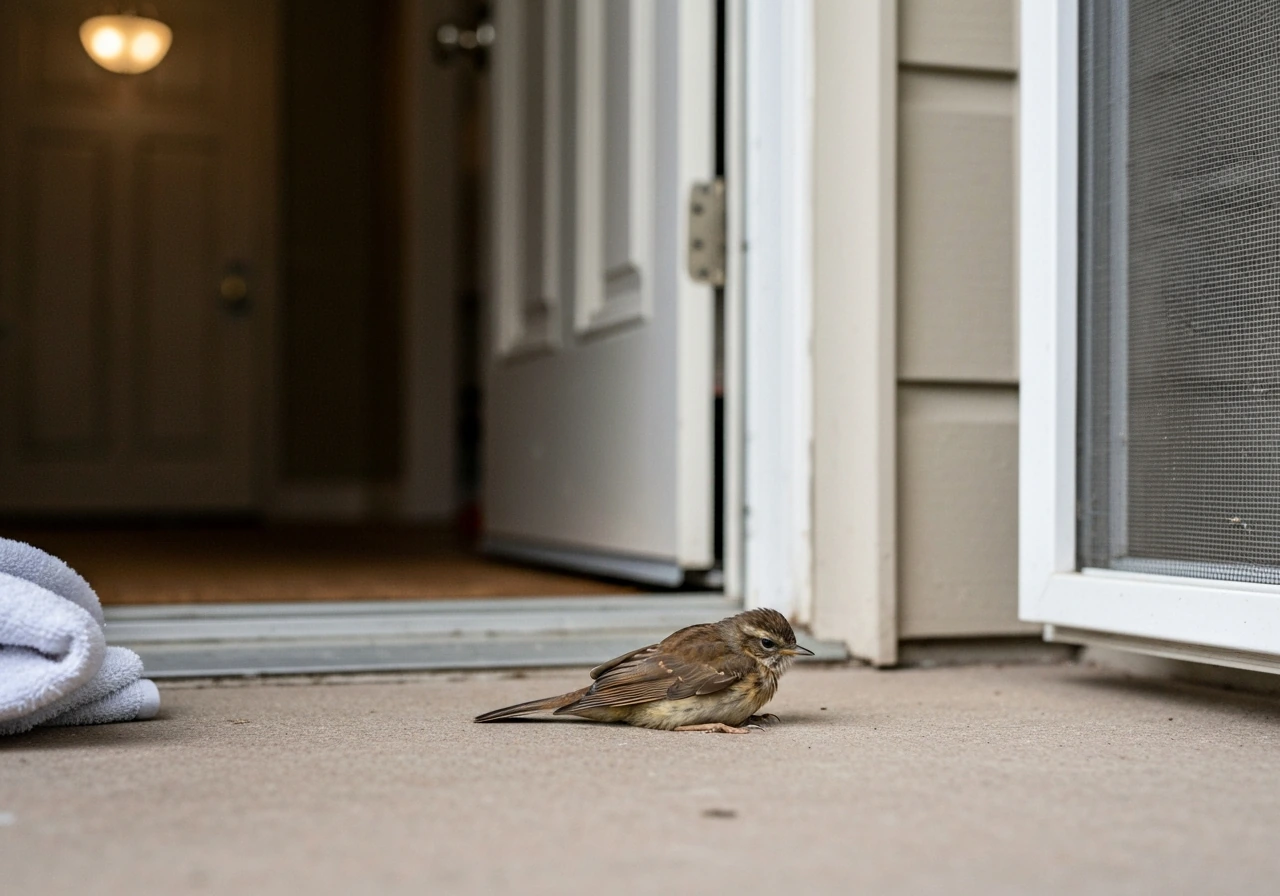
Don't assume it's fine just because it's still alive. Window strikes cause concussion and internal injuries that aren't always visible. If the bird is stunned but breathing, place it in a small cardboard box with air holes, lined with a paper towel. Keep the box in a warm, dark, quiet place for 30 to 60 minutes. Darkness reduces stress. Do not give it food or water. After that time, take the box outside and open it. If the bird flies out strongly, it's likely recovered. If it can't fly or seems disoriented, contact a wildlife rehabilitator.
To prevent repeat strikes at the same window, the cause is almost always reflection. Birds perceive the glass as open sky or habitat. Solutions include applying window film or tape in patterns spaced 2 inches apart or less, moving feeders either closer than 3 feet to the glass (so birds can't build up speed) or farther than 30 feet away, and using screens or exterior window treatments to break up the reflection.
If a bird is nesting on your property
This is one of the most common 'repeated visit' scenarios, especially in spring. A bird that keeps returning to the same spot isn't delivering a message; it's building or tending a nest. In most parts of the US, active bird nests are federally protected under the Migratory Bird Treaty Act, so you can't legally disturb them once eggs are laid. The practical move is to note the location, give the area a wide berth, and enjoy the observation opportunity. Most nests are vacated within 4 to 6 weeks.
When to get help and how to document the encounter
Get wildlife rehabilitation involved sooner rather than later if you observe any of the following: the bird can't fly or is dragging a wing, it's bleeding, it's lying on its side or upright but not moving voluntarily, or it's been more than an hour since a window strike and it still seems disoriented. Audubon is clear that rehab expertise matters here because injury signs aren't always obvious to untrained observers, and treatment (including anti-inflammatory medication for head trauma) requires professional assessment.
To find a rehabilitator, search for your state or province wildlife rehabilitator network, or contact your local animal control office. The BC SPCA and similar organizations in Canada maintain wildlife helplines. In the US, the Wildlife Center of Virginia and similar regional centers often have online intake forms.
Documenting the encounter is useful whether your interest is spiritual, ornithological, or practical. If you came here searching for bird visiting you meaning, start by checking which kind of encounter you have and whether there’s a practical explanation first. Note the date, time, location, weather conditions, and what the bird did before and after. Take a photo if you can do so without disturbing the bird. If you're trying to identify the species later, photos from multiple angles and a note about the habitat (backyard feeder, forest edge, urban street) will narrow it down quickly in Merlin or a regional field guide. This kind of documentation also gives any spiritual or symbolic interpretation much more to work with than a vague memory of 'there was a bird.'
If the encounter stays with you and you want to explore the symbolic dimension further, sitting with your own emotional response is more useful than looking up a generic meaning list. What did the bird's appearance feel like in the moment? What were you thinking about that day? Those personal associations are exactly what analytical psychology suggests actually drives meaningful dream and encounter symbolism, not a fixed species-to-meaning lookup table.
FAQ
What’s the fastest way to figure out the bird visit meaning in real life versus spiritually?
Start with whether the bird behaved like it was searching (food, water, nest) or like it was reacting to something in your environment (glass reflection, a doorway entry, panic from light). If you have repeated window pecking or strikes, prioritize the practical explanation first, then add symbolic meaning only after you’ve ruled out injury and reflection causes.
How do I know if a bird that hit my window is actually injured, not just stunned?
Watch for prolonged disorientation after it regains its footing, repeated stumbling, inability to fly straight, or awkward wing positioning. Even if it looks “alive,” concussion and internal injury can be present, especially if it hit hard and stayed near the glass more than a brief moment.
Should I feed or give water to a window-strike bird after I find it on the ground?
No. Place it in a small, ventilated cardboard box in a warm, dark, quiet area for 30 to 60 minutes, do not offer food or water, then release outside if it can fly normally. Feeding can increase stress and delay recovery.
What if the bird won’t leave after I open a door or window?
Try adjusting light direction, dim other rooms, and open the closest exit toward natural light. Give it space and avoid chasing, which increases panic and collisions. If it cannot orient within a short period or shows injury signs, contact a wildlife rehabilitator.
Does bird visit meaning change depending on the bird species, even if my spiritual tradition is different?
The species often changes both practical likelihood (for example, crows are very behavioral around people and reflections) and symbolic associations, but your personal cultural lens still matters. Use species as a context filter, then choose the interpretation that matches your own emotional response and tradition instead of relying on a single universal “omen” list.
Can a bird following me have a practical cause, and how would I tell?
Yes. Look for patterns like the bird approaching after you feed birds, hanging around a regular route with food sources, or repeatedly returning when you stop at specific places. If the bird stays calm near you and then leaves when you move away, that often points to habituation or food association rather than a fixed “message.”
What should I do if a bird is nesting and keeps coming back to the same spot near my home?
Don’t relocate the bird or disturb the area once eggs or nest building are likely. In many places, active nests are protected, so instead note the location, give it a wide berth, and observe from a distance until the nesting period ends (often several weeks).
Is it ever safe to move a window feeder to prevent bird strikes?
Often, yes, but do it in a way that reduces reflection risk. Keep feeders at least 30 feet away from windows or closer than 3 feet so birds cannot build up speed for a strike, and consider window film or patterned tape to break up the visual illusion of open sky.
What photo details help most with identifying bird visit meaning (and the species)?
Capture the bird’s side profile and any visible wing or tail pattern, plus one photo showing it relative to your surroundings if scale helps. Note the habitat type (backyard feeder, patio, forest edge, street) and whether it was perched, hovering, pecking, or flying into the glass.
How should I interpret a dream bird if I don’t have any personal association with birds?
Treat it as a clue about the dream’s emotional tone (threatening, liberating, curious) and the situation in the dream rather than forcing a fixed species-to-meaning translation. If you can recall what else was happening (fear, transition, a decision you were avoiding), that usually gives more useful signal than guessing from general bird symbolism.
When should I contact wildlife rehab, even if I’m not sure the bird is injured?
Contact rehab sooner if the bird cannot fly or seems to drag, if there’s bleeding, if it lies upright but does not move voluntarily, or if more than an hour has passed after a strike and it still looks uncoordinated or disoriented. Head trauma signs can be subtle to non-experts.
Citations
Ornithomancy is the historical practice of divination/readings (omens) from birds—often based on the actions of birds such as their flight and cries.
https://en.wikipedia.org/wiki/Ornithomancy
Mainstream psychological dream interpretation is often discussed in terms of Freud’s model of manifest dream content being interpreted to find latent meaning, reflecting that “dream symbolism” is not universally standardized across people.
https://en.wikipedia.org/wiki/The_Interpretation_of_Dreams
Popular ‘spiritual meaning of birds’ framing in everyday web content often treats a bird sighting as a sign to pay attention to intuition, trust instincts, and connect with the spiritual realm.
https://www.astrology.com/spiritual-meaning-animals/bird
Popular spiritual-meaning articles commonly advise that “to fully interpret the omen,” attention should be paid to how the bird appears and behaves (not just that a bird showed up).
https://www.mysticmag.com/psychic-reading/guide-to-spiritual-meaning-of-birds/
Audubon advises that for a bird collision victim, a key “meaning disambiguation” step is to switch from trying to interpret the event to getting the bird to proper wildlife rehabilitation for expert care when needed.
https://www.audubon.org/magazine/you-found-bird-crashed-window-now-what
Audubon emphasizes that birders use “field marks” (size/shape, bill structure, plumage patterns) and behavior/habitat to narrow identity—showing that practical context (what kind of bird) matters more than generic symbolism.
https://www.audubon.org/content/how-identify-birds
Purdue Extension frames residential window strikes as an issue with preventing harm and provides guidance on what to do when a strike occurs—indicating a nature-based explanation (window collision mechanisms) rather than omen-based meaning.
https://www.purdue.edu/fnr/extension/birds-and-residential-window-strikes-tips-for-prevention/
Purdue Extension’s “Birds and Residential Window Strikes” PDF describes that birds strike windows for several reasons (including reflections and the possibility of birds misperceiving glass as pass-through habitat).
https://www.extension.purdue.edu/extmedia/FNR/FNR-562-W.pdf
USGS explains common causes of repeated window hits, including (1) birds mistaking reflections/visual cues, and (2) birds seeing their reflection and treating it as a territorial intruder.
https://www.usgs.gov/index.php/faqs/how-can-i-stop-birds-repeatedly-hitting-my-windows
No high-confidence data point captured.
https://www.u f l.edu/
All About Birds highlights reflective landscapes and “visual tunnels” created by window arrangements as a driver of deadly bird window strikes.
https://www.allaboutbirds.org/news/why-birds-hit-windows-and-how-you-can-help-prevent-it/
Purdue Extension notes bird migration as a major natural phenomenon, supporting the idea that increased bird “visits” can be seasonal rather than symbolic (e.g., migrants passing through).
https://www.purdue.edu/fnr/extension/backyards-and-migratory-birds/
Audubon (Great Lakes) states that water features (birdbaths/fountains/small ponds) bring migrants down from trees so you can observe them—practical “visit” drivers beyond symbolism.
https://www.audubon.org/birds/water-attracts-birds
Purdue Extension’s 4-H wildlife material states birds can hit windows near bird feeders for reasons such as reflections creating an expansive scene that birds think they can fly into, or birds perceiving their reflection as a competing bird.
https://www.extension.purdue.edu/extmedia/4H/4-H-907-W.pdf
Audubon describes backyard conflicts (e.g., window collision and predator interactions) as “trouble” scenarios, illustrating that what looks like a ‘sign’ is often an understandable ecological event.
https://www.audubon.org/magazine/how-deal-backyard-mishaps
Audubon cautions that laypeople may not recognize all bird injury signs and that wildlife rehab expertise is important for correct assessment and treatment after window collisions.
https://www.audubon.org/magazine/you-found-bird-crashed-window-now-what
Tufts Wildlife Clinic describes window strikes as related to reflection/territorial behavior (example: male cardinal pecking at window reflection as intrusion), and provides recovery steps like dark, warm, quiet containment in a shoebox.
https://vet.tufts.edu/tufts-wildlife-clinic/resource-library/bird-strikes-and-windows
BC SPCA advises that if a bird strikes a window, you should note obvious injury signs and contact a local wildlife rehabilitation center (or their helpline) for advice.
https://www.spca.bc.ca/faqs/bird-flew-into-window-injured/
Audubon notes that a small adult bird that has just hit a window may need time to regain senses, but if you can’t contact a rehabber, you should contact local animal services.
https://www.audubon.org/debs-park/about-us/what-do-if-you-find-injured-or-orphaned-bird
Audubon states it’s usually possible to narrow a bird’s identity to a few possibilities by using key distinguishing features (proportions, bill structure, plumage patterns) and then confirming with habitat/behavior.
https://www.audubon.org/content/how-identify-birds
All About Birds’ identification guidance emphasizes using size/shape, color pattern, behavior, habitat, and “field marks,” with field marks used to resolve similar species.
https://www.allaboutbirds.org/page.aspx?pid=1058
eBird Merlin Photo ID uses mobile photo identification models trained from image resources, and it can correctly identify birds in different postures/angles with enough images.
https://support.ebird.org/support/solutions/articles/48000966224
Audubon emphasizes that identifying flying birds can be difficult, but key features still often distinguish species—supporting the idea that specific encounter details (landing vs flying) should narrow meaning/ID.
https://www.audubon.org/content/how-identify-birds
Tufts notes a specific behavioral clue for causal disambiguation: male birds (e.g., cardinals) may peck at windows because they perceive their own reflection as an intruding rival.
https://www.tufts.edu/tufts-wildlife-clinic/resource-library/bird-strikes-and-windows
BC SPCA’s reporting/infographics emphasize that after a window-collision, you should contain the bird and contact a wildlife rehabilitation center for next steps; example cases may include wing trauma/head trauma.
https://www.spca.bc.ca/news/striking-bird-window-collisions/
Audubon recommends wildlife rehabber involvement and notes that treatment may require anti-inflammatory medication and expert assessment beyond what a layperson can provide.
https://www.audubon.org/magazine/you-found-bird-crashed-window-now-what
Audubon advises a practical ‘document for help’ mindset: if the bird is unable to recover and you can’t contact rehab, contact animal services—supporting the need to act based on observable condition/behavior rather than omen beliefs.
https://www.audubon.org/debs-park/about-us/what-do-if-you-find-injured-or-orphaned-bird
BC SPCA (window-strike infographic PDF) instructs people to note obvious injury signs when a bird has struck a window, as part of deciding what to do next (care escalation).
https://spca.bc.ca/wp-content/uploads/2022/02/news-wildlife-birds-window-strikes-infographic.pdf
Purdue Extension’s window-strike prevention guidance supports that actions should be based on causation (reflections/territoriality) and mitigation, not on symbolic meaning of the event.
https://www.purdue.edu/fnr/extension/birds-and-residential-window-strikes-tips-for-prevention/
Sleep Foundation discusses dream-interpretation as a reflective exercise and cites Freud’s view of symbolism as rooted in psychological processes—implying that “bird in a dream” meaning should be approached cautiously rather than literally.
https://www.sleepfoundation.org/dreams/dream-interpretation
Analytical psychology resources describe dreams as a symbolic process (Jung’s idea of the dream as a “symbolical form” of unconscious psychic situation), which supports using personal associations and emotion rather than fixed universal meanings.
https://www.encyclopedia.com/psychology/dictionaries-thesauruses-pictures-and-press-releases/interpretation-dreams-analytical-psychology
Wikipedia summarizes that dream interpretation approaches vary and are subjective; this supports a caveat against treating dream symbols as universal omens.
https://www.wikipedia.org/wiki/Dream_interpretation