A bird trap is any device or method used to catch, hold, or confine a bird, ranging from a simple baited cage to a professional mist net used by wildlife researchers. Beyond the physical object, the phrase carries considerable symbolic weight: a trapped bird is one of the most enduring images in world culture, standing variously for lost freedom, oppression, hidden potential, or spiritual longing. This guide covers all of those layers, starting with the practical and legal facts, then moving into cultural, spiritual, dream, and artistic meanings, so you can find what you actually came here for without having to wade through only one narrow reading of the term.
Bird Trap Meaning: Literal, Cultural, Dream & Ethical Guide.

Marcus Holloway
17 Jul 2026
What 'bird trap' actually means: the full scope
The term works on at least three levels simultaneously, and which one a reader needs depends entirely on their situation. A backyard birder who just found a starling caught in garden netting needs practical rescue steps. A student analysing Maya Angelou's 'I Know Why the Caged Bird Sings' needs cultural and literary context. A dreamer who woke from a vivid image of a bird in a cage needs a psychological or spiritual framework. This article is structured so each reader can locate their entry point quickly, though the sections are deliberately woven together because the literal and symbolic meanings reinforce each other in interesting ways.
The literal definition: what a bird trap is and how it works
In the most concrete sense, a bird trap is a device designed to capture a live bird without killing it, or to prevent a bird from leaving a defined space. Traps are used by licensed wildlife researchers conducting population surveys, by licensed rehabilitators handling injured birds, by pest-management professionals dealing with birds in food-handling premises, and by licensed falconers capturing raptors for training. In all of these contexts, the key word is licensed. Most jurisdictions with significant wild-bird populations have strong legal frameworks that make unlicensed trapping of wild birds a criminal offence (more on that in the legal section below).
The mechanics vary widely by target species and purpose. Some traps rely on entanglement (mist nets), others on funnel geometry that guides a bird toward a dead end (Heligoland traps), others on a triggered door (box or cage traps), and others on nooses designed to grip a raptor's talons momentarily (bal-chatri traps). UK guidance for food premises recommends using box or cage (clap) traps as a lawful, non‑lethal option when carried out with appropriate welfare safeguards, blank" rel="noopener noreferrer">Wild birds: remove them from food premises using nets or traps - GOV.UK. blank" rel="noopener noreferrer">Global review and guidelines to avoid opportunistic predation of birds and bats in mist nets (Moura et al., Ecology & Evolution, 2023) notes that mist nets are typically nylon, multi-panel nets (commonly 6–12 m long for passerines, with mesh sizes around 12–38 mm depending on target) and recommends checking nets every 20–30 minutes (shorter intervals in hot or wet conditions) to minimise entanglement injuries and opportunistic predation. Each type has a distinct operational profile, a specific set of welfare requirements, and a legal context.
Common trap types at a glance
The table below summarises the main trap types you will encounter in field literature, wildlife rescue contexts, and historical or cultural references. Understanding what each one is helps when you come across the term in a nature documentary, a research paper, or a piece of historical writing.
| Trap type | How it works | Typical use | Key welfare/practical notes |
|---|---|---|---|
| Mist net | Nylon multi-panel net (6–12 m long, mesh 12–38 mm) strung between poles; birds fly into it and fall into pockets | Scientific banding/ringing, population surveys | Must be checked every 20–30 minutes (more often in heat or rain); prolonged entanglement causes injury |
| Heligoland (funnel) trap | Permanent or semi-permanent wire/netting funnel that channels birds into a collecting box | Bird observatories, long-term monitoring stations | Small versions ~3 m high; large 'Rybatchy' types up to ~20 m; broken netting is an entanglement hazard |
| Box/cage trap (clap trap) | Baited open cage; trigger releases a door or lid when bird enters | Pest control in food premises, licensed research | Non-lethal; birds must be checked frequently and not left overnight without authorisation |
| Bal-chatri trap | Small baited cage ringed with fine nylon-monofilament nooses that grip a raptor's talons | Raptor banding and research | Requires constant supervision; nooses must not tighten on legs; birds released promptly |
| Corral/funnel trap | Large wire-mesh funnel placed over a feeding area; birds walk in but cannot find the exit | Waterfowl and ground-bird research, avian influenza surveillance (FAO) | Scale means multiple birds captured; welfare depends entirely on check frequency |
| Glue/birdlime (historical and largely banned) | Adhesive applied to perches or surfaces; birds become stuck on landing | Historically used in pest control and subsistence trapping; now widely prohibited | Causes severe suffering, non-target captures; banned or heavily restricted in the UK, EU, and many US states |
Related practical terms: bird caging, cage lining, netting, and aviaries
Several related terms orbit 'bird trap' and are often searched alongside it. Bird caging refers to the act of placing or keeping a bird in a cage, which can be a straightforward pet-keeping practice or a loaded metaphor depending on context. Cage lining is the material placed on the floor of a cage to absorb droppings and make cleaning easier. Aviaries are large, walk-in enclosures designed to house birds in conditions that allow more natural movement than a small cage. Netting, in a practical sense, can refer to protective garden netting designed to keep birds away from crops, to mist nets used in research, or to containment netting around large outdoor aviaries. Each of these terms has both a workaday definition and a symbolic resonance that writers, dreamers, and cultural analysts have made use of for centuries.
Bird cage lining: practical uses, materials, and symbolic readings
On the purely practical side, cage lining is chosen for absorbency, safety, and ease of replacement. Unbleached paper, newspaper, and commercial cage-liner paper are the most commonly recommended materials by avian veterinarians because they allow owners to monitor droppings for health changes and are non-toxic. For a fuller explanation of bird cage lining meaning, covering both practical materials and symbolic readings, see the dedicated guide on cage lining. Sand, grit, and corn-cob bedding are sometimes used but carry risks: fine particles can cause respiratory irritation, and ingestible grit can compact in the gut. Cedar and pine shavings are broadly discouraged because the aromatic compounds (phenols) are toxic to birds.
Symbolically and ritually, cage lining has attracted its own layer of meaning. In some folk-magic and protective-charm traditions across the Caribbean and West Africa, specific materials placed beneath a caged bird (certain leaves, herbs, or coloured paper) are believed to amplify or redirect the bird's spiritual energy. In art contexts, the material on the floor of a painted or drawn cage can serve as a compositional anchor or a narrative clue: straw suggests natural captivity; torn paper suggests damage or decay; clean white lining suggests clinical control. These readings are worth keeping in mind when you encounter them in literature or visual art, though they are interpretive frameworks rather than universal meanings.
If you find a trapped bird right now: what to do
Before anything else: most adult birds found on the ground or caught in netting are not fatally injured, but they are stressed, and stress itself can kill a bird quickly. The goal is to reduce stress, prevent further injury, and get the bird to a licensed rehabilitator as fast as possible. Here is a clear sequence based on guidance from the RSPCA, Tri-State Bird Rescue and Research, and the National Wildlife Rehabilitators Association.
- Stop and observe from a distance first. Is the bird actually stuck, or is it a fledgling resting on the ground naturally? Clear signs that intervention is needed: visible entanglement (string, netting, wire around a leg or wing), open wounds, blood, a wing drooping at an unnatural angle, inability to stand, neurological signs (spinning, head tilt), or the bird is clearly cold and unresponsive.
- If the bird is entangled in soft material (garden netting, string) and you can safely remove it without pulling on the bird, do so gently and slowly, cutting the material away with scissors if needed. Do not pull. Wrap the bird loosely in a clean cloth to prevent wing-flapping injuries.
- Place the bird in a ventilated cardboard box lined with a folded cloth or paper towels. Make the box dark and quiet; darkness reduces panic. Do not put water or food in the box and do not attempt to feed the bird yourself.
- Keep the box warm (around 30°C / 86°F for small passerines, cooler for large birds) away from direct sunlight, pets, and children.
- Contact a licensed wildlife rehabilitator immediately. In the US, the NWRA maintains a rehabilitator locator. In the UK, the RSPCA helpline (0300 1234 999) can direct you. In the EU, national wildlife organisations hold listings. Do not attempt prolonged or invasive treatment yourself.
- If the bird is a raptor (hawk, owl, falcon, eagle), be especially careful: talons cause serious wounds. Use a thick towel or gloves, cover the bird's head gently, and call a specialist raptor centre. Auburn University's veterinary college notes that many ground-found raptors are in shock rather than severely injured, which is a reason to act calmly rather than urgently.
The legal picture: permits, protected species, and where folklore ends
The legal framework around bird trapping is stricter than most people expect, and it is worth understanding even if your interest is primarily symbolic, because the cultural weight of the trapped bird as a symbol is partly built on the real historical practice of trapping wild birds, much of which is now illegal.
In the United States, the Migratory Bird Treaty Act of 1918 (MBTA) prohibits the taking, possession, transport, or sale of most native migratory birds without a federal permit. This covers a huge range of species, from warblers to raptors, and the penalties are significant. Permits are available for specific purposes: scientific research, bird banding, educational display, and licensed rehabilitation. If you find an injured migratory bird, you can possess it temporarily to get it to a rehabilitator, but you cannot keep it.
In the UK, the Wildlife and Countryside Act 1981 gives blanket protection to all wild birds, their nests, and their eggs. The government issues specific standard licence conditions (GL33) that control where, when, and how trapping may be carried out legally, including the use of decoy birds and holding cages. At the EU level, the Birds Directive (2009/147/EC) prohibits deliberate capture or killing of wild birds across member states except under strictly defined exemptions.
The practical upshot: if you are reading about bird trapping in a historical, literary, or cultural context, you are often reading about practices that were once common and are now significantly curtailed. The image of the bird catcher selling captured songbirds at a market, or the falconer trapping passage raptors, belongs to a historical world with different rules. Today, those activities require licences, welfare standards, and oversight. Glue trapping (birdlime), historically one of the most widespread methods, is now banned or heavily restricted in the UK, Scotland, and much of Europe because of documented severe welfare harms.
The cultural and spiritual meanings of a trapped bird
Across a remarkably wide range of cultures and historical periods, the image of a bird in a trap or cage has functioned as a powerful and flexible symbol. The core tension it represents, between a creature built for flight and a space that prevents it, makes it unusually versatile as a metaphor. Here are the main symbolic frameworks you will encounter.
Freedom, oppression, and the desire to escape
The most widespread reading of the trapped bird is as a symbol of constrained freedom, of a person or soul prevented from living as it naturally would. This appears in ancient Chinese poetry, in West African proverbs, in European Romantic literature, and in modern English-language writing. Maya Angelou's title 'I Know Why the Caged Bird Sings' draws directly on this tradition, using the trapped bird's song as a metaphor for resilience under racial oppression. In Persian poetry, the caged nightingale (bulbul) is a recurring figure for the soul separated from the divine. In much of Western folk tradition, releasing a caged bird was considered an act of mercy with spiritual reward attached to it.
Protection, safety, and deliberate shelter
Not all traditions read the cage negatively. In some East Asian contexts, a caged bird represents care and cultivation: the bird is protected from predators, fed, and tended. In certain protective-charm traditions across the Philippines, the Caribbean, and parts of Latin America, a caged bird in the home is believed to absorb negative energy or deflect harmful spirits, functioning more as a spiritual shield than a prison. The trap or cage here is a container that collects or holds something that might otherwise cause harm.
Concealment and hidden knowledge
In some folklore traditions, particularly from parts of Eastern Europe and the Slavic world, a bird kept or trapped in a specific place represents concealed knowledge or a secret that cannot be revealed. The motif of a soul trapped in the form of a bird inside a box or cage appears in Slavic fairy tales as a plot device: the villain's death is 'hidden' in a trapped bird, which the hero must find and release to defeat evil. This connects to broader Indo-European folklore about the soul existing outside the body in animal form.
Sacrifice, offering, and ritual use
Trapping birds for ritual purposes has a long history across many cultures. In ancient Rome, augury involved observing birds, and live birds were sometimes kept for oracular consultation. In certain Mesoamerican traditions, birds were trapped and their feathers harvested for ceremonial regalia with complex spiritual protocols attached to the capture. In some African diasporic religious traditions (including Candomblé and Santería), live birds feature in specific ritual contexts. These uses are distinct from decorative or metaphorical readings and belong to specific, living religious traditions that deserve accurate, context-sensitive treatment rather than generalisation.
Cross-cultural comparison of trapped bird symbolism
| Cultural tradition | Primary symbolic reading | Key nuance |
|---|---|---|
| Western literary/Romantic | Lost freedom, oppression, longing | Bird's song or silence both carry meaning; cage is the oppressor |
| Persian/Sufi poetry | Soul separated from the divine or from the beloved | Nightingale is the canonical bird; the cage is the material world |
| East Asian (Chinese, Japanese) | Care and cultivation, or melancholy of confinement, depending on context | Keeping songbirds was a respected hobby; caging can be tender or sad |
| West African and diaspora traditions | Protective vessel, spiritual absorption, connection to ancestors | Cage may be positive; the bird as spiritual mediator |
| Slavic folklore | Hidden soul, concealed life-force, secret knowledge | Motif of the death or power of a figure 'stored' in a trapped bird |
| Mesoamerican ritual | Sacred connection, offering, access to divine energy through feathers | Trapping was ritual, governed by ceremony; bird is a sacred intermediary |
Dream meanings: bird trapped vs bird escaping
Dreams involving a trapped bird are among the more commonly reported bird-related dream images, and the psychological and cultural frameworks for interpreting them vary considerably. It is worth being explicit here: dream interpretation is not a predictive science, and no single reading is universally 'correct.' What follows are the frameworks most commonly applied, which you can weigh against your personal context.
In Jungian and broadly Western psychological frameworks, a bird typically represents the spirit, the aspiration, or the capacity for transcendence. A bird in a trap or cage in a dream is often read as an indication that the dreamer feels constrained in waking life, whether in a relationship, a job, a belief system, or a role they have outgrown. The condition of the bird matters enormously: a distressed, starving bird in a cramped cage carries different psychological weight than a calm bird in a spacious enclosure. Some interpretations emphasise that the dreamer may be the one doing the trapping, which shifts the reading toward an exploration of control, fear of loss, or an unwillingness to let something (or someone) go.
A bird escaping from a cage or trap in a dream is generally read more positively in most frameworks: release, liberation, or the resolution of a long-standing constraint. The related topic of a bird escaping a cage in dreams explores this in more depth, including cultural variants where the escaping bird can symbolise the departure of a soul or a lost opportunity rather than a straightforwardly positive release. The emotional tone of the dream, which is something only the dreamer can fully assess, is often the most reliable guide.
Dream interpretation: a bird carrying a snake
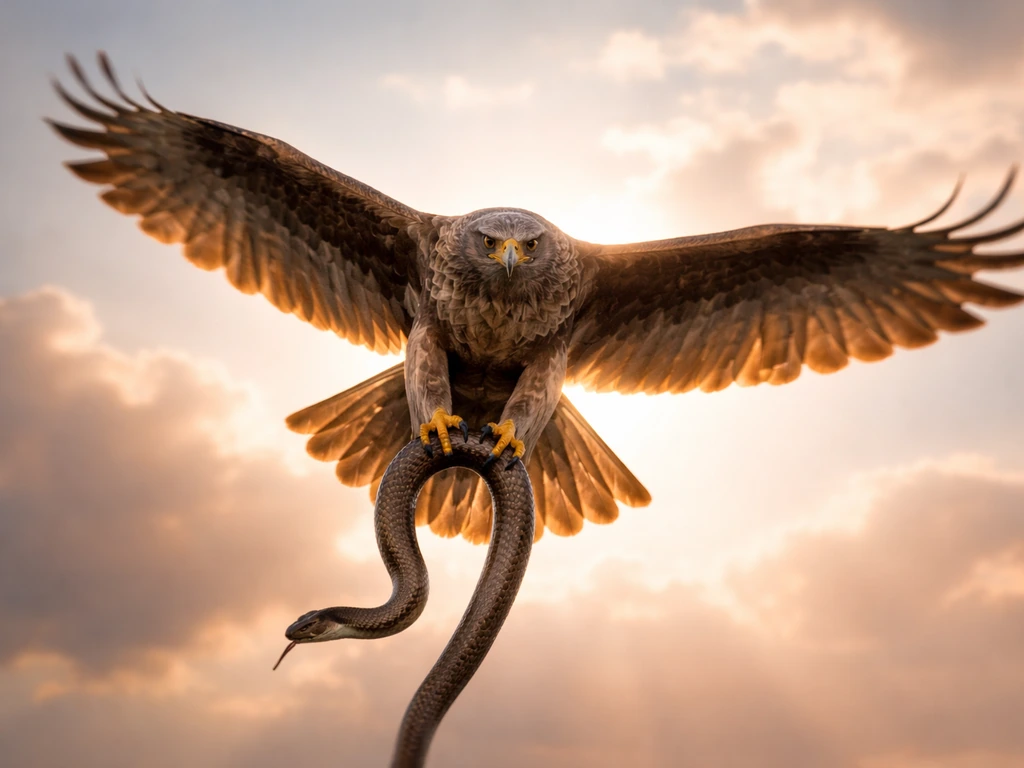
This specific image, a bird holding or carrying a snake, appears frequently in reported dreams and also in widespread cultural iconography, from Aztec mythology (the eagle and serpent on Mexico's flag) to ancient Egyptian and Greek imagery. In dream contexts, the combination of bird and snake is typically interpreted as a tension between opposites: sky and earth, spirit and instinct, consciousness and the unconscious. The bird 'winning' by carrying the snake suggests the rational or spiritual aspect holding the instinctual or shadowy aspect in check, which many Jungian analysts read as a positive integration sign. In some Indigenous North American traditions, this image is a specific power symbol with particular meaning attached to certain birds and certain snakes. The detailed symbolic breakdown of this image, including its cultural variants and psychological readings, runs to considerable depth and is worth exploring as a standalone subject. For a focused exploration of that motif, see our deeper guide on bird carrying snake meaning.
Birds in cages in art and writing: what the image means in creative contexts
Visual artists and writers have used the caged bird so extensively that it has become one of those images you have to engage with carefully to avoid cliché. In European still-life painting from the 17th century onward, a caged bird often functioned as a vanitas symbol, a reminder of the transience of freedom and life, alongside skulls, wilting flowers, and guttering candles. In Victorian genre painting, a caged bird frequently represented a woman's domestic confinement, a reading that was sufficiently well established that contemporary viewers would have decoded it immediately.
In contemporary art, particularly in works by artists from formerly colonised cultures, the caged bird retains political force while gaining additional layers: the question of who built the cage, who holds the key, and who benefits from the bird's captivity becomes central. Drawings and illustrations of birds inside cages work through compositional choices as much as symbolic ones: the thickness and material of the bars, the size of the bird relative to the enclosure, what the bird is doing (singing, silent, pressing against the bars, looking away), and what lines the cage floor all contribute to the meaning. For a focused discussion of visual choices when artists draw a bird inside a cage, see bird inside the cage drawing meaning (558edac6-575a-4621-9069-d10a5895a1ea). Cage lining in an artistic context can carry its own semantic weight, from the clinical white of a controlled environment to the warm straw of something natural but still confined.
Idioms, slang, and expressions using bird imagery
English is unusually rich in bird-related idioms, and several of them connect directly to the ideas of trapping, caging, and freedom. Here is a selection of the most relevant ones, with brief explanations.
- 'A bird in the hand is worth two in the bush': having something certain is better than the prospect of something greater but uncertain. This idiom is directly rooted in falconry and bird-trapping traditions, where a captured bird had concrete value.
- 'Cage-free': originally a poultry industry term, now used metaphorically to describe a person or situation that has been freed from constraints.
- 'Snare someone': from bird-trapping technology (a snare being a loop trap), now used to mean catching or tricking a person.
- 'Lure': originally a falconry term for a decoy used to call a trained hawk back, now used broadly to mean attracting someone, sometimes with deceptive intent.
- 'Decoy': from the Dutch 'de kooi' (the cage), referring to a pen or enclosure used to trap wildfowl; now used to mean a distraction or false signal used to mislead.
- 'Cagey': wary and reluctant to give information. The metaphor is of a creature unwilling to be caught or confined.
- 'Free as a bird': utterly unconstrained, used to describe the opposite state from captivity.
- 'Bird-dogging': pursuing aggressively or persistently, originally from hunting-dog behaviour but now used in sales and political contexts.
Several of these idioms connect naturally to deeper explorations available across this site, including the cultural history behind common bird idioms, the dream meanings of birds in various states, and the practical and legal dimensions of bird behaviour and bird law and permit requirements.
Ethical considerations: when symbolism should not replace action
One genuine risk in writing about the symbolic meanings of trapped birds is that readers who encounter a real trapped or injured bird might default to contemplation when what the bird needs is intervention. Symbolic frameworks are valuable for understanding art, dreams, and culture, but they do not apply to a living animal in distress. If you find a bird caught in netting, a glue trap, or any other confinement, the ethical obligation is clear: act, call a professional, and get the bird appropriate help. A bird in a glue trap, in particular, is in severe pain and needs immediate professional extraction because amateur attempts to remove it can remove feathers and skin along with the adhesive.
For bird owners, ethical considerations extend to the ongoing question of whether keeping a particular species in captivity is appropriate for that species' welfare. Not all birds thrive in cage environments. Minimum welfare standards for captive birds require appropriate space, nutrition, environmental enrichment, and social contact. Many countries have specific legislation governing minimum cage sizes and conditions for commonly kept species. Owning a bird is a long-term commitment with genuine welfare obligations, not a decorative choice.
There is also an ethical dimension to how we talk about bird symbolism in relation to living religious and cultural traditions. Using a practice from a specific tradition (such as keeping a specific bird for protective purposes in a diasporic religious context) as a colourful cultural detail without engaging with its actual meaning or the community that holds it is a form of misrepresentation. The symbolic readings in this article are offered as interpretive frameworks, not as endorsements or complete descriptions of living traditions.
Where to go next: practical help, further reading, and deeper interpretation
If you need practical help with a trapped or injured bird, start with a licensed wildlife rehabilitator in your area. In the US, the National Wildlife Rehabilitators Association (NWRA) maintains a rehabilitator locator at nwrawildlife.org. In the UK, the RSPCA helpline (0300 1234 999) and the RSPB both provide guidance and referrals. Tri-State Bird Rescue and Research (tristatebird.org) offers clear intake guidance for found birds. For legal questions about permits or possession, the US Fish and Wildlife Service (fws.gov) and the UK's Natural England are the authoritative sources.
If your interest is interpretive, start with the specific layer that brought you here. For dream analysis, focus on the emotional tone of the dream and your personal associations before applying cultural frameworks. For literary or artistic analysis, situate the image in its historical and cultural moment before defaulting to a universal reading. For spiritual or ritual contexts, engage with the specific tradition rather than generalising across traditions.
This site has a great deal more detail on the specific topics this article has touched on: the layered symbolism of caging and confinement, what cage-related imagery means in dreams (including the distinct and nuanced topic of a bird escaping from a cage), the symbolic dimensions of the bird-and-snake image, what artists and illustrators are working with when they draw a bird inside a cage, and the rich, practical history behind the bird-related idioms we still use without thinking about their origins. For a focused explanation, see our guide on bird cage symbolism meaning. Each of those threads is worth following if this article has opened up a question you want to pursue further.
FAQ
What does “bird trap” mean in literal and practical terms?
Literally, a “bird trap” is any device, structure or method designed to capture, confine or restrain birds temporarily or permanently. Practical categories include: mist nets (entangling nets used in scientific capture and banding), funnel/Heligoland traps (guiding funnels into collection chambers used at ringing stations), clap/box or baited cage traps (doors that close when birds enter to feed), bal‑chatri traps (small baited cages surrounded by nooses used for raptors), and historically used adhesive methods (birdlime/glue) which are now widely condemned on welfare grounds. Natural‑history facts (how devices work, typical materials, welfare risks) are supported by field manuals and monitoring protocols; folklore and symbolic uses of the phrase are separate topics.
What are common trap types and a concise reference table I can use in the article?
Use a small, plain table of major trap types with one‑line descriptions and primary concerns: • Mist net — nylon panel net, captures by entanglement; scientific use with strict checking intervals to avoid injury. • Heligoland/funnel trap — net funnels guiding birds into a chamber; used in monitoring, requires maintenance to prevent entanglement. • Clap/box/cage trap — baited cage with trigger door; used for live capture/removal under licence. • Bal‑chatri — baited small cage with nooses for raptors; designed for temporary, safe handling. • Adhesives/birdlime — sticky substances historically used; cause severe suffering and non‑target captures and are widely restricted/banned. Cite FAO field manual, ringing station SOPs, and recent welfare literature for dimensions, materials and safety notes.
How should I separate natural‑history facts from cultural or symbolic meanings in the article?
Label sections clearly: “Literal/practical” for devices, materials, legal status and welfare guidance (sourced to FAO, mist‑netting SOPs, rehab standards); “Cultural & symbolic” for metaphors, dreams and art interpretations (sourced to comparative religion, folklore and art history texts). Explicitly prefix interpretive statements with terms like “symbolically,” “metaphorically” or “in folklore,” and avoid presenting symbolic claims as biological fact. Where possible, cite scholarly or authoritative sources for cultural claims, and mark uncited or community‑specific meanings as local folklore or contemporary interpretation.
What cultural, spiritual and cross‑cultural meanings does a “trapped bird” carry?
Common symbolic meanings (with cross‑cultural variants): • Loss of freedom/oppression — widespread, used in political and personal metaphors. • Protection/sanctuary — in some traditions a caged bird can indicate shelter or safety. • Concealment/secret — trapped or silenced bird as a sign of hidden truths. • Transformation and restraint — in rites where captivity precedes release as a symbolic rebirth. Note cross‑cultural differences: for example, in some Western literary traditions cage imagery emphasizes repression and melancholy, while certain ritual contexts treat containment as purposeful protection or initiation. Cite art‑history and folklore surveys when attributing meanings to specific cultures and avoid universalizing a single interpretation.
How do dream meanings differ for a trapped bird versus a bird escaping?
Dream readings are culturally and psychologically variable; present both common psychological interpretations and cultural variants, and avoid definitive claims. Common psychological angles: • Trapped bird — may symbolize feelings of constraint, blocked creativity, suppressed speech or unresolved trauma. • Bird escaping/freeing — often interpreted as release, regained autonomy, hope, or the emergence of repressed parts of self. Cultural variants: some traditions read escape as spiritual deliverance, others see it as a warning about loss. Recommend readers treat dream interpretation as exploratory: consider emotional context, recent life events, and cultural background; consult dream dictionaries cautiously and prefer psychotherapeutic or cultural‑specific sources for deeper work.
What does it mean if a dream shows a bird carrying a snake?
This is an uncommon, potent image with layered meanings. Possible symbolic readings: • Opposition/resolution — the bird (spirit/freedom/aspiration) carrying a snake (danger/temptation/shadow) may suggest mastery over fears or a messenger bringing a challenge to consciousness. • Ambivalence — a union of life/death or creative/destructive forces (bird as transcendence, snake as transformation or hidden knowledge). • Cultural/spiritual variants — in some mythologies, snakes symbolize healing or wisdom (so the image could indicate a healing revelation), while in others they signal betrayal or threat. Recommend linking to culture‑specific myth sources and psychological literature on dream symbolism; advise readers to interpret via personal associations and to seek professional support if the dream is distressing.
Next Article
Bird Carrying Snake Meaning: Dreams, Spiritual Signs, and Context
Learn bird carrying snake meaning in dreams and spiritual signs, plus how to interpret context, species, and snake state