Bird shuffling most commonly refers to the small, side-to-side or rocking foot movements a bird makes while stationary, adjusting its grip on a perch or the ground. It is a normal postural behavior in most healthy birds, used for balance, comfort, and repositioning. That said, people search for 'bird shuffling meaning' for very different reasons: some noticed a wild sparrow doing something odd, some are worried about a pet parrot, and some are looking for a symbolic or idiomatic interpretation. This article covers all of those angles, along with closely related behaviors like hopping, tail shaking, tail bobbing, twitching, and the puzzling phrase 'bird trunk', so you can figure out exactly what you're looking at and what (if anything) to do about it.
Bird Shuffling Meaning: Tail Moves, Health Signs & Symbolism

Quick definitions: eight bird-behavior terms at a glance
Before diving into detail, here is a fast-reference guide to the terms this article covers. Each one gets its own full section below, but if you just need a working definition, this is the place to start.
| Term | Plain-language definition | Normal or concern? |
|---|---|---|
| Bird shuffling | Small rocking or side-stepping foot movements on a perch or ground surface, used for balance, comfort, or repositioning | Usually normal |
| Bird hopping | Two-footed jumping locomotion used by many small birds instead of walking; also used for alarm and play | Usually normal |
| Shaking tail feathers | Rapid lateral or full fan-spread tail movement during courtship, after preening/bathing, or as a stress-displacement signal | Usually normal; context is key |
| Tail bobbing while breathing | Rhythmic up-down tail pumping synchronized with each breath; a recognized clinical sign of respiratory difficulty | Requires attention when persistent |
| Tail meaning (general) | How birds use the tail for balance, signaling vigilance/alarm, courtship display, thermoregulation, and feather maintenance | Informational |
| Bird twitching | Rapid, involuntary muscle jerks in one limb, the head, or the whole body; ranges from harmless startles to neurological red flags | Varies; focal or persistent twitching warrants veterinary attention |
| Bird trunk (ambiguous) | Could mean the bird's torso/body, the trachea or crop anatomy, or a misheard phrase; needs clarification before interpretation | Informational |
| Displacement behavior | Seemingly out-of-place preening, shaking, or foot-pulling that occurs during stress or conflict; a stress indicator but not an illness | Monitor in context |
Normal motion or a problem? A quick diagnostic checklist
Run through these yes/no questions before deciding whether a bird needs help. You do not need to answer every question; even one 'yes' in the concern column is worth paying attention to.
| Question | If YES | If NO |
|---|---|---|
| Is the tail moving rhythmically with every single breath? | Possible respiratory distress — watch closely | Likely balance or display motion |
| Is the bird breathing with its mouth open at rest? | Veterinary attention urgently | Less urgent |
| Are there audible wheezes, clicks, or rattling sounds? | Respiratory or infectious concern — act quickly | Reassuring sign |
| Is the bird fluffed, lethargic, or reluctant to move? | Likely ill — seek care | Reassuring sign |
| Is the twitching isolated to one body part and brief? | Monitor; could be normal startle or minor focal event | If widespread and repeated, escalate to vet |
| Did the movement happen right after bathing, preening, or landing? | Almost certainly normal maintenance or rebalancing | Look for other signs |
| Is the bird eating, drinking, and perching as usual? | Reassuring — behavior likely normal | Concerning if combined with other signs |
| Is the bird wild and apparently unable to fly or stand? | Contact a wildlife rehabilitator | Continue observing |
What these behaviors look like in everyday birds
Sparrows, pigeons, and parrots are the birds most people encounter up close, so they make useful reference points before getting into species-specific details.
House sparrows shuffle and hop almost constantly on the ground, shifting weight from foot to foot and making short two-footed jumps between food sources. This is entirely normal locomotion for a ground-foraging bird. You will also see them shake their whole body and tail rapidly after a dust bath, which serves to redistribute particles through the feathers. A sparrow sitting still on a fence doing rhythmic small rocks is probably just balancing on an uneven surface.
Feral rock pigeons are a good case study for tail bobbing specifically. Research on feral rock pigeons confirms that grooming and maintenance behaviors, including shaking, increase noticeably during molt. If you see a pigeon doing occasional tail bobs while walking or strutting, that is normal. Rhythmic tail pumping that continues when the bird is perched and at rest, especially if the bird also looks dull-eyed or is sitting puffed up, is a recognized marker of lower respiratory disease in this species and warrants a closer look or a call to a wildlife rehabilitator.
Parrots (psittacines as a group) are the birds where owners most frequently misread normal movement as illness, and vice versa. A parrot shaking its feathers after a bath is doing healthy maintenance. A parrot bobbing its tail gently while chattering is probably excited. A parrot sitting quietly on its perch with its tail pumping in time with each breath, especially overnight or in the morning, is showing a well-documented clinical sign that avian veterinarians list as a triage red flag. The difference really does come down to context and whether other illness signs are present.
Behavior profile: bird shuffling
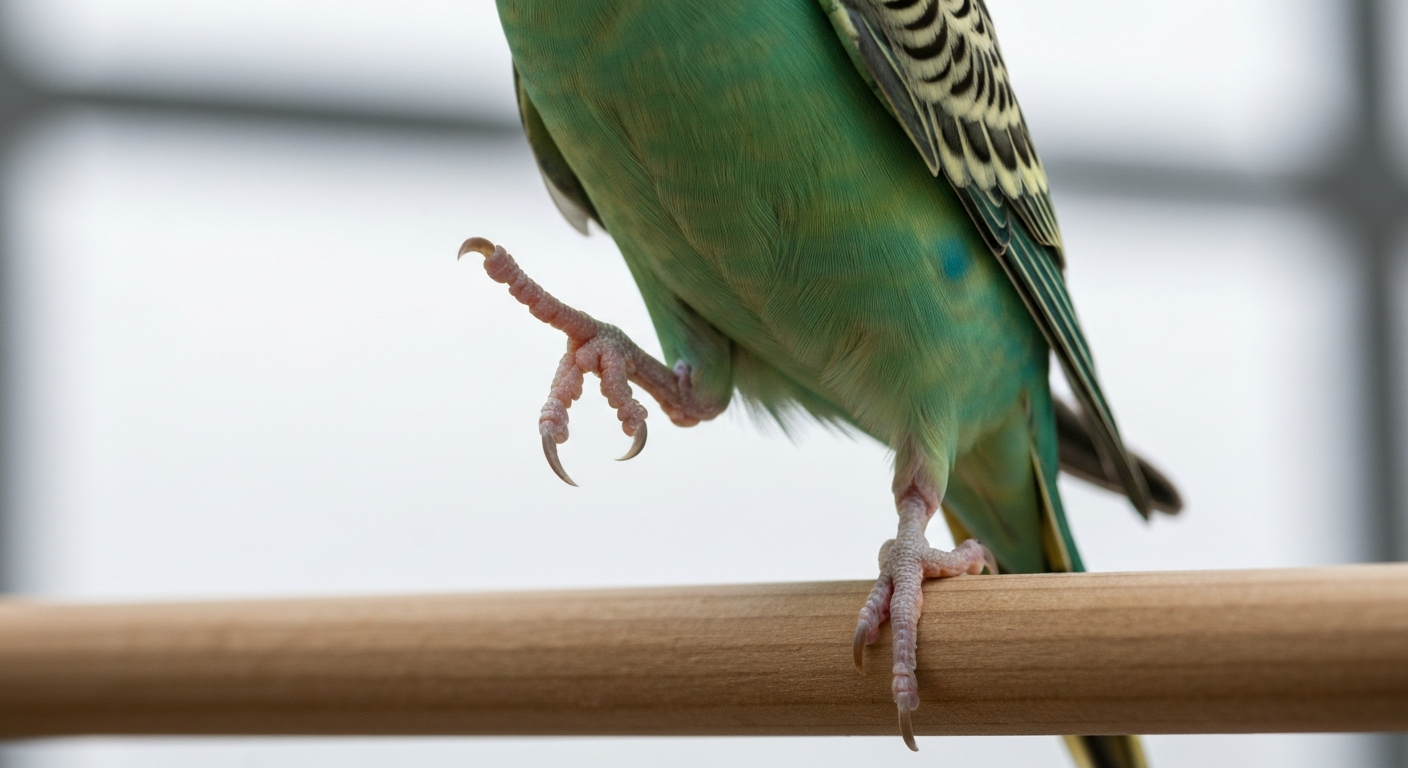
Shuffling is a low-amplitude, repetitive foot movement that a bird makes without actually traveling. Think of a budgerigar shifting its weight back and forth on a dowel, or a pigeon making tiny side-steps before settling on a ledge. The mechanics make sense: birds' feet are precision instruments for grip and balance, and small adjustments are constant.
The most common causes of shuffling in healthy birds are perch adjustment (finding a more comfortable grip), thermoregulation (shifting to expose one foot to warmth), social positioning in a flock or cage with multiple birds, and mild excitement before feeding. Shuffling can also appear as a displacement activity: an ethological term for a behavior that emerges in conflict or frustration situations. If a parrot wants out of its cage but is not being let out, it may pace and shuffle as a way of channeling that tension.
When shuffling warrants attention is when it is combined with other signs: favoring one foot, holding one leg up, grinding the beak, or showing visible swelling around the foot or leg. Foot problems (bumblefoot, gout, arthritis) and leg injuries can all cause a bird to shift weight in ways that look like shuffling but are actually compensatory postures.
- Common in: budgerigars, cockatiels, pigeons, corvids, sparrows
- Normal triggers: perch adjustment, excitement, displacement stress
- Watch for: asymmetric weight-bearing, swollen joints, reluctance to use one foot
- Action: if shuffling is accompanied by any lameness sign, consult an avian vet
Behavior profile: bird hopping
Hopping is the default ground locomotion for most small passerines (perching birds). Because their legs are set close together and adapted for gripping branches rather than striding, a two-footed jump is biomechanically more efficient for them than walking. Sparrows, robins, thrushes, and finches all hop; crows and starlings tend to walk or stride. This is a taxonomic difference, not a health signal.
Beyond locomotion, hopping has communicative functions. Rapid, high hops in a small bird near a perceived threat often signal alarm, sometimes coordinated with a sharp call. In corvids, exaggerated sideways hops and bows are part of courtship and play. In pet parrots, enthusiastic hopping between perches is usually a sign of excitement and good health.
A hopping pattern to watch for is asymmetric hopping: the bird favoring one side, landing heavily on one foot, or hopping in tight circles. Circling combined with a head tilt can indicate a vestibular or neurological problem. A wild bird hopping on the ground that does not fly when approached may have an injury and should be assessed by a wildlife rehabilitator rather than handled by an untrained person.
Hopping is a close companion behavior to shuffling, and the two often appear together when a bird is actively foraging or adjusting its position. If you want to explore the nuances of hopping as its own topic, there is dedicated coverage of bird hopping meaning in a related article on this site.
Behavior profile: shaking or shaking tail feathers
A full-body shake or tail-feather shake after bathing or preening is one of the most normal things a bird can do. The mechanical purpose is well understood: shaking dislodges water or dust particles, helps realign the microscopic barbules that give feathers their structure, and redistributes preen oil from the uropygial gland. Think of it as a bird's version of toweling off.
In courtship contexts, tail-shaking takes on a display function. Male house sparrows and many finches fan and quiver their tails to advertise fitness to potential mates. Peacocks are the obvious extreme example, but the underlying principle (tail display as a fitness signal) shows up widely across species. In wren species, frequent tail cocking and flicking also serves as a vigilance signal; ethological research has shown that tail-flicking rates increase when birds are closer to predators or at the edge of cover, making the tail a real-time alarm flag. Comparative reviews and meta‑analyses (see Anti‑Predator Signals (meta‑analysis & discussion)) conclude tail‑flicking commonly correlates with vigilance, distance to cover, and predation risk, supporting its interpretation as an adaptive alarm signal rather than a single universal function.
Displacement shaking is the version that can indicate stress. If a bird abruptly shakes or preens in the middle of an interaction with a person, another bird, or a new object in its environment, this is a recognized displacement behavior: the animal is in mild conflict and the grooming action serves as a tension release. It is not an illness sign on its own, but repeated displacement grooming in a pet bird is a cue to look at its environment and stress levels.
- Post-bath or post-preening shake: normal feather maintenance, seen in virtually all birds
- Courtship tail display: normal; usually accompanied by vocalizations and posturing
- Vigilance tail flicking: adaptive signaling behavior, especially at cover edges
- Displacement shaking: stress indicator; not illness but worth addressing environmentally
- Concern sign: shaking combined with feather loss, skin lesions, or excessive scratching could indicate ectoparasites or feather-destructive behavior in psittacines
For a deeper look at what tail movements specifically communicate across contexts, see the related articles on bird shaking tail feather meaning and bird tail meaning on this site.
Behavior profile: tail bobbing while breathing
This is the behavior that carries the most clinical weight, and it is worth being very specific about what it looks like. Respiratory tail bobbing is a rhythmic, up-down pumping of the tail that happens in sync with every breath the bird takes. Clinical guidance such as Avian Respiratory Diseases (ISVMA clinical bulletin) states that respiratory tail‑bobbing is rhythmic and synchronized with each breath and typically occurs with other illness signs, distinguishing it from brief communicative tail movements. You can time it: if the tail moves once per breath cycle and does not stop when the bird is calm and at rest, that is the pattern described in avian medicine texts as a sign of dyspnea (labored breathing). Birds use abdominal and tail muscles to assist breathing when their respiratory system is under strain, which is why the tail becomes a visible indicator.
The Merck Veterinary Manual and BSAVA avian medicine references both list persistent tail bobbing alongside open-mouth breathing and audible respiratory sounds as key triage signs that should prompt veterinary evaluation. In pigeons specifically, owners and vets frequently flag rhythmic tail bobbing as a marker of lower respiratory disease, often accompanied by nasal discharge or clicking sounds.
For parrots, the picture is slightly more nuanced. A parrot that bobs its tail vigorously while vocalizing, playing, or just after exercise may simply be catching its breath, the way you would breathe harder after climbing stairs. A parrot whose tail is bobbing steadily while it sits quietly, especially in the morning or overnight, is showing a different pattern. Avian vets specifically mention this resting-state tail bob as a reason to book an appointment rather than wait and see.
For small songbirds like sparrows or finches, the same principle applies but the movements are faster and subtler. Because small birds have higher resting respiratory rates, a mild bob can be easy to miss or dismiss. The best approach is to watch the bird for a full minute in a calm state and ask whether the tail is moving with every breath or only occasionally.
There is also a neurological overlap worth mentioning: some tail tremors and repetitive tail movements stem from neurological conditions rather than respiratory ones. The distinguishing feature is rhythm. Respiratory bobbing is metronomic and breath-linked; neurological tremors tend to be irregular, may affect other body parts, and are not reliably timed to the breath cycle. If you are unsure, a short video recorded at close range (see the documentation section below) is the single most useful thing you can provide a vet.
The related article on bird tail bobbing when breathing on this site goes deeper into the respiratory physiology behind this sign if you want more detail.
Behavior profile: bird twitching
Twitching covers a wide range, from a totally normal muscle startle to a serious neurological event, and the word itself is not precise enough to act on without more context. In casual observation, a bird may twitch because it heard a sudden sound, because a feather is irritating its skin (causing a brief flick or tremble), or because it is in light sleep. These are benign. A brief, full-body fluff-and-shake when a bird wakes up is often described as a twitch but is actually a normal arousal behavior.
Focal twitching (one limb, one side of the face, repetitive head jerking) is medically more significant. Avian medicine texts distinguish these as possible focal seizures, which can result from toxin exposure, heavy-metal poisoning, hypocalcemia, infectious encephalitis, or metabolic disease. A 2025 review in Frontiers in Veterinary Science specifically lists organophosphates, heavy metals, and some plant and algal toxins among the causes of tremors and twitching in birds, which is relevant for wild birds found near agricultural land or contaminated water.
If you observe a bird with repeated, involuntary, focal twitching that does not stop after a few seconds, or a bird going through what looks like a convulsive episode, the appropriate response is the same regardless of species: minimize stress on the bird, do not try to restrain it unless it is in immediate danger, and contact a wildlife rehabilitator for wild birds or an avian vet for pet birds as quickly as possible.
- Harmless: brief startle twitch, sleep twitch, single feather-adjustment flick
- Monitor: occasional head or wing tremor without other signs in an otherwise healthy bird
- Urgent: repetitive focal twitching, full-body tremors, loss of balance, convulsive episodes
- Key differentials: toxin exposure, calcium deficiency, infectious disease, neurological lesion
- Action: video the episode if safe to do so, then contact a vet or rehabilitator
For a focused exploration of this behavior, the bird twitching meaning article on this site covers the medical and observational details in greater depth.
Understanding tail meaning: balance, signal, and survival
The bird's tail is a multi-purpose structure, and understanding its functions helps make sense of why it moves so much. Structurally, the tail feathers (rectrices) are anchored to a fused set of tail vertebrae called the pygostyle and are controlled by a network of small muscles that allow rapid, precise movement in multiple directions.
For balance, the tail acts as a counterweight and rudder, especially during landing and perch transitions. For signaling, it is a visual flag: fanned tails signal alarm or dominance; cocked or raised tails in wrens and wagtails may advertise fitness or convey vigilance. For thermoregulation, birds can press the tail against a surface to trap warmth or fan it to release heat. For grooming, the tail feathers are regularly worked through the bill, and the whole tail is the most direct route between the uropygial gland and the rest of the plumage.
Ethological studies, including a widely cited 2007 study on Eurasian moorhens by Randler, show that tail-flicking rates correlate with predation risk: birds flick more when predators are near or when they are at the exposed edge of cover. This means a bird flicking its tail near you is not necessarily distressed; it may be communicating awareness. The tail meaning article on this site goes into the signaling functions in more detail if you want the full picture. For a focused explanation, see the bird tail meaning page (ID 255b9a88-bb62-46ba-ac44-f5a8d036437c) for a detailed discussion of balance, signaling, and thermoregulation.
What does 'bird trunk' mean? Sorting out an ambiguous phrase
Unlike the other terms in this article, 'bird trunk' does not have a single agreed meaning in ornithology, veterinary medicine, or common birding usage. When I see this phrase used, it typically falls into one of four categories, and working out which one applies requires a few follow-up questions.
- The bird's torso or body: The most literal reading. 'Bird trunk' can simply mean the main body of the bird (excluding head, wings, and tail), used in anatomical descriptions or art references. This is common in informal writing and educational materials aimed at children.
- The trachea or upper airway: Some older or non-specialist texts use 'trunk' loosely to describe the trachea (windpipe) or the general airway pathway in birds. If the context is medical (breathing problems, blockage, surgery), this is probably the intended meaning.
- The crop or esophageal region: In poultry and aviculture, the area around the crop (a muscular sac in the esophagus where food is temporarily stored) is sometimes described informally. If the query is about a bulge, lump, or swelling at the base of a bird's neck, the crop is the likely reference.
- A misheard or mistyped phrase: 'Bird trunk' could be a mishearing of 'bird trachea', 'bird torso', or even 'bird funk' (an informal term used in some birder communities for a musty plumage odor during molt). Asking what prompted the question almost always clarifies this.
If you are researching bird trunk for a writing project, the safest approach is to specify what part of the bird you mean: body, airway, crop, or something else entirely. The related article on bird trunk meaning on this site examines these interpretations in more detail and may help you pin down the right terminology.
Quick reference table: behaviors, causes, symptoms, and next steps
| Behavior | Likely causes | Watch for (red flags) | Suggested next steps |
|---|---|---|---|
| Bird shuffling | Perch adjustment, balance, excitement, displacement stress, foot discomfort | Asymmetric weight-bearing, swollen foot or leg, reluctance to use one foot | Observe; consult avian vet if lameness signs are present |
| Bird hopping | Normal locomotion (passerines), alarm, play, courtship | Circling, head tilt, inability to fly when approached (wild bird) | If bird cannot escape, contact wildlife rehabilitator |
| Shaking tail feathers | Post-bath maintenance, courtship display, vigilance, displacement stress | Feather loss, skin lesions, excessive self-directed scratching | Observe; check for ectoparasites or feather-destructive behavior in parrots |
| Tail bobbing (breathing-linked) | Respiratory distress (dyspnea), lower respiratory disease, systemic illness | Synchronized with every breath, open-mouth breathing, wheezing, lethargy | Veterinary evaluation urgently if persistent at rest |
| Tail bobbing (non-respiratory) | Balance correction, landing, courtship display, excitement | Not synchronized with breath, stops when bird is calm | Normal; observe context |
| Bird twitching | Startle reflex, sleep twitch, feather irritation (harmless); toxins, hypocalcemia, infection, seizure (serious) | Focal and repetitive, loss of balance, convulsive episodes | Video the behavior; contact avian vet or wildlife rehabilitator promptly |
| Bird twitching (tracheal/neurological overlap) | Neurological tremor (irregular, multi-site) vs respiratory bob (rhythmic, breath-linked) | Irregular timing, affects multiple body parts, not breath-linked | Veterinary diagnosis needed to differentiate |
| Bird trunk (ambiguous) | Torso anatomy, trachea/airway reference, crop region, misheard phrase | Crop impaction (firm lump at base of neck), respiratory obstruction signs | Clarify which body part is meant before acting |
How to photograph and record bird behavior for reporting
A short video is almost always more useful than a written description when you are trying to get help for a bird, whether from a vet, a wildlife rehabilitator, or an online identification community. Here is a practical approach based on established ethological recording guidelines.
- Film for at least 60 seconds continuously without zooming in and out. One steady, close shot is better than multiple short clips with camera movement.
- Capture the bird's whole body in frame, not just the area of concern. Vets and rehabilitators want to see posture, perching behavior, and eye brightness, not just a tail or a foot.
- Note the time of day, temperature, and what the bird was doing immediately before the behavior started. Context matters enormously.
- Record whether the behavior is constant, episodic (comes and goes), or was triggered by something specific like a sound, another bird, or being disturbed.
- For respiratory assessment specifically, film the bird at rest and try to capture both the chest and tail in frame. Count the tail bobs per 10 seconds if you can; this helps a vet assess severity.
- Add metadata to the file: date, time, species if known, and location (general, not precise, for privacy). Free tools like BORIS (Behavioral Observation Research Interactive Software) allow timestamped event-logging if you are doing more systematic observation.
- Sample caption for a rescue report: 'Adult male house sparrow, observed 08:45, 12 July 2026, urban garden. Resting on fence post. Tail bobbing approximately once per second for 4+ minutes. Did not fly when approached within 1 meter. No audible respiratory sounds captured on this clip.'
Good documentation protects both you and the animal: it gives the professional enough information to triage remotely, which can save a bird's life when in-person evaluation is not immediately available.
Cultural, idiomatic, and symbolic interpretations
Bird movements have attracted symbolic meaning across many cultures, and it is worth including these interpretations here, with the important caveat that they are cultural constructions layered onto natural behaviors, not ornithological facts. Knowing both layers makes you a more accurate writer and a more thoughtful interpreter.
In various folk traditions, a bird shuffling or hopping in place near a person has been read as a sign of restlessness, impending change, or a message trying to be delivered. In some European and Indigenous North American traditions, an unusually calm or persistent wild bird is interpreted as a messenger from ancestors or the spirit world. These readings draw meaning from the bird's apparent lack of fear, not from the behavior itself being biologically significant.
Tail-shaking and feather-displaying birds appear repeatedly in literature and poetry as symbols of vanity, pride, or courtship. The peacock's tail display is the obvious archetype, but magpies, lyrebirds, and birds of paradise appear in similar symbolic roles across Asian, European, and Oceanic cultures. In dream interpretation traditions (particularly those drawing on Jungian frameworks), a bird shaking or ruffling its feathers is sometimes read as a symbol of shedding old patterns or releasing tension, though these readings are explicitly interpretive and not universally shared.
The key rule for writers using these interpretations is transparency: label them as cultural or symbolic readings when you use them, and avoid conflating a folk meaning with a behavioral or medical fact. A bird with respiratory distress is not sending a spiritual message; it needs a vet. Keeping that distinction clear is what separates good nature writing from misleading content.
When to call a vet or wildlife rehabilitator
For pet birds, the threshold for calling an avian vet should be lower than most owners assume. Birds are prey animals and instinctively hide illness; by the time clinical signs are obvious, the condition is often advanced. The following signs in a pet bird warrant same-day or next-day contact with an avian vet: persistent tail bobbing at rest, open-mouth breathing, noisy or wheezy respirations, collapse or inability to perch, discharge from the nares (nostrils) or eyes, sudden behavior change, and any neurological sign including focal twitching, head tilt, or loss of balance.
For wild birds, the rule of thumb is: a bird that can fly is generally fine and should be left alone. A wild bird that cannot fly, is being approached easily by people or pets, is lying on its side, or is showing any of the respiratory or neurological signs above should be assessed by a licensed wildlife rehabilitator. Do not attempt to feed or medicate a wild bird yourself. Confine it gently in a ventilated box in a quiet, dark place and contact your local rehabilitator or wildlife rescue organization.
- Pet birds: contact an avian-specialist vet (not a general practice vet if avian-certified care is available) for any persistent or unexplained behavior change
- Wild birds: contact a licensed wildlife rehabilitator; in the US the National Wildlife Rehabilitators Association (NWRA) and the Wildlife Center of Virginia maintain referral directories
- Observation-only situations: a bird that is behaving actively, flying normally, foraging, and not showing any red-flag signs from the checklist above does not need intervention
- When in doubt, document first (video), then call for advice before attempting to handle the animal
Further reading worth bookmarking
If you want to go deeper on any of the topics covered here, these are the categories of resources that will give you reliable, evidence-based information.
- Tail signaling and anti-predator behavior: look for Randler (2007) on Eurasian moorhens in the journal Ethology; broader meta-analyses of tail flicking as anti-predator signals are available in behavioral ecology literature
- Preening and feather maintenance: the Journal of Avian Biology publishes regular research on grooming; the 2025 rock pigeon molt study is a good starting point for molt-related maintenance behavior
- Respiratory distress in birds: the Merck Veterinary Manual (freely available online) has clear owner-facing sections on illness signs in pet birds; the BSAVA Manual of Psittacine Birds covers psittacine respiratory disease for more clinical detail
- Bird behavior documentation methods: Altmann (1974) in Animal Behaviour is the foundational reference for sampling methods; BORIS software (free, open-source) is the practical tool for timestamped video coding
- Avian toxicology: the 2025 Frontiers in Veterinary Science review on avian toxicoses covers heavy metals, organophosphates, and other causes of neurological signs
- Symbolism and cultural meanings: for scholarly treatment of bird symbolism in world cultures, look for titles in comparative mythology, ethno-ornithology, and dream symbolism; always cross-check folk interpretations against natural-history sources
The quick takeaway (and a mini-checklist to save)
Bird shuffling is almost always a normal postural adjustment, but the phrase sends people looking for answers because bird movement in general sits at the intersection of natural behavior, health concern, and symbolic meaning. The most important distinctions are: tail bobbing that is synchronized with every breath at rest is a clinical sign worth acting on; shaking and shuffling after bathing or landing are routine maintenance; twitching that is focal, repetitive, or escalates to convulsion needs veterinary attention; and 'bird trunk' needs clarification before you can interpret it. Cultural and symbolic readings of these behaviors are real and interesting, but they belong in a different interpretive lane from ornithological or medical assessment.
Here is a printable mini-checklist to keep near your bird or take into the field:
- Is the tail bobbing with every breath at rest? YES = call vet today
- Is the bird breathing with mouth open or making sounds? YES = call vet urgently
- Is twitching focal, repeated, or causing loss of balance? YES = call vet or rehabilitator
- Did the movement happen after bathing, preening, or landing? Probably normal
- Is the bird eating, drinking, flying, and alert? Probably fine; keep observing
- Wild bird that will not fly when approached? Contact wildlife rehabilitator
- Unsure? Film 60 seconds of continuous video, then call for advice
FAQ
What does the phrase "bird shuffling" usually mean?
"Bird shuffling" is an informal, catch‑all description people use when they see a bird make small, repetitive shifts in posture or foot/leg movements, often while standing or moving slowly. It can refer to (a) short hopped steps or sideways weight shifts used to reposition feet, (b) small body‑or tail movements during balance or preening, or (c) a series of tiny steps when a bird moves along a perch or the ground. The term is nontechnical — to interpret it you need context (activity, species, environment, presence of other signs).
How is "bird shuffling" different from "bird hopping" or "bird walking"?
Hopping: one or both feet leave the substrate in distinct jumps (common in sparrows, pigeons). Walking/stepping: alternating foot placement with clear forward progress (seen in many ground‑foraging species). Shuffling: smaller, slower weight shifts or short sliding steps without clear progress; may be for balance, cautious approach, or when perching on narrow surfaces. Watch whether movements are deliberate (foraging, balance) or awkward/weak (possible illness).
What does "shaking tail feathers" or full‑body feather‑shaking indicate?
Brief, vigorous feather‑shaking is a normal maintenance behavior used to realign barbs and remove dust or water after bathing or preening. It also redistributes preen oil. Repeated shaking outside preening/bathing contexts can reflect agitation, displacement activity under stress, or occasionally irritation (mites). If shaking is constant, injurious, or paired with poor feather condition, investigate health or parasite causes.
What is "tail bobbing" and why is it important?
Tail bobbing is a rhythmic up‑and‑down motion of the tail synchronized with respiration. It is an established clinical sign of respiratory distress (dyspnea) in birds. Persistent tail bobbing at rest, especially with open‑mouth breathing, noisy breathing, fluffed posture, lethargy, or nasal discharge, should prompt urgent veterinary evaluation. Short, occasional tail flicks during movement or alert postures are usually normal signalling, not bobbing from respiratory effort.
How can I tell normal tail movement (communication, balance) from a health warning?
Use context and associated signs. Normal: brief flicks or pumps tied to alertness, predator presence, courtship, or preening; bird is active, responsive, perching normally, feeding. Concerning: rhythmic tail bobbing matching breaths, open‑mouth breathing, wheeze or crackle sounds, fluffed feathers, decreased appetite, inability to perch, bluish mucous membranes. If in doubt and tail bobbing is persistent at rest, seek veterinary care.
What does "bird twitching" mean and when is it a problem?
Twitching can mean transient muscle jerks (e.g., a head bob, leg twitch, or localized feather twitch) that are often harmless (startle, minor irritation, preening reflex). However, persistent, focal twitching or generalized tremors/seizure‑like activity may indicate neurologic disease, toxin exposure, hypocalcemia, metabolic disorder, or infectious encephalitis. Red flags: repeated uncontrolled jerks, altered consciousness, collapse, inability to stand, or other systemic signs — these require veterinary assessment.