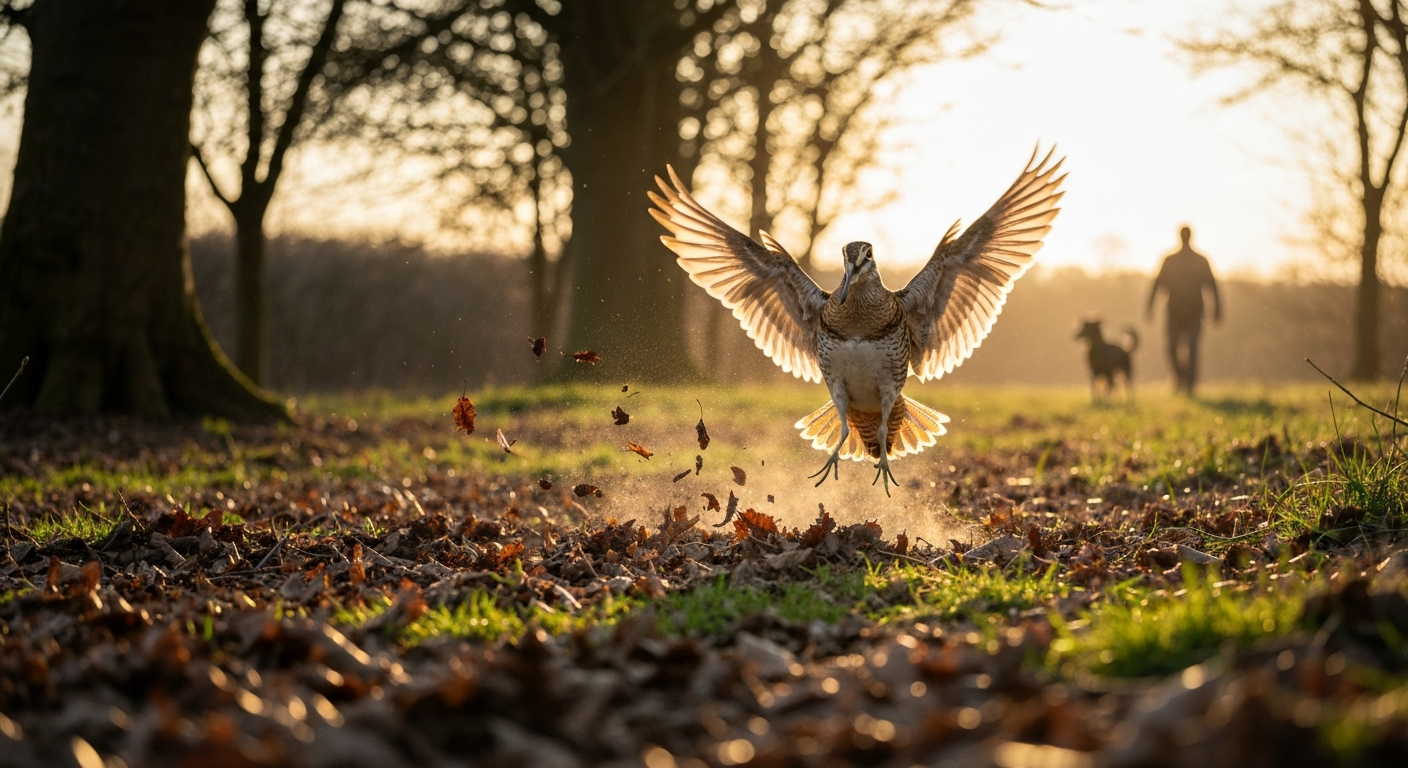
Bird flushing means the sudden, explosive takeoff of a bird from its resting or hiding place, usually triggered by an approaching threat. Whether a pheasant bursts from a hedgerow ahead of a spaniel, a woodcock rockets up from leaf litter underfoot, or a shorebird springs off a mudflat as you round a bend, that startling eruption of wings is what ornithologists, hunters, and birdwatchers all call a flush. The word works both ways: a bird can flush on its own, or a person, dog, or predator can flush it.
Bird Flushing Meaning: Causes, Cues, Examples & Ethics

Marcus Holloway
7 Aug 2026
What "bird flushing" actually means
At its core, flushing describes a bird leaving cover suddenly and rapidly, almost always in response to a perceived danger. Merriam-Webster records the verb sense 'to cause a bird to fly up suddenly from cover,' and both Oxford and Cambridge dictionaries confirm the same meaning, noting that the bird itself can 'flush' (spring up spontaneously) or be flushed (driven up by an outside agent). For the specific term 'bird choch', see bird choch meaning in english. The word traces back to early Modern English, where 'flush' carried the sense of a sudden, springing movement, which is exactly why it attached itself to the hunting vocabulary and eventually to scientific ornithology.
So the definition is simple: a flush is an abrupt, fear-driven escape flight from a resting position, cover, or feeding area. It is not the same as a bird simply flying off after finishing a meal or shifting perches. The distinguishing feature is urgency, that split-second snap from stillness into full wing-beat, and it signals that the bird has crossed its personal threshold of acceptable risk.
Why birds flush: causes and the visual cues that come first
Researchers studying escape behavior use the term Flight-Initiation Distance, or FID, to measure flushing precisely. FID is simply the distance between the approaching threat and the bird at the exact moment it takes off. A large body of work, including a widely cited meta-analysis by Stankowich and Blumstein synthesizing 61 studies, identifies the strongest predictors of a longer FID: a faster or larger approaching threat, a more direct line of approach, and a greater distance to the nearest refuge. In plain terms, a bird flushes earlier when the danger looks serious and escape looks urgent.
The theoretical backbone comes from optimal escape theory, first formalized by Ydenberg and Dill in 1986. The idea is essentially economic: a bird weighs the cost of abandoning what it is doing (lost feeding time, energy spent flying) against the risk of staying put. When the threat tips the balance, the bird flushes. Habituation matters too; urban birds regularly exposed to humans have measurably shorter FIDs than their rural counterparts because they have learned that most people are not actually predators.
Before the actual flush, most species show a recognizable alert phase. Ethogram elements commonly cited as pre‑flight alert cues include head‑up posture, cessation of feeding, neck‑extension scanning, wing‑flick or 'wing‑flutter' displays, and brief body freezes (Fine‑scale tracking reveals visual field use for predator detection and escape in collective foraging of pigeon flocks - PMC) blank" rel="noopener noreferrer">Fine‑scale tracking reveals visual field use for predator detection and escape in collective foraging of pigeon flocks - PMC (reviews vigilance and alert cues). Researchers call this the blank" rel="noopener noreferrer">Alert Distance (AD), the point at which a bird first detects and reacts to a threat without yet flying. Knowing these pre-flush cues is genuinely useful in the field.
- Head raised sharply and turned toward the disturbance
- Cessation of feeding or preening mid-movement
- Neck extended into a stiff, upright scan posture
- Body freeze or crouching just before launch
- Wing-flick or brief flutter without taking off
- Alarm calls, chirps, or alarm chips directed at the threat
If you notice any of these cues while approaching a bird, you are already inside its alert distance. Slow down or stop; you may still have time to observe before triggering a full flush.
Why flushing matters biologically and ecologically
Flushing is an adaptive survival behavior, not a panic reflex. The explosive takeoff interrupts a predator's attack sequence, creates unpredictability (a zig-zagging snipe is genuinely hard to catch), and moves the bird rapidly out of a danger zone. The cost is real: a flushed bird burns significant energy, abandons food, may leave eggs or chicks unguarded, and can end up in less familiar territory. This is precisely why birds have evolved to tolerate some level of threat before flushing rather than launching at every leaf that rustles.
Ecologically, repeated flushing from human disturbance carries documented consequences. Birds flushed repeatedly from feeding areas lose foraging time and body condition, particularly in winter when energy reserves are tight. Nesting birds flushed repeatedly may abandon nests or leave eggs exposed to temperature extremes and nest predators. Wildlife managers use published FID databases to set recommended buffer distances around sensitive habitats, effectively translating the science of flushing into practical land-use policy.
Classic flushers: species and context examples
Flushing behavior looks different across bird groups, and knowing what to expect from common species makes field encounters far more meaningful.
Gamebirds
The American Woodcock is one of the most quoted examples in both hunting literature and birding guides. This cryptically patterned bird sits so still on the forest floor that, as field accounts consistently note, it is typically noticed only after it flushes a few feet away, rocketing upward through the canopy on whistling wings. Wilson's Snipe (and common snipe) are equally celebrated for their flush: when driven from sedge marsh or wet meadow, they explode upward in a sharp zig-zag accompanied by a rasping 'scaipe' call, a pattern so erratic it gave rise to the word 'sniper.' Pheasants, quail, grouse, and partridges all belong to the classic gamebird flushing tradition, typically running ahead of a threat before choosing the moment to burst upward rather than flushing immediately.
Shorebirds
Shorebirds like dunlin, godwits, and sandpipers often flush in coordinated flocks, wheeling in tight, synchronized formations. A lone walker on a mudflat can send hundreds of birds into the air simultaneously. Waders that nest on the ground, such as lapwings and killdeer, combine flushing with distraction displays, feigning injury to draw threats away from nests before eventually taking flight.
Songbirds and other species
Songbirds flush from hedgerows, tall grass, and reed beds. Rails and bitterns in wetlands are notorious for flushing almost underfoot after sitting motionless for extraordinary amounts of time. Raptors perched on fence posts or tree limbs flush at longer distances, reflecting both their larger body size and their need to assess threats from exposed positions. The pattern holds across taxa: body size, habitat, proximity to cover, and prior experience with humans all shape an individual bird's flushing threshold.
How ornithology, birdwatching and hunting each use the term
The word 'flush' appears across three distinct professional and recreational traditions, and each uses it with slightly different emphasis.
In ornithology and behavioral ecology, flushing is measured, not just described. FID values are collected systematically, entered into databases, and used to calculate setback distances for infrastructure projects, trails, and recreation management. Survey methods explicitly account for flushing as a detection event and as a potential source of bias: if a bird flushes and moves before a surveyor counts it, the count is compromised. Point-count and distance-sampling methodologies include protocols for recording whether a detection was visual, auditory, or a flush, precisely because the type of detection affects the statistical analysis.
Birdwatchers use 'flush' conversationally to describe any sudden departure triggered by disturbance, their own included. 'I flushed a rail out of the reeds' or 'the heron flushed before I could get a good look' are standard entries in field notes. The vocabulary helps distinguish an undisturbed flight from one cut short by a human presence, which matters for honest record-keeping and site assessment.
In hunting, flushing is both a goal and a craft. Flushing dog breeds, primarily spaniels, are trained specifically to push birds from dense cover into the air within shooting range and then hold steady after the shot. Hunting literature distinguishes flush-and-retrieve work, where the dog does both jobs, from pointer and setter traditions where the dog freezes and signals the bird's location for the hunter to approach and flush. Walk-pause-walk survey techniques in wetland bird monitoring borrow directly from this hunting tradition, using the same principle of deliberate movement and stillness to provoke and standardize flush responses.
Symbolism, dreams and idiomatic echoes of flushing
Bird flushing does not carry a rich independent tradition in folklore or dream interpretation the way that, say, an owl at the window or a robin at the door does. That is worth saying plainly, rather than inventing symbolism where little exists. What the act of flushing does carry is a general cultural resonance around sudden revelation and startled awareness that appears across metaphorical language. The phrase 'flushed out,' as in revealing something hidden, draws directly on the bird-hunting sense: you flush a bird from cover, and you flush out a secret or a fugitive from concealment.
In dream interpretation literature, birds taking sudden flight are sometimes read as symbols of alarm, urgent change, or suppressed anxiety breaking through into conscious awareness. These are folklore-level interpretations rather than empirically validated claims, and they vary widely across cultural traditions. A sudden flush of birds in a dream might be read as a warning in one tradition and as liberation in another. The honest approach is to treat dream symbolism as personal and culturally contingent rather than universal.
Idiomatically, the hunting sense of 'flush' bleeds into broader English in phrases like 'flush out the truth' or 'flush someone out of hiding.' The word also connects to its other common meanings (blushing, a rush of water, a run of good cards), all of which share the underlying sense of a sudden surge or revelation. Writers reaching for bird imagery to convey sudden exposure, startled awareness, or a moment of involuntary action will find 'flush' a surprisingly versatile term.
Bird flushing alongside related bird terms
Flushing is one of many bird-specific terms that blend behavioral description with cultural meaning. See bird cloaca meaning for a brief explanation of the cloaca, the single posterior opening birds use for excretion and reproduction. The table below places it beside the related terms covered elsewhere on this site, giving you a quick orientation to how they differ.
| Term | Primary meaning | Domain | Cultural/symbolic weight |
|---|---|---|---|
| Flushing | Sudden escape flight triggered by a threat | Behavior / hunting / ornithology | Moderate: 'flushed out' as idiom for revelation |
| Flutter | Rapid, often low-amplitude wing movement; trembling flight | Behavior / general usage | High: excitement, anxiety, romantic agitation |
| Flirting (bird) | Courtship displays including wing-spreading, tail-fanning, posturing | Behavior / courtship | High: directly parallels human romantic meaning |
| Craw | The crop or gullet; early stage of a bird's digestive system | Anatomy / idiom | Moderate: 'sticks in my craw' (irritation) |
| Regurgitation | Returning partially digested food to feed chicks or expel pellets | Physiology / behavior | Low: mainly biological; some cultural disgust associations |
| Cloaca | Single posterior opening for digestive, urinary and reproductive tracts | Anatomy | Low: primarily anatomical; occasionally used humorously |
| Choch | Uncertain or informal term; meaning varies by regional/slang context | Informal / regional | Unclear: definition disputed or context-dependent |
Flutter is probably the term most likely to be confused with flushing in casual description; a flushing bird flutters its wings, but a flutter does not necessarily mean a flush. See bird flutter meaning for a clear comparison between flushing and fluttering. Bird flirting covers a range of courtship behaviors that can superficially resemble flushing, since both involve dramatic wing and body movements, but courtship displays are directed toward a potential mate rather than away from a threat. The anatomical terms (craw, regurgitation, cloaca) occupy a completely different register from flushing, describing internal structures and processes rather than escape behavior, though all of them connect to the broader project of understanding what birds actually do and why. For a clear explanation of the bird's craw and its function, see bird craw meaning.
Watching flushed birds well: practical tips and ethical guidelines
The simplest rule is also the most important: if a bird flushes because of you, you were too close. That is useful feedback, not a moral judgment. Most experienced birdwatchers treat a flush as information about their own approach rather than as a birding failure, and adjust accordingly.
In the field
- Approach habitat slowly and at an angle rather than directly, which reduces perceived threat directness and typically increases the distance at which you can observe before triggering a flush.
- Stop moving when you see pre-flush alert cues (head-up, feeding cessation, neck extension). Waiting still for 60 to 90 seconds often lets a bird relax and resume normal behavior.
- Use natural cover, sit quietly against a tree or bank, and let birds come to you rather than pressing forward yourself.
- Keep noise and sudden movements to a minimum, including avoiding bright or contrasting clothing when watching secretive ground birds.
- Record flushes in your field notes, noting the species, what caused it, and the approximate distance. Over time this builds a personal picture of FID thresholds for your local birds.
Ethical and legal considerations
Repeatedly flushing a nesting bird, whether intentionally or not, can cause nest abandonment, egg chilling, or chick exposure to predators. Most countries with bird protection legislation treat deliberate disturbance of nesting birds as an offense, and several extend that protection to roosting sites used by species of conservation concern. In the United States, the Migratory Bird Treaty Act prohibits actions that 'harass' migratory birds, a category that can include deliberate repeated flushing. In practice this means giving nesting areas a wide berth during breeding season, which typically runs from March through July in the Northern Hemisphere, and following any posted buffer zone guidance at managed reserves.
For hunters, flushing is a legal and regulated activity governed by state and national game laws. Legal hunting seasons, bag limits, and species identification rules all apply. Using dogs to flush birds is legal in many jurisdictions but subject to specific regulations; checking current local rules before a hunt is straightforward and mandatory.
For researchers and surveyors, the ethical bar is higher still. Published survey standards require that disturbance be minimized, that flush events be documented rather than ignored, and that repeated visits to the same site be spaced to allow recovery time. If your survey protocol requires deliberately flushing birds (as some rail and secretive marsh bird protocols do), that activity typically requires a research permit in addition to any standard land access permissions.
Quick reference: key flushing terms at a glance
| Term | Definition |
|---|---|
| Flush (verb, intransitive) | A bird springs suddenly into flight from cover or a resting position |
| Flush (verb, transitive) | A person, animal, or stimulus drives a bird into sudden flight |
| Flight-Initiation Distance (FID) | The measurable distance between an approaching threat and the bird at the moment it takes off |
| Alert Distance (AD) | The distance at which a bird first shows behavioral signs of awareness of a threat, before flying |
| Flushing dog | A dog breed (typically a spaniel) trained to push birds from dense cover into the air |
| Flush-and-retrieve | A hunting technique where the dog both flushes the bird and recovers it after the shot |
| Cover | Dense vegetation, brush, or terrain features where a bird hides before flushing |
| Habituation | The process by which birds in regularly disturbed areas develop shorter FIDs through learned tolerance |
FAQ
What is 'bird flushing' in plain language?
'Bird flushing' means causing a bird that was hidden, resting or feeding to take off suddenly from cover. Non‑technical sources (Merriam‑Webster, Oxford, Cambridge) and hunting/field guides use 'flush' to describe that abrupt lift‑off and flight from vegetation, ground cover or marsh.
How do ornithologists and behavioral ecologists define flushing?
In scientific contexts flushing is treated as the moment an animal initiates escape flight and is closely related to 'flight‑initiation distance' (FID) — the distance at which an approaching threat causes a bird to flee. Studies of FID use flushing as an observable, measurable response to perceived risk.
What causes birds to flush — biological and environmental drivers?
Evidence shows flushing is driven by perceived predation risk and balances costs of staying vs. leaving (optimal escape theory). Strong predictors of earlier/longer flush responses include threat speed and directness, proximity to refuge, habitat visibility, and prior experience/habituation to humans.
What visual cues typically precede a flush?
Field studies document consistent pre‑flight cues: head‑up/posture change, cessation of feeding, neck extension and scanning, wing‑flicks or short wing‑flutter, alarm calling and a pause or freeze. Researchers recommend recording 'alert distance' (when these cues start) as well as the flush moment.
How is 'flush distance' or FID measured and used?
Researchers measure the distance between an approaching threat and the bird at first escape (FID). FID data are used to quantify tolerance to disturbance, model risk, design buffer zones for management, and standardize survey methods. Meta‑analyses synthesize many studies to identify general predictors of FID.
Which species are classic examples used to explain flushing?
Secretive ground‑feeding birds like American Woodcock (often 'noticed after they flush a few feet') and marsh species such as Wilson's Snipe (which 'explode' into zig‑zag flight when flushed) are common examples in field guides and hunting literature.