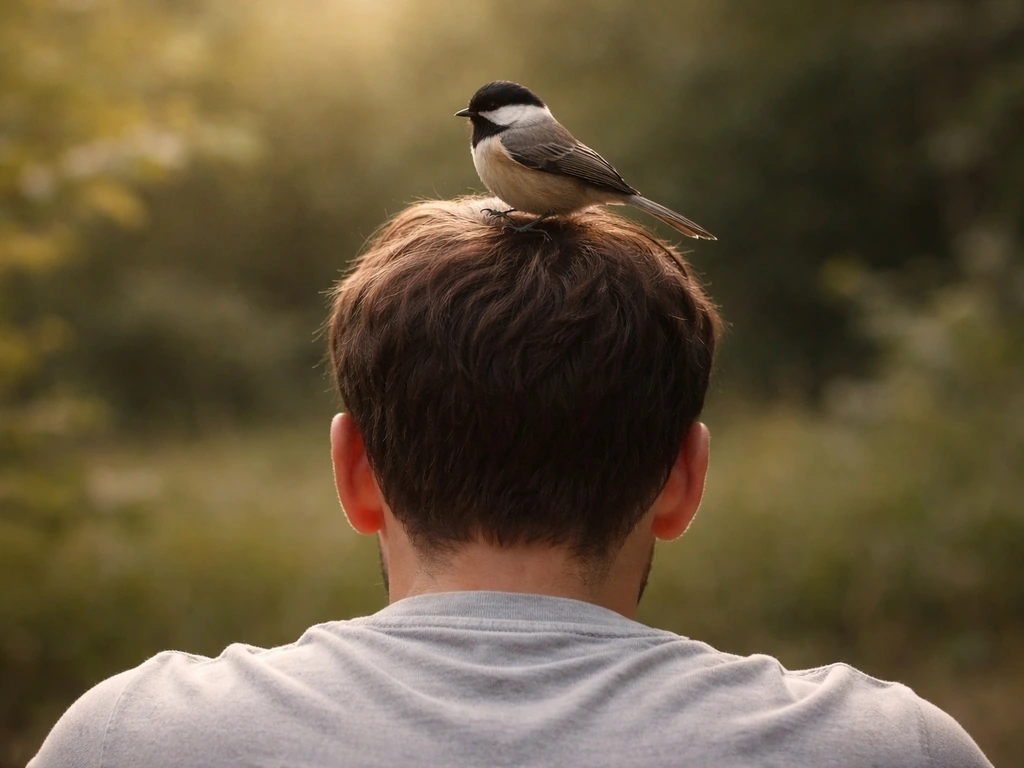
When a bird sits near you, the most common explanation is a straightforward one: the bird is habituated to humans, looking for food, or simply using you as a convenient landmark. Urban and suburban birds like rock pigeons, house sparrows, European starlings, and American robins have spent generations living alongside people and have lost much of the wariness their rural cousins still carry. That said, the encounter carries real weight in dozens of cultural traditions, and there are specific scenarios, a bird landing on your shoulder, sitting on your car, or appearing unusually still and close, that each have their own practical and symbolic explanations worth understanding.
Bird Sitting Near Me Meaning: Why Birds Land by You - Symbolism

Marcus Holloway
21 Jul 2026
What it usually means at a glance
Most birds that sit near you are doing one of a few things: foraging in an area where humans reliably drop or provide food, scouting a warm or elevated perch, asserting territorial presence, or simply moving through a space they no longer find threatening. Research measuring flight-initiation distances (FID), how close a person can get before a bird flies away, consistently shows that urban birds tolerate much closer human approach than rural birds of the same species. This is driven by habituation, food conditioning, individual boldness, and in some cases intergenerational learning in populations that are regularly hand-fed. So if a bird sits unusually close without fleeing, the bird has likely decided you are not a threat, not that the universe has sent you a message (though you're free to hold both ideas at once).
Quick-reference: common scenarios and likely explanations
| Scenario | Most Likely Biological Explanation | Common Cultural or Symbolic Reading |
|---|---|---|
| Bird forages within arm's reach on the ground | Habituated urban species (pigeon, sparrow, starling, robin) seeking food near people | Presence, grounding, or a gentle reminder to stay present |
| Bird lands on your shoulder or arm | Hand-fed or highly habituated individual; tame/escaped pet bird | Personal message, spiritual contact, or blessing in many traditions |
| Bird lands on or near your head | Very bold or hand-raised individual; possibly disoriented or ill | Omen of good fortune or divine attention in folklore |
| Bird sits on your car or pecks at mirror | Territorial male seeing its own reflection; warm surface as a perch | Persistence, stubbornness, or a warning in some folk readings |
| Bird sits near you and pants or holds wings out | Thermoregulation in heat; could indicate heat stress if prolonged | Vulnerability; may also signal distress requiring your help |
| Bird sits very still, fluffed, on the ground | Possible injury, illness, or a fledgling resting between short flights | Stillness and pause; culturally read as a sign to slow down |
| Bird tucks head under wing near you | Normal resting or sleeping behavior, often with one eye open | Peace, trust, or protection in symbolic readings |
| Bird returns to the same spot near you repeatedly | Territorial behavior, reliable food source, or individual recognition | Visitation, remembrance, or an ongoing sign in grief folklore |
Why birds land near people, the biology behind it
The short version is that some birds have co-evolved with human settlements so thoroughly that proximity to people is simply part of their normal ecology. Rock pigeons (Columba livia) originally nested on cliff faces and adapted so well to buildings, bridges, and plazas that urban environments are now their primary habitat across the world. House sparrows (Passer domesticus) are so deeply tied to human activity that they are rarely found far from settlements at all. European starlings, introduced to North America in the 1890s, followed a similar path and are now one of the most abundant birds on the continent, breeding in cavities in buildings and foraging wherever people congregate. European Starling | Audubon Field Guide describes the species as an introduced, highly urban‑tolerant bird that commonly breeds around buildings and in settlements.
Beyond species-level adaptation, individual behavior matters a lot. Studies on flight-initiation distance have found that birds in cities not only tolerate closer approach but that this reduced wariness can be passed on or reinforced across generations in populations that are regularly provisioned with food. Corvids, crows, ravens, jays, magpies, take this further. John Marzluff's research documented in In the Company of Crows and Ravens shows that individual crows can recognize specific human faces, adjust their behavior based on past interactions, and approach people they have learned are safe or generous. A crow sitting near you might genuinely be responding to your identity, not just your species.
American robins offer a slightly different example. They forage almost exclusively on the ground, using lawns and garden beds to hunt earthworms and invertebrates. If a robin is hopping close to you while you dig in the garden, it is exploiting the disturbed soil you're creating, not commenting on your spiritual state. That said, robins can be territorial during breeding season and may approach as a form of assessment rather than comfort.
Scenario by scenario: shoulders, heads, cars, and sitting right next to you
A bird landing on your shoulder
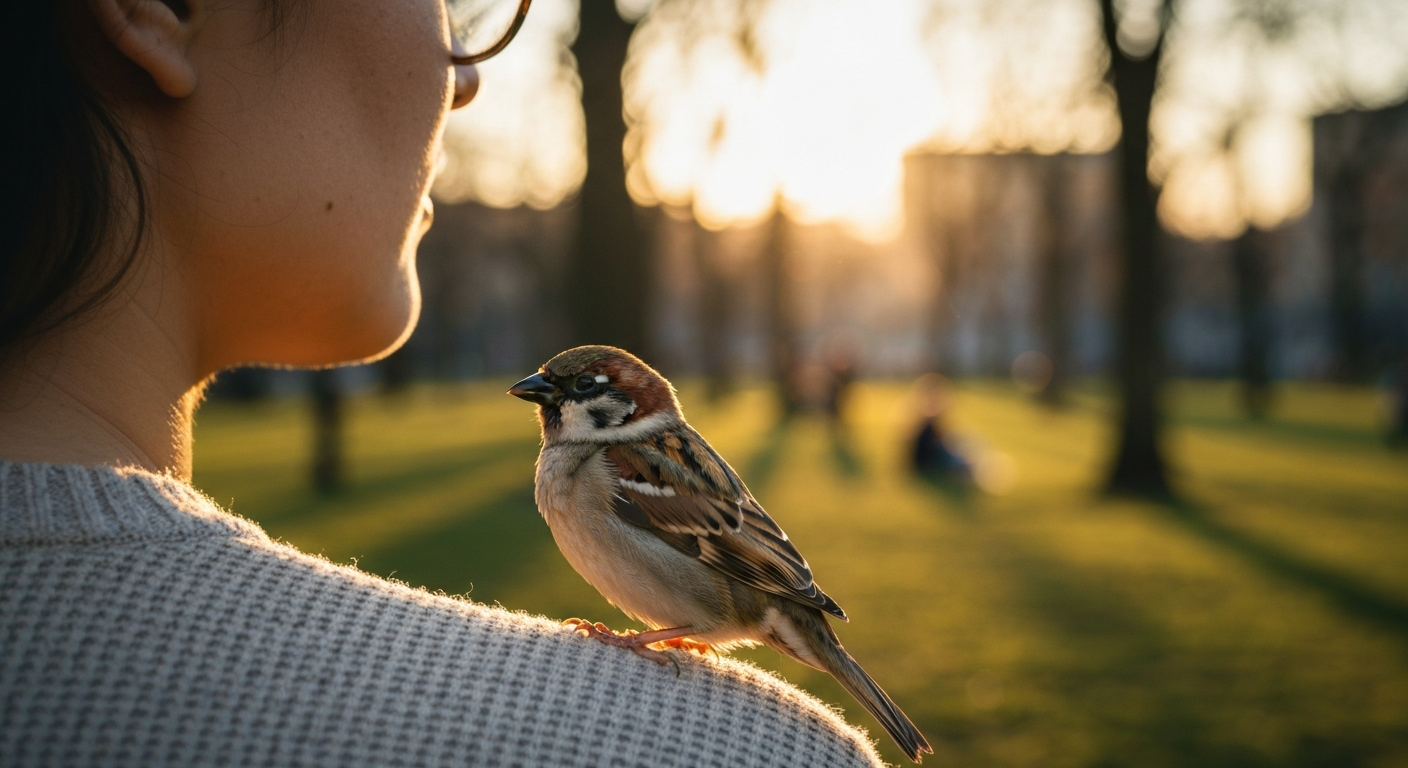
A bird landing on your shoulder almost always means one of two things biologically: the bird is hand-tamed or has escaped from captivity, or it is an exceptionally habituated wild bird in an area where hand-feeding is common (think park pigeons or the chickadees at certain nature centers that land on outstretched palms). For more on symbolic and practical interpretations, see bird landing on shoulder meaning. Shoulders are elevated perches that offer a good vantage point, and to a bird that has lost its fear of humans, a person's shoulder is just a convenient high spot. Culturally, a bird landing on the shoulder is one of the most widely interpreted encounters, it appears in folklore across Europe, the Americas, and parts of Asia as a sign of personal communication from a spirit, ancestor, or divine messenger.
A bird landing on or near your head
This is rarer with wild birds and usually signals a very bold or hand-raised individual, or occasionally a bird defending a nearby nest (some mockingbirds and red-winged blackbirds will dive at heads during nesting season, which is territorial aggression, not affection). In some cases, a bird near your head that seems confused or unable to orient properly may be ill or disoriented from a window strike. Symbolically, the head is associated with thought and divine communication across many traditions, so a bird making contact there is frequently interpreted as a heightened omen or message. For more on the symbolic interpretations of a bird landing on the head, see bird sitting on head meaning.
A bird sitting on or near your car
Cars are warm, elevated, and, during spring breeding season, reflective. The reflection behavior is one of the more dramatic examples of birds misreading the modern world: a male robin, cardinal, or mockingbird sees what looks like a rival bird in your side mirror and attacks it repeatedly, sometimes returning for days. University of Georgia Cooperative Extension documents this as a common spring complaint and recommends covering mirrors or applying window clings to break up the reflection. Apart from the reflection issue, birds also use cars simply as perches with good sightlines. A warm hood on a cold morning is an attractive resting spot for any bird looking to conserve energy. For symbolic or cultural readings beyond the biological reasons, see the discussion on bird sitting on car meaning.
A bird sitting right next to you on a bench, path, or table
This is the scenario most people are actually asking about, and it almost always comes down to food or habituation. Parks, outdoor cafes, and picnic areas attract species that have learned that humans equal food scraps. If no food is involved and the bird still sits unusually close without moving, it is worth checking whether the bird looks healthy: is it alert, tracking you with its eyes, and holding its body upright? A healthy habituated bird will watch you carefully. A bird that seems unaware of you, sits with feathers puffed out, or doesn't react when you move closer may be unwell.
Reading bird behaviors up close: panting, sleeping, preening, molting, and nesting
When a bird sits near you long enough to observe closely, you might notice behaviors that look unusual or alarming but are often completely normal. Here is what the most common ones actually mean.
Preening is feather maintenance, plain and simple. Birds spend a significant portion of each day realigning feather barbs, distributing preen oil from the uropygial gland at the base of the tail, and removing parasites. Cornell Lab's feather guides describe preening as essential to maintaining insulation and flight capability. A bird preening near you is relaxed and considers its immediate environment safe enough to engage in vulnerable maintenance behavior.
Molting makes birds look genuinely rough: patchy, scruffy, sometimes nearly bald-headed (house sparrows and American robins mid-molt can look startling). Cornell Lab notes that molt is energetically costly and is timed carefully to avoid overlap with migration and active breeding. A molting bird near you is not sick, it is replacing worn feathers with new ones. The scruffiness is temporary.
Panting with an open beak, sometimes combined with wing-spreading or visible throat fluttering, is a bird's primary way of managing heat. For a detailed explanation of bird panting meaning, see bird panting meaning. Unlike mammals, blank" rel="noopener noreferrer">birds have no sweat glands and rely on evaporative cooling through the respiratory system. The Merck Veterinary Manual identifies this gular flutter as normal thermoregulation in warm conditions. However, if panting is prolonged, the bird appears lethargic or unsteady, or the temperature is extreme, this moves from normal behavior into potential heat stress that requires intervention.
Sleeping positions in birds are quite varied. A bird tucking its bill under a wing near you is resting and, in doing so, is expressing a degree of comfort with its surroundings. For more on why different sleeping postures matter, see bird sleeping positions meaning. Many birds sleep on one leg to reduce heat loss, and some species will allow their eyelids to droop while still tracking movement through a half-open eye. These are normal comfort behaviors and are not signs of illness on their own.
Nesting behavior brings birds into close contact with people in ways that can feel intentional: a bird collecting your hair, nesting in a wreath on your door, or building right outside a window. This is opportunism, not symbolism, though in folk traditions, a bird nesting at your home has long been considered a sign of good fortune and protection.
What to do in the moment when a bird lands near or on you
If a bird lands on you or sits unusually close, your first move should be to stay calm and keep your movements slow and steady. Sudden movement is what triggers a bird's flight response, and if you jerk or wave your arm, you risk startling the bird into a panicked flight where it might hit a window or other obstacle. If the bird has landed on you and you want it to leave, try slowly tilting the surface it is perched on, your arm or shoulder, rather than shaking or swatting.
- Stay still and avoid loud noises or sudden movements when the bird first lands or approaches.
- If it lands on you and you want it to move, slowly extend or tilt your arm toward a nearby branch or railing so it can step off naturally.
- Do not grab or restrain a wild bird — even small birds can scratch and bite, and handling causes significant stress.
- If the bird seems comfortable and healthy, enjoy the encounter without trying to feed it unless you have appropriate food (bread and processed foods are poor choices for wild birds).
- Once you move on naturally, a healthy habituated bird will simply stay or relocate without distress.
If the bird looks injured or distressed: how to assess and what to do
Not every bird sitting near you is there because it wants to be. Some birds end up close to humans because they are grounded and unable to fly away. Knowing the difference between a resting healthy bird and one that needs help is one of the more practically useful things a person can take from an encounter like this.
Assessing what you are looking at
Cornell Lab's guidance on sick and injured birds lists the following as signs that intervention is needed: inability to fly or stand, a drooping or dragging wing, visible bleeding or wounds, head tilting or disorientation, labored or rattling breathing that is not explained by heat, and collapse. These are different from the normal behaviors described above and indicate that the bird is genuinely in trouble.
There is also the fledgling question, which catches a lot of people off guard. A fledgling, a bird that is mostly feathered but hopping rather than flying strongly, is often on the ground as part of normal development. Its parents are almost certainly nearby and still feeding it. The RSPCA and Cornell both advise leaving fledglings alone unless they are in immediate danger (on a busy road, being stalked by a cat). A naked or pin-feathered nestling that has clearly fallen from a nest is a different situation and can often be gently replaced in the nest without causing the parents to abandon it.
Immediate steps if the bird is injured
- Do not try to feed or give water to an injured bird — aspiration is a serious risk and the bird's needs are beyond basic nutrition at this point.
- If you need to contain the bird, place it gently in a cardboard box with air holes, lined with a soft cloth (not fluffy material that can tangle feet). Keep it in a warm, dark, quiet location.
- If the bird is in direct sun and showing signs of heat stress (prolonged panting, lethargy, collapse), move it to shade and place a shallow dish of cool water nearby without forcing it to drink.
- Contact a licensed wildlife rehabilitator as soon as possible. In the US, you can search for your nearest rehabilitator through the National Wildlife Rehabilitators Association or your state's wildlife agency. In the UK, the RSPCA runs a wildlife helpline.
- If you cannot reach a rehabilitator, a local veterinary clinic can often provide emergency stabilization or refer you to someone who can help.
- Minimize handling — the stress of being held by a human can worsen a bird's condition rapidly.
What different cultures make of a bird sitting near you
Across cultures and centuries, a bird landing near or on a person has rarely been treated as a neutral event. The interpretations vary widely, but a few threads run through many traditions: birds as messengers between the living and the dead, birds as omens of change, and birds as emblems of the soul's freedom or vulnerability.
In many European folk traditions, a bird entering your home or landing on a windowsill was read as a message from a deceased relative. This belief is still held in parts of Wales, Ireland, and the American South, where robins and wrens carry particular weight as carriers of the dead's presence. In Indigenous North American traditions, the meanings vary widely by nation and by species: a raven near you might signify transformation or trickery, while an eagle's presence near a person is often associated with spiritual strength and clarity. These are not interchangeable readings, the species, the direction the bird came from, and the circumstances all matter in these systems.
In Chinese tradition, certain birds near the home carry fortune: swallows nesting under eaves are considered excellent omens for the household's prosperity, and a bird landing on you is sometimes read as incoming good news. Hindu traditions associate specific birds with particular deities, the peacock with Saraswati, the crow with ancestors, so a crow landing near you during a ritual period like Pitru Paksha carries specific significance that a pigeon in a park does not.
In contemporary Western spiritual practice, the idea of birds as messengers has been absorbed into a more personal framework: many people interpret a bird landing near them as a sign relevant to whatever they are currently thinking about or experiencing. This is a subjective and personal interpretive mode, and it does not require ethnographic backing to be meaningful. What I would say is that the richest reading usually holds both things at once: here is what the bird is actually doing, and here is what it means to me in this moment.
Birds sitting near you in dreams
Dream symbolism involving birds follows its own interpretive logic, separate from what a live bird encounter actually means biologically. Across Jungian-influenced dream analysis and folk dream interpretation traditions, a bird sitting near you in a dream is generally read as a sign of communication, a message arriving or needing to be sent, freedom within reach, or the presence of something subtle that deserves your attention. The species matters in dream lore just as it does in waking folklore: a dream of a black bird sitting quietly near you is read very differently from a dream of a colorful songbird on your hand.
If the bird in the dream is injured or unable to fly, dream traditions generally interpret this as a feeling of restricted freedom, creative blockage, or a part of the self that is not being expressed. If the bird flies away from you after sitting nearby, it often represents something fleeting, an opportunity, a connection, or a feeling, that is moving on. These readings are culturally constructed and personal rather than empirically verifiable, but they have deep roots in the way humans have always used birds as mirrors for interior experience.
Bird sheet, bird idioms, and what the language around birds reveals
The phrase 'bird sheet' refers to droppings or excrement, a piece of informal language used in everyday speech and also in superstition. Being hit by a bird dropping is considered good luck in a surprising number of cultures, from Russia to Turkey to parts of Latin America, the logic being that something unpleasant happening to you carries an inverse fortune. It is the kind of folk reading that turns an annoyance into something you can live with.
English is saturated with bird-based idioms, many of which are so embedded that we rarely notice them. 'A little bird told me' invokes the idea of birds as secret messengers. 'Bird-brained' uses perceived avian intelligence as an insult, though it is worth noting that corvids and parrots have demonstrated cognitive abilities that challenge that framing entirely. 'Bird-dogging' refers to persistent pursuit or close following, drawn from the behavior of hunting dogs trained to work with birds. 'Bird law,' popularized in current slang culture, refers to informal or absurd rule-making. These phrases each carry their own entry-point into the broader cultural relationship between humans and birds, a relationship built over millennia of close observation, dependence, and storytelling.
Suggested images for this article
| Image Description | Recommended Alt Text |
|---|---|
| Close-up of a small bird (chickadee or sparrow) perched on a person's outstretched finger or shoulder in a park setting | Bird sitting on a person's shoulder in an outdoor park, illustrating habituated bird behavior |
| Bird perched on a car side mirror, appearing to look at its own reflection | Bird sitting on a car mirror engaging in territorial reflection behavior during breeding season |
| Sleeping bird tucked on a branch with head under wing, soft natural light | Bird sleeping with head tucked under wing, demonstrating normal avian resting posture |
| Bird with beak open, wings slightly spread, panting in warm conditions on a sunny surface | Bird panting with open beak and spread wings as a thermoregulation response to heat |
| Grounded bird on pavement looking lethargic or showing a drooped wing | Injured or distressed bird on the ground showing signs that may require wildlife rehabilitator assistance |
Holding science and meaning together
The biology of why a bird sits near you is well-documented and worth knowing: habituation, food conditioning, territorial instinct, thermal regulation, and species-specific boldness all explain the mechanics of the encounter. None of that erases the meaning that humans have built around birds over thousands of years of living alongside them. A crow sitting near you is almost certainly there because it has assessed you as safe and possibly useful. It is also, in Norse tradition, one of Odin's scouts. Both things can be true in the same moment, and understanding the first one actually deepens the second, you are not the subject of a random cosmic event, but a specific, recognized presence in a specific bird's world, which is its own kind of remarkable.
If you want to go deeper on any part of this, the related topics around this subject are worth exploring individually: the specific meaning of a bird landing next to you versus landing on you, what it means when a bird lands on your shoulder or your head, the behavioral details behind bird sleeping positions and bird panting, and the particular folklore attached to a bird sitting on your car. Each of those scenarios pulls from the same intersection of biology and culture, and each has nuance that a general overview like this one cannot fully cover.
FAQ
Concise immediate answer: What does a bird sitting near me usually mean?
Most often it’s practical: the bird is foraging, resting, seeking warmth, inspecting a perch, or has become habituated to people (especially in urban areas). Less commonly it’s injured, stunned, or exceptionally curious/bold (corvids, pigeons, hummingbirds). Cultural or spiritual readings vary by tradition and are subjective.
Species- and behavior-based reasons a bird might land on or very near a person (shoulder, head, car, etc.)
Common urban/near-human species (rock pigeon, house sparrow, European starling, some corvids, and habituated hummingbirds) tolerate close approach because of habituation and food conditioning. Specific reasons: perching for vantage or warmth (cars/hands retain heat), investigating reflections (mirrors/car windows), opportunistic feeding at handouts or crumbs, territorial displays (to reflections), social boldness in corvids, or mating/parental territory defence during breeding season.
Why do birds pant, hold wings open, or sit with fluffed feathers when near me?
Panting and gular flutter are normal thermoregulatory responses to heat; wing‑spreading and holding wings away from the body help cooling. Fluffing traps air for insulation or comfort. If panting is prolonged, accompanied by lethargy, collapse, open‑mouth breathing at rest, or drooped wings, it may be heat stress or illness and needs prompt attention.
What do preening, tucking the head under a wing, stretching or molting indicate?
Preening = routine feather maintenance. Tucking the head = resting/sleeping or conserving heat. Stretching/yawning = normal comfort behaviour. Molting = natural feather replacement; birds look scruffy and may be less flight‑agile during this energetically costly period.
Why might birds land on cars, windows or mirrors specifically?
They often see their reflection and mistake it for a rival (territorial response), or use shiny surfaces as vantage/roost points that retain heat. During breeding season reflections commonly trigger repeated attacks; simple deterrents (clings, covers) reduce that behaviour.
What are the cultural and symbolic meanings of a bird sitting near me?
Meanings differ by culture and context: many traditions see close birds as omens of messages, protection, or guidance; others interpret specific species (dove = peace, crow/raven = intelligence or trickster/harbinger) differently. Folklore and dream lore are symbolic, often reflecting personal belief: a bird near you can symbolize attention to communication, a prompt to notice surroundings, or a sign of a transition. These readings are subjective and vary by culture and individual.
Next Article
Bird Sitting on Head Meaning: Spiritual and Practical Guide
Bird on head meaning explained by context, spiritual symbolism, and safe next steps for real or dream encounters.