"Bird's-eye view" means a broad, general perspective seen from above, either literally (looking down from a height) or figuratively (getting an overview of a situation without diving into the fine details). If you searched "bird eye view meaning," you've landed on the right idea, just with a small spelling tweak to address below. The core meaning is simple: step back, look at the big picture, and see how everything fits together.
Bird Eye View Meaning: Definition, Usage, Examples

Marcus Holloway
15 Apr 2026
What "bird's-eye view" actually means

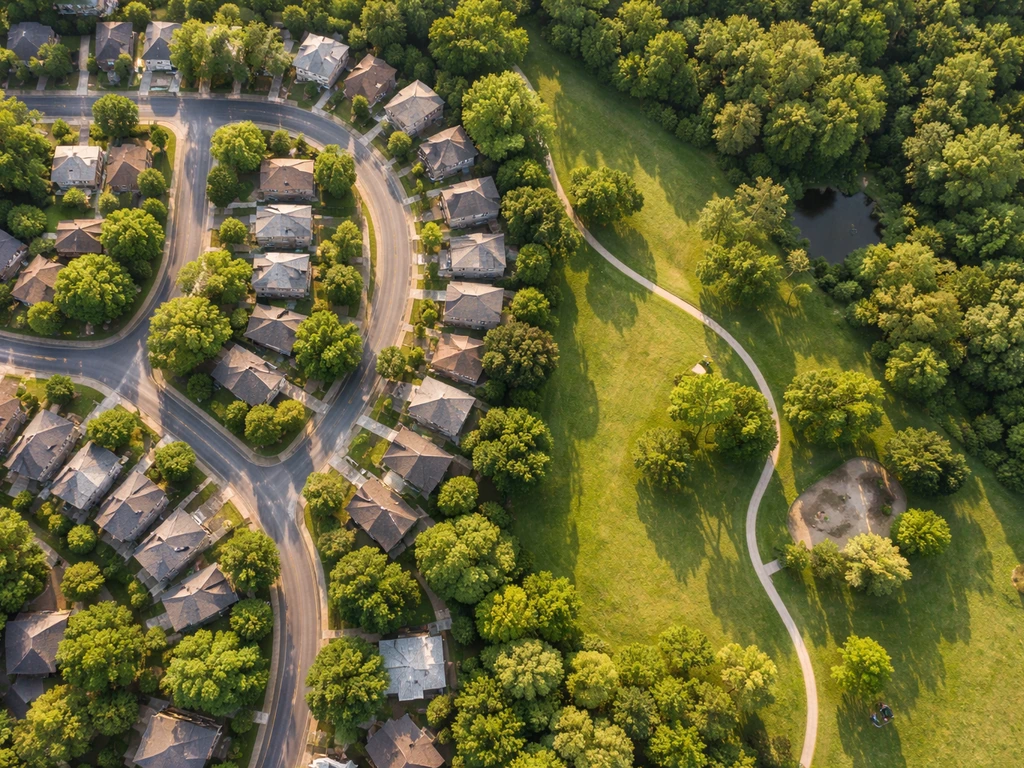
Merriam-Webster gives two senses of the phrase. The first is literal: a view from above where you can see a long way but everything looks very small. The second is broader: an overall but cursory view of something. Cambridge keeps it clean with "a general view from above," and Encyclopedia.com, drawing on Oxford's Pocket Dictionary, adds "a broad, general, or superficial consideration." All three point to the same idea: you're getting scope and context, not granular detail.
blank" rel="noopener noreferrer">Wikipedia grounds the idiom in how birds actually see the world, noting that the phrase refers to an elevated, steep viewing angle as if a bird were looking downward. That's also why the expression shows up constantly in architecture, cartography, and planning: floor plans, blueprints, and maps are all drawn from this kind of elevated perspective. The phrase captures both the physical vantage point and the mental one.
Idiom vs. literal: what it really means in everyday use
Taken literally, a bird's-eye view is exactly what a hawk sees when it's circling 200 feet overhead: the full landscape laid out below, with individual blades of grass invisible from that height. Taken figuratively, it's the mental equivalent, stepping back far enough to see how all the parts of a situation relate to each other. Both uses are common, and both carry the same implication: breadth over depth.
This figurative sense is worth understanding if you're thinking about bird eye meaning more broadly across language and culture. Birds in idioms and symbolism almost always signal heightened observation or elevated perspective, and "bird's-eye view" is probably the clearest example of that pattern. The bird isn't peering at one ant on the ground; it's reading the whole terrain.
There's also a useful contrast with the opposite expression: a worm's-eye view, which describes the perspective from ground level looking up, full of close-up detail but no sense of the wider landscape. The two terms are mirror images, and knowing both makes each one sharper.
How to spell and punctuate it correctly
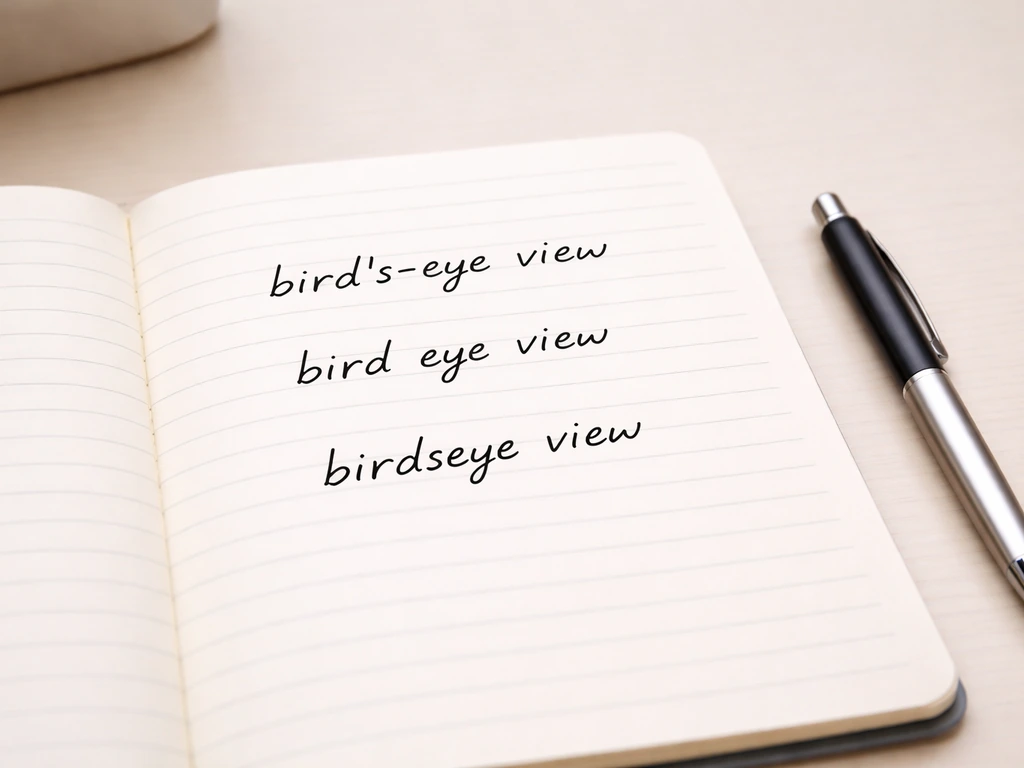
The standard spelling, confirmed by Merriam-Webster, Cambridge, and Collins, is "bird's-eye view," with a possessive apostrophe after "bird" and a hyphen between "eye" and... well, nothing in this case, since "bird's-eye" functions as a compound adjective modifying "view." So the full phrase breaks down as: bird's (possessive) + eye (hyphenated to form the adjective) + view (the noun being modified).
"Bird eye view" (no apostrophe, no hyphen) is the version people type into search engines, and it's understandable why. In casual speech the apostrophe vanishes and the hyphen goes unnoticed. But in any formal or professional context, including emails, reports, presentations, and published writing, "bird's-eye view" is the correct form. Collins also lists "bird's eye views" as the standard plural, so you can write "several bird's-eye views of the project" without issue.
One quick note: don't confuse the idiom with the Birds Eye trademark, the frozen food brand named after Clarence Birdseye. That's a proper noun and a different thing entirely, though the visual pun is obvious.
When to use it: contexts and examples
The idiom works in a wide range of situations. Here are the most common ones, with example sentences drawn from dictionary sources and real-world usage:
- Maps and navigation: "The map was a cartographer's bird's-eye view, with the icy mountains unfolding white and hazy below." (Collins)
- Travel and geography: "We got a bird's-eye view of the town from the plane." (Cambridge)
- Journalism and reporting: Using it to signal broad scene awareness, like reporting on traffic patterns from above rather than street-level congestion.
- Planning and strategy: "Before we get into the details, let me give you a bird's-eye view of the project roadmap."
- Presentations and reports: Introducing a summary section that covers the whole before narrowing into specifics.
- Photography and aerial imaging: Describing drone shots, satellite images, or overhead photography that captures layout rather than close-up texture.
In technical fields, the phrase gets even more specific. In autonomous vehicle research, for example, Bird's-Eye-View (often abbreviated BEV) refers to a spatial representation of road scenes that captures the overall layout of surrounding objects, prioritizing context and scene structure over fine local detail. That's a precise technical use, but it maps perfectly onto the everyday idiom: you want the spatial big picture, not a close-up of the road surface.
If you're interested in how birds visually take in their surroundings from a biological standpoint, the concept connects to bird gazing meaning, which explores the attentive, observational quality that makes birds such persistent metaphors for watchful awareness in human language.
What it implies, and what it doesn't
Using "bird's-eye view" signals that you're offering or requesting scope, not precision. That distinction matters in practice. If your manager asks for a bird's-eye view of the quarterly results, they want the high-level story: trends, totals, key movements. They are not asking for a line-by-line breakdown of every transaction. Getting that wrong and responding with a 40-page detail report misses the point of the request.
| Bird's-eye view implies | Bird's-eye view does NOT imply |
|---|---|
| Broad overview of the whole situation | Close examination of individual parts |
| Context and how elements relate to each other | Granular data or fine detail |
| General sense of scale, layout, or direction | Specific measurements or precise figures |
| Cursory but useful survey of a topic | Deep expertise or exhaustive analysis |
| High-level summary suitable for quick decisions | Step-by-step instructions or procedures |
Merriam-Webster's example makes this concrete: a bird's-eye view image shows several dozen tents arranged side-by-side in a desert setting with mountains in the background. You know the layout, the scale, the general environment. You don't know the size of each tent or what's inside any of them. That's the trade-off built into the phrase.
This is also why "bird's-eye view" language sits in a different register than, say, a bird side view meaning, which implies a more lateral, close-up perspective on something rather than a top-down sweep. Perspective angle, whether in art, cartography, or metaphor, changes what you can and can't see.
How "bird's-eye view" fits into the wider world of bird idioms
English has a long tradition of using birds to represent elevated awareness and broader perspective. "Bird's-eye view" is the most literal example of that pattern, but it's far from the only one. The idea that birds observe more than ground-level creatures shows up across idioms, symbolism, and folklore in ways that feel almost universal.
If you're exploring how birds function in language and culture more broadly, the concept of bird view meaning covers the wider symbolic territory: what it means for a bird to "see" in the context of human language, from literal ornithological vision to metaphorical watchfulness. The two ideas are closely linked.
There's also a behavioral angle worth noting. When birds physically pin or fix their gaze, it's a sign of focused attention that contrasts sharply with the sweeping overhead view the idiom describes. The concept of bird eye pinning meaning explores exactly that kind of intense, narrowed focus in birds, which is the opposite of a cursory bird's-eye scan.
Birds communicate through posture, movement, and position in ways that map surprisingly well onto human expressions. The bird style meaning covers some of those postural and behavioral signals, which adds another layer to understanding why bird-based idioms feel so intuitive: we've been observing and interpreting bird behavior for a very long time.
Even anatomical terms connect to how birds convey presence and power. A bird pinion meaning, referring to the outermost wing joint and flight feathers, is part of what gives birds their ability to reach the heights that make the bird's-eye view possible in the first place. And the bird gape definition gets into the expressive facial anatomy of birds, a reminder that bird observation goes well beyond what they see from above.
Quick usage tips and mistakes to avoid
Here's a fast checklist for getting the phrase right:
- Spell it "bird's-eye view" in formal writing: apostrophe after "bird," hyphen between "bird's" and "eye," no hyphen before "view."
- Use it when you mean broad overview, not detailed analysis. If you're going deep, say so differently.
- Don't use it redundantly: "a bird's-eye overview" is repetitive since "bird's-eye" already means overview.
- In presentations or reports, it works well as a framing phrase: "Here's a bird's-eye view of where we stand" signals that you're about to give the summary, not the full breakdown.
- Plural is "bird's-eye views," not "birds-eye views" or "bird's eye views" (keep the apostrophe).
- Avoid mixing it with precision language: don't write "a bird's-eye view of the exact figures" since those two ideas contradict each other.
One last thing: if the phrase you actually want is about a different kind of elevated or observational perspective, check your meaning carefully. "Bird's-eye view" is about breadth. If you want to convey acute, focused observation from a specific angle, you might need a different expression entirely, one that doesn't carry the same implication of sweeping, overhead distance.
The phrase has been in common use for centuries precisely because it captures something real: there are times when stepping back and taking in the whole is more valuable than zooming in. Knowing when you're in one of those moments, and having a clean, precise phrase for it, is genuinely useful. "Bird's-eye view" is that phrase.
FAQ
Does “bird’s-eye view” always mean literally looking from above?
In most contexts, yes. The figurative sense can be used without any literal “from above” reference, for example when you summarize a project, audit, market, or event at a high level. The key expectation is still breadth and context, not minute detail.
Is “bird’s-eye view” about distance, or about summarizing?
Not really. A bird’s-eye view implies scope and relationships, but the “distance” can be physical or conceptual. You can offer it in writing by organizing around themes, totals, and key drivers, rather than listing every individual item.
What should I include if my boss asks for a bird’s-eye view of results?
Keep it scope-appropriate. If you are asked for a bird’s-eye view, include the main categories, the overall trend, and the most important exceptions. If someone asks for details later, you can follow up with a separate deep-dive document.
How can I clarify the level of detail when I use the phrase?
Use “bird’s-eye view” when you want a quick overview, then define the limits. For example, you can say what you are not covering, like “not including line-item breakdowns” or “excluding minor edge cases.” That prevents readers from expecting precision the phrase does not promise.
Is it acceptable to write “bird eye view” without an apostrophe and hyphen in a report?
“Bird’s-eye” is typically hyphenated and takes an apostrophe in standard usage, even in short forms like “a bird’s-eye view.” Dropping punctuation is mainly acceptable in casual typing, but in professional documents it looks like a mistake.
What is the correct plural form of “bird’s-eye view”?
The proper plural is “bird’s-eye views.” Also, avoid mixing versions in the same document, for example “bird eye views” alongside “bird’s-eye views,” since consistency affects credibility.
If I mention BEV in a technical document, do I need to explain it differently from the idiom?
In technical contexts, BEV is a specific term (for example in mapping or autonomous driving) and should be treated as a defined label. If you use the general idiom in the same material, be explicit about whether you mean the everyday overview or the technical representation.
Can “bird’s-eye view” and “worm’s-eye view” be swapped?
Yes, but be careful. A “worm’s-eye view” suggests emphasis on near-up detail from below, while a bird’s-eye view suggests overall layout and relative position. They are not interchangeable, so choose based on whether you want “big picture” or “up-close specifics.”
What phrase should I use if I need a side perspective instead of a top-down overview?
Use “bird’s-eye view” for top-down sweeps, whether literal or metaphorical. If you need a perspective from the side, from the front, or a single subject-focused shot, phrases describing that angle will fit better than a bird’s-eye metaphor.
What’s a common mistake people make when they ask for a “bird’s-eye view”?
Yes. If your request is specifically about fine-grained inspection, measurements, or step-by-step analysis, “bird’s-eye view” may signal the opposite. Consider wording like “detailed breakdown” or “line-item analysis” when you truly need precision.