
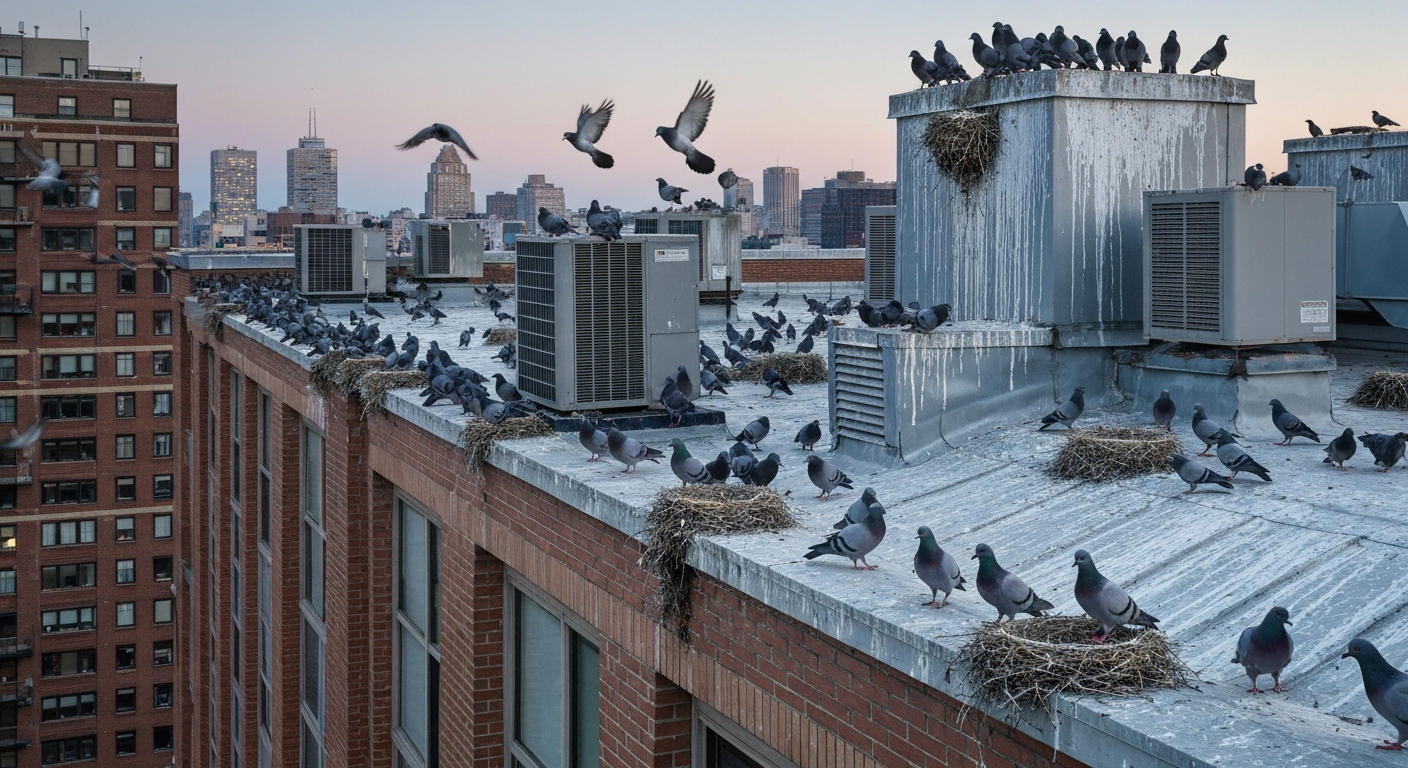
A bird infestation means an unwanted congregation or occupation of birds, in numbers large enough to cause measurable nuisance, damage, contamination, or safety risk, at a specific structure, site, or property. In everyday pest-management use, 'infestation' borrows from its general dictionary sense: a large number of pest organisms spreading or swarming in a troublesome way. Applied to birds, it describes what happens when feral pigeons colonize a warehouse roof, when European starlings roost in the thousands in a city park, or when house sparrows repeatedly nest in a building's vents. Ornithologically, the same situations are called colonial roosting, high-density communal roosts, or persistent occupation by synanthropic species. The two framings, pest-control and ecological, point at exactly the same event from different angles.
Bird Infestation Meaning: Definition, Risks, and Controls Guide

The precise definition from two angles
From a pest-management and cooperative-extension standpoint, a bird infestation is any situation where bird activity creates a demonstrable nuisance or hazard that warrants an integrated pest management response. The threshold is practical: droppings accumulating on walkways or equipment, nests blocking drains, flock noise disrupting a business, or disease risk to workers. The word 'infestation' signals that the problem has crossed from occasional visitor to persistent, damaging occupant.
From an ornithological perspective, what looks like an infestation is usually a recognized ecological behavior: communal roosting, colonial nesting, or the natural concentration of a synanthropic species (one adapted to living alongside humans). 'Roost' and 'colonial roosting' are the scientific terms Cornell Lab's All About Birds uses for birds gathering in large groups to rest or sleep. There is nothing pathological about the behavior from the bird's viewpoint. The problem arises when that behavior intersects with human property, health, or safety. Understanding this distinction matters because it shapes how you respond: you are not dealing with a sickness in the bird population, you are managing a conflict between normal bird behavior and human land use.
Why flocks and nesting birds get described as infestations
The word 'infestation' carries weight. We typically reserve it for rats, cockroaches, or bed bugs, organisms that intrude and contaminate. When it attaches to birds, it almost always marks a shift from presence to damage. Three factors drive that shift. First, sheer density: a handful of pigeons on a ledge is background urban life; two hundred pigeons nesting in the same building's roof cavities is a structural and health problem. Second, persistence: migratory or seasonal visitors pass through. Synanthropic species like feral pigeons and house sparrows are year-round breeders that return to the same sites season after season because those sites offer reliable food and shelter. Third, scale of impact: droppings buildup, blocked vents, contaminated water sources, and the secondary arrival of bird mites all compound the problem in ways that justify the stronger language. It is worth noting that some bird 'menace' situations, particularly around airports and agricultural land, shade into public-safety concerns that go well beyond nuisance, a distinction explored more fully when you look at aviation and crop-damage contexts.
When it's NOT an infestation
Not every flock of birds in your yard or on your roof qualifies as an infestation, and it is worth being clear about this because misidentifying routine bird presence can lead to unnecessary, sometimes illegal, control attempts. A single nesting pair of robins in a hedgerow, a seasonal passage of waxwings stripping a berry bush for a few days, or a loose group of house finches at a feeder are all normal and, in many jurisdictions, legally protected behaviors. The key questions to ask: Are the birds present year-round and in growing numbers? Are they causing measurable damage, soiling, or health risk? Have multiple control attempts failed to reduce the population? If the answer to all three is no, you are looking at ordinary bird activity, not an infestation. This distinction also matters symbolically and culturally: birds congregating around a home have been read as omens, signs of seasonal change, and indicators of a healthy ecosystem, not automatically as a problem requiring intervention.
Physical signs of a bird infestation
If you are trying to confirm whether a bird problem has reached infestation level, here is what to look for on-site. These indicators come directly from Iowa State Extension and USDA APHIS damage-management guidance.
- Heavy droppings buildup: persistent white-gray soiling on walkways, roofing, vehicle roofs, loading docks, or HVAC equipment, not just a few splashes but a continuous coating that returns within days of cleaning
- Visible dense nests: multiple nests concentrated in vents, soffits, roof cavities, chimneys, ledges, or drain outlets; feather and nesting-material debris accumulating below
- Blocked vents or chimneys: nest material visibly protruding from or plugging dryer vents, bathroom exhaust vents, chimney flues, or gutters
- Continuous or loud flock noise: persistent calling, chattering, or wing noise, particularly at dawn and dusk with communal roosts; noise that disrupts sleep or business operations
- Structural surface damage: corrosion, staining, or pitting on painted metal, stonework, or roofing materials caused by the uric acid in droppings
- Slip and fall hazards: wet or heavily fouled walkways, stairs, or access routes creating a demonstrable safety risk for pedestrians or workers
- Secondary pest presence: bird mites appearing on walls or window frames near active nests; mite infestations often spike after nests are abandoned and mites seek a new host
- Bird carcass accumulation: dead birds near regular congregation sites, which can indicate disease, predation, or collision events and attract secondary scavengers
Common culprit species and how to ID them
Most urban and suburban bird infestation problems in North America and Europe come down to a short list of synanthropic or invasive species. blank" rel="noopener noreferrer">New Mexico State University Extension lists common nuisance species in urban and suburban contexts, including feral (rock) pigeons, European starlings, house sparrows, gulls, Canada geese, American crows/blackbirds, and some swallows. Here is a quick-reference breakdown based on species accounts from Cornell Lab's All About Birds and New Mexico State University Extension guidance.
| Species | Key ID features | Typical problem behavior | Protected status (US) |
|---|---|---|---|
| Feral (Rock) Pigeon | Blue-gray body, iridescent neck, red feet; highly variable color morphs | Year-round nesting on ledges, heavy droppings, uric acid corrosion, equipment fouling | Not federally protected (non-native feral population) |
| European Starling | Stocky, short tail, speckled plumage (winter); yellow bill (summer); iridescent black | Huge communal roosts, cavity nesting, foul trees and structures, compete with native species | Not federally protected (non-native invasive) |
| House Sparrow | Small, brown-streaked, males have black bib; closely associated with buildings | Persistent nest building in vents, gutters, signs; droppings/feather debris; crop damage | Not federally protected (non-native) |
| Gulls (various) | White and gray, yellow or red-tipped bill; size varies by species | Roof nesting, aggressive diving near humans, contamination of water features and HVAC | Most species protected under Migratory Bird Treaty Act (MBTA); depredation permit needed for control |
| Canada Goose | Large, black head and neck, white chin patch, brown body | Lawn grazing, fecal contamination of turf and water, aggressive nesting behavior | Protected under MBTA; hazing and egg addling require federal coordination |
| American Crow / Common Grackle / Red-winged Blackbird | Crows: large, all black; Grackles: iridescent, long tail; Blackbirds: male with red/yellow shoulder patch | Large communal roosts (millions in some grackle/blackbird cases), agricultural crop damage, noise | Crows and most blackbirds protected under MBTA |
| Cliff / Barn Swallow | Streamlined, forked tail, often iridescent blue-black above | Mud nests on building eaves and bridges; messy but ecologically beneficial insectivores | Protected under MBTA; nest removal timed carefully |
The three non-native species, pigeons, starlings, and house sparrows, give property managers the most flexibility for control because they are not covered by the federal Migratory Bird Treaty Act in the US. Every native species on that list requires permits or specific legal conditions before active control measures can be taken.
Why birds concentrate in certain places: the ecological drivers
Birds do not randomly choose to occupy a building or site. The USDA APHIS Wildlife Damage Management technical guidance identifies four primary attractors, and understanding them is foundational to any prevention strategy.
- Reliable food sources: open garbage containers, dumpsters near loading docks, deliberate feeding by residents or staff, open composting, outdoor dining areas, and grain storage all function as consistent food subsidies that anchor bird populations to a site
- Accessible shelter and nesting sites: building ledges, parapet walls, rooftop HVAC equipment, unscreened vents, open cavities in eaves or soffits, and flat warehouse roofs are structural equivalents of the cliffs and cave mouths many pest species evolved to use
- Standing water: flat roof puddles, ornamental ponds, clogged gutters, and poorly drained pavement provide drinking and bathing water that makes a site self-sufficient for resident flocks
- Seasonal and migratory concentration: some infestations are amplified by migratory patterns that temporarily concentrate large numbers of birds in staging or wintering areas; a problem that seems manageable in summer can become overwhelming when a local flock is joined by migrants in autumn
Urban design plays a particular role. Cities generate more food waste per square kilometer than any natural habitat, building surfaces mimic cliff faces for cavity-nesting species, and the urban heat island extends suitable weather conditions year-round. Landfills adjacent to airports are a documented aviation safety concern for exactly this reason: they attract gulls, starlings, and corvids in densities that would not naturally occur in that landscape.
Risks worth taking seriously
Health risks
The CDC identifies several human-health concerns associated with heavy bird droppings and roost accumulations. Histoplasmosis, caused by the fungus Histoplasma capsulatum, is the most widely documented: it spreads when soil or material contaminated by bird or bat droppings is disturbed, and the fungal spores become airborne. How People Get Histoplasmosis, CDC explains that people become infected when spores in contaminated soil or bird or bat droppings are disturbed and inhaled How People Get Histoplasmosis — CDC. Psittacosis (caused by Chlamydia psittaci) can be inhaled from dried droppings or secretions of infected birds. Cryptococcus species have been isolated from pigeon droppings. Salmonella associated with bird activity is a documented concern in food-handling environments. Bird mites, which abandon nests when birds leave, can bite humans and cause significant skin irritation. None of these risks require panic, but they do require proper PPE and dust-suppression protocols if you are cleaning up a significant accumulation.
Property and structural risks
Bird droppings contain uric acid, which is corrosive to painted surfaces, stonework, metal roofing, and car finishes. USDA APHIS environmental assessments document shortened roof lifespan, clogged drainage systems, and fouled HVAC equipment as recurring property costs from persistent bird occupation. Nests in dryer vents, bathroom exhaust vents, and chimney flues are a well-documented fire and overheat hazard, because the dry nesting material is highly combustible and the blockage can cause heat and moisture to back up into the building. The CDC and NIOSH engineering-controls guidance specifically flag this as a mechanical hazard worth addressing during any bird exclusion project.
Agricultural risks
For farmers and growers, bird damage to crops is a direct economic threat. Starlings, crows, and blackbird flocks can strip grain fields, damage fruit, and contaminate feedlots. House sparrows target stored grain. Canada geese graze turf and winter crops. The financial impact is documented in USDA extension literature and varies enormously by crop type and local bird density.
Aviation and public safety
Bird strikes at airports are tracked systematically. The FAA's National Wildlife Strike Database and the report 'Wildlife Strikes to Civil Aircraft in the United States, 1990-2024' document hundreds of thousands of strike events, with gulls, waterfowl, raptors, and flocks of small songbirds identified as the highest-risk groups near airports. A concentrated bird population near an airport, exactly the kind of situation that arises when a landfill or food-waste facility sits within the airport's wildlife hazard zone, dramatically elevates risk. ICAO and national aviation regulators require Wildlife Hazard Management Plans (WHMPs) for certified airports, covering habitat modification, monitoring including avian radar, and integrated mitigation. This aviation context connects directly to what is described in detail when covering bird-hit-plane events and their causes: the root issue is often an ecological one, a dense bird population attracted to a site by food, water, or shelter that overlaps with an aircraft flight path. For more on what bird–aircraft collisions involve and their causes, see bird hit meaning.
Prevention and humane control: your options
Integrated pest management (IPM) for birds follows the same logic as IPM for any species: start with the least invasive, most habitat-focused interventions and escalate only as needed. Here is a practical breakdown from DIY fixes through to professional removal.
DIY and habitat modification
- Secure all garbage and food waste in covered containers; remove outdoor bird feeders if pest species are exploiting them
- Eliminate standing water: fix flat-roof drainage, clear gutters, drain ornamental ponds if they are drawing problem species
- Trim or remove vegetation that provides roost cover adjacent to structures (dense ivy on walls is a classic starling habitat)
- Install vent covers and chimney caps to block nest entry points; use hardware cloth (half-inch galvanized mesh) to screen open soffits and gaps
- Remove existing nests promptly before birds re-establish (confirm species and legal status first; timing matters for protected species)
Exclusion devices
- Bird spikes on ledges, parapets, and beams: physically prevent landing and perching on flat surfaces; most effective for pigeons and gulls on architectural features
- Bird netting: heavy-duty exclusion netting across large openings, courtyards, or under roof overhangs; the most reliable long-term exclusion for enclosed or semi-enclosed spaces
- Slope/angle modifications: installing angled surfaces (45 degrees or greater) on ledges removes flat landing platforms without ongoing maintenance
- Electric track systems: low-voltage deterrent strips on ledges; effective but higher cost, typically a commercial solution
Deterrents
- Visual deterrents (reflective tape, predator decoys, eye-spot balloons): provide short-term effectiveness; birds habituate quickly if decoys are stationary, so regular movement is essential
- Sonic and ultrasonic devices: distress calls and predator calls can be effective for specific species in open outdoor areas; ultrasonic devices have limited evidence for outdoor use
- Laser deterrents: automated or handheld green lasers are effective for dispersing roosts at dusk; commercial automated systems are used at airports and large agricultural sites
- Chemical repellents (polybutylene gel, methyl anthranilate): gel repellents on surfaces make perching uncomfortable; methyl anthranilate (a grape-derived compound) is a registered bird repellent for turf and water surfaces
Professional removal and when to escalate
Call a licensed wildlife control professional when: the infestation involves protected species requiring federal or state permits; droppings accumulation exceeds what you can safely clean with standard PPE; structural exclusion work requires scaffolding, roof access, or specialized installation; or previous DIY attempts have failed. In the US, companies conducting bird control must understand MBTA permit requirements, and any lethal control of protected migratory birds requires a federal depredation permit issued by the USFWS. Egg addling (oiling or shaking eggs to prevent hatching) for Canada geese is another regulated activity requiring federal registration. The humane baseline across all professional methods is to prioritize exclusion and habitat modification over lethal control, and to use lethal methods only when permitted and when non-lethal options have been exhausted.
Deterrence methods compared
| Method | Effectiveness | Cost (approx.) | Best for | Legal notes |
|---|---|---|---|---|
| Physical spikes | High (long-term) | Low to moderate ($5-$20/ft) | Ledges, parapets, beams | No permits needed; humane |
| Exclusion netting | Very high | Moderate to high (site-dependent) | Enclosed areas, large gaps, building facades | No permits needed; humane |
| Visual deterrents (decoys, tape) | Low to moderate; short-lived | Very low | Gardens, small areas, temporary use | No restrictions |
| Sonic/distress call devices | Moderate outdoors | Moderate ($100-$500+) | Open fields, parking lots, airports | Noise ordinance compliance required in some areas |
| Laser deterrents | High for roost dispersal | High ($500-$5,000+ for automated) | Large roosts, airports, warehouses | Aviation airspace considerations near airports |
| Chemical repellent gels | Moderate | Low to moderate | Ledges, signs, HVAC equipment | EPA-registered products required |
| Habitat modification (food/water removal) | Very high (prevents re-establishment) | Low (operational change) | All sites; foundational step | No restrictions; recommended first |
| Egg addling / nest removal | High for colony reduction | Low to moderate (permit costs) | Canada geese, gulls, some colonial nesters | Federal permit required for protected species |
| Lethal control (shooting, trapping) | High short-term; re-colonization risk | Variable; high regulatory burden | Large-scale agricultural/aviation situations | Federal depredation permit required for protected species; not permitted for pigeons/starlings/house sparrows federally |
When to contact authorities
- You identify a protected species (gulls, swallows, native songbirds, raptors) nesting on your property: contact the USFWS or your state wildlife agency before taking any action
- You are managing an airport or aviation facility: file bird strikes with the FAA's National Wildlife Strike Database and develop a WHMP if not already in place
- A public health risk is confirmed (workers with respiratory symptoms, documented histoplasmosis exposure): contact your local or state health department and follow CDC/NIOSH cleanup protocols
- You suspect the bird activity is linked to a neighboring property or public facility attracting birds: contact your local animal control, public health authority, or municipal pest management office
Legal and ethical constraints you need to know
In the United States, the Migratory Bird Treaty Act (MBTA) of 1918 protects almost all native bird species from being taken, killed, or having their active nests disturbed without a federal permit. This is not a minor regulation: violations carry civil and criminal penalties. The three main urban pest species, feral pigeons, European starlings, and house sparrows, are all non-native and are specifically excluded from MBTA protection, which is why they appear in most pest-control recommendations without permit requirements. Every other species on the culprit list, gulls, Canada geese, crows, swallows, and blackbirds, falls under MBTA protection or equivalent state-level protection. Outside the US, equivalent legislation applies: the UK's Wildlife and Countryside Act 1981, Canada's Migratory Birds Convention Act, and EU Bird Directive all impose similar constraints. The ethical baseline is also practical: protected-species populations are often part of functioning ecosystems that provide pest-insect control and other services. Exclusion and habitat modification protect both your property and those ecological functions.
What 'bird infestation' means in language, culture, and folklore
This site covers birds as carriers of meaning as much as living animals, so it is worth noting how the language of bird infestation sits inside a longer cultural tradition. The word 'infest' has Latin roots (infestare: to disturb, attack, make unsafe), and the verb was applied to enemies, bandits, and plagues long before it attached itself to pest organisms. When we call a bird gathering an infestation, we are reaching for the same register of threat and disorder that earlier cultures mapped onto omens and dark auguries.
In folklore and dream symbolism, a vast flock of birds descending on a house or field has rarely been read as neutral. In many European traditions, a house suddenly full of birds signals an imminent death or major change. The Hitchcock reference is unavoidable: 'The Birds' (1963) drew on exactly this cultural unease, transforming routine bird presence into existential menace. The shift from 'birds are here' to 'birds are a problem' mirrors the psychological shift from symbol to threat that appears in everything from biblical plague narratives to contemporary horror. Crows and ravens in particular occupy this liminal space in Western folklore, birds of intelligence and presence that tip easily from omen to nuisance depending on their number and behavior.
The idiom 'bird menace' extends this: in language, birds become menacing not when they are individually threatening but when they arrive in numbers that overwhelm the normal order. That is functionally the same threshold the pest-control literature uses to define an infestation. The cultural and practical definitions turn out to be describing the same perceptual shift: one bird is a visitor, a hundred birds is a problem. This site's coverage of related topics, from bird collision events and what they mean symbolically to the specific public-safety context of birds hitting aircraft, all sit within this broader framework of birds as beings that can move between symbol, ecological actor, and genuine hazard depending on context and density. For more on how collisions carry both symbolic and practical implications, see bird collision meaning.
FAQ
What does 'bird infestation' mean in technical (ecological/ornithological) terms versus everyday (pest/menace) usage?
Technical: ornithologists use neutral terms like 'roost,' 'communal roosting,' and 'colonial nesting' to describe birds gathering in groups for rest or breeding. These are ecological behaviors with no inherent judgment. Everyday/pest usage: 'bird infestation' describes when bird presence or repeated use of a site reaches levels that cause nuisance, damage, health or safety risks—i.e., a large number of birds occupying or repeatedly using a structure or area in a troublesome way (consistent with dictionary and pest‑management definitions).
How can I tell when ordinary bird presence has become an infestation? (Quick checklist)
Physical signs that indicate nuisance/infestation levels: heavy, persistent droppings on roofs, walkways, vehicles or equipment; dense accumulations of nests, feathers or nesting material under roosts; loud, continuous flock noise at dawn/dusk; blocked vents, chimneys or dryer exhausts; visible bird carcasses or many sick birds; increases in ectoparasites (bird mites) inside or near buildings. If bird activity repeatedly causes contamination, corrosion, structural blockage, fire risk, or regular cleanups, it has crossed into 'infestation' for management purposes.
Which bird species most commonly cause infestations in urban, agricultural, and airport settings?
Common pest species and why they matter: - Feral (rock) pigeon: nests on ledges/cavities, year‑round in cities, heavy droppings that corrode surfaces. - European starling: large flocks, communal roosts, cavity‑nesting (displaces natives). - House sparrow: small but persistent breeders near buildings and feeders. - Gulls: aggressive, large birds causing safety hazards and waste fouling near coasts/landfills. - Canada geese: turf damage, droppings in parks and farms. - Crows/blackbirds: crop damage, noisy communal roosts. Airports also worry about waterfowl, raptors and large flocks of small birds because of bird‑strike risk.
What ecological and human factors cause bird infestations?
Primary drivers: reliable food sources (open garbage, deliberate feeding, composts), available shelter (roof ledges, eaves, cavities), standing water, landscape features (tall trees for roosts), and built elements that provide nesting/roosting sites. Seasonal and migratory behavior can concentrate birds. Urban design (flat roofs, unscreened vents, nearby landfills) and poor waste management commonly create attractants. An integrated approach focuses on removing these attractors.
What health risks do bird infestations pose?
Documented health risks from accumulations and disturbance of bird droppings/roosts include: - Respiratory fungal infections such as histoplasmosis (from disturbed droppings/soil). - Psittacosis (Chlamydia psittaci) from inhaled dried secretions/droppings. - Potential exposure to Cryptococcus and Salmonella species. - Increased presence of ectoparasites (bird mites, fleas) that can bite humans. Prevention emphasizes avoiding aerosolization during cleanup (dust suppression, PPE) and eliminating droppings build‑up.
What property and mechanical risks do birds cause?
Property/mechanical hazards: uric acid in droppings corrodes metal and paint, shortening roof and equipment life; nests and debris can clog gutters, vents, chimneys and HVAC intakes; nests in dryer vents or equipment can create fire/overheat hazards; fouling of solar panels reduces efficiency; frequent cleaning and repairs increase maintenance costs.