
"Bird classes" can mean at least six genuinely different things depending on who is asking. A biology student wants the taxonomic rank Class Aves and its major orders. A birdwatcher wants folk groupings like raptors, waterfowl, or songbirds. An ecologist wants functional guilds like granivores or cavity nesters. A writer or folklorist wants cultural categories tied to omens, dreams, and idioms. A wildlife manager wants to know what bird culling means legally. And anyone studying bird populations will eventually need a working definition of a colony, a census, or a flock. This article covers all six senses clearly and with concrete examples, so you can pick up whichever meaning you actually need.
Bird Classes Meaning: Scientific, Ecological, Cultural Guide

Marcus Holloway
6 Aug 2026
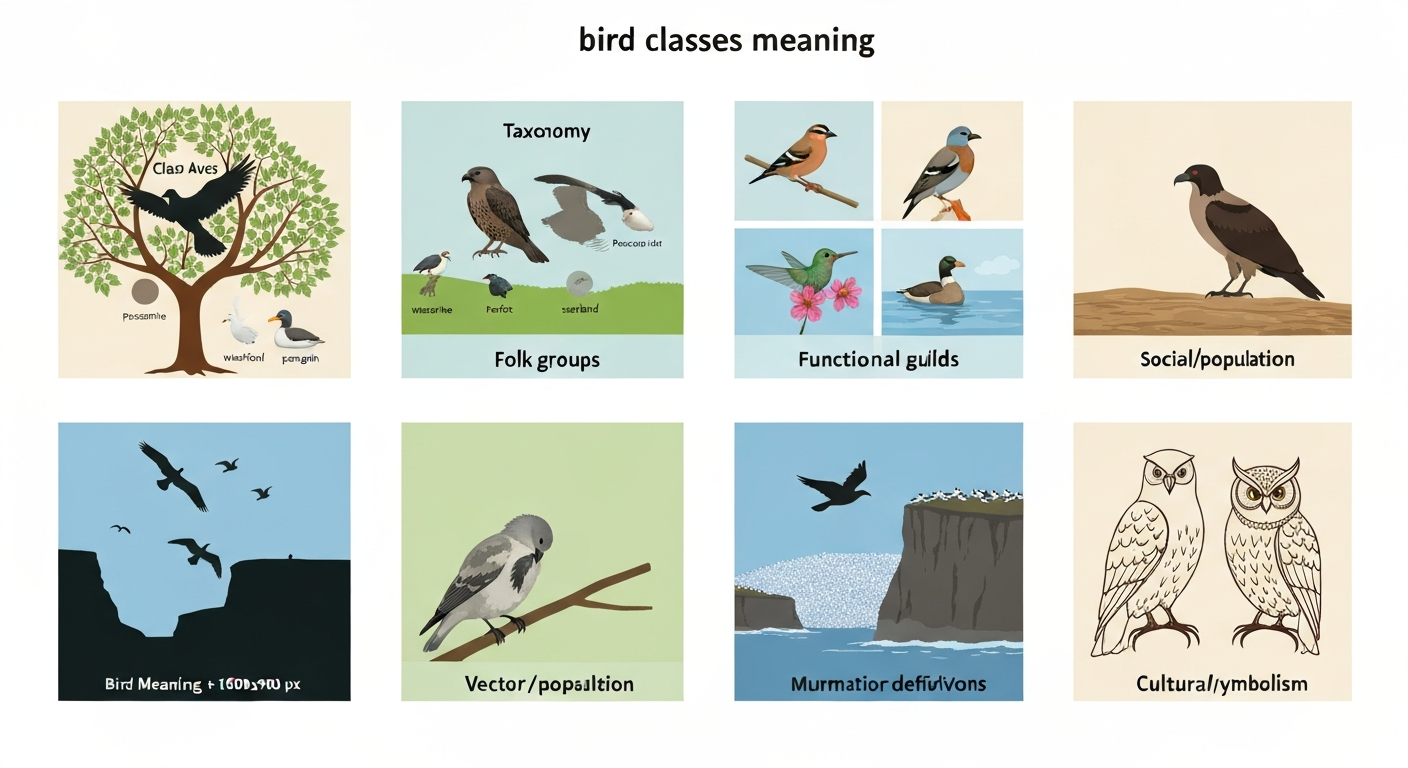
What people actually mean by "bird classes"
The word "class" carries different weight in different contexts. In formal biology, it is a specific rank in the Linnaean hierarchy sitting between Phylum and Order. Biologists say Class Aves the same way they say Phylum Chordata, it is a precise, bounded concept. But outside a biology classroom, people reach for the word "class" much more loosely. Raptors, seabirds, and songbirds are called classes even though they cut across multiple scientific orders. Behavioral phases like molting or migration get called classes of activity. Population terms like colony and flock define classes of social organization. And in cultural contexts, birds are classed as omens, messengers, tricksters, or symbols of the soul depending on the tradition. All of these uses are legitimate, and understanding which sense a source is using will save you real confusion.
Quick definitions at a glance
| Term | One-line definition |
|---|---|
| Class Aves | The formal taxonomic class containing all living birds, nested within Phylum Chordata |
| Passeriformes | The largest bird order (perching birds/songbirds), containing well over half of all described species |
| Raptor (folk class) | A functional grouping of predatory birds that seize vertebrate prey, spanning multiple scientific orders |
| Waterfowl (folk class) | Ducks, geese, and swans of order Anseriformes, adapted for swimming and diving |
| Seabird (ecological class) | Ocean-dependent birds from several orders (Procellariiformes, Suliformes, Sphenisciformes, etc.) |
| Granivore (functional guild) | A bird that specializes in eating seeds (e.g., finches, sparrows) |
| Cavity nester (functional guild) | A bird that nests inside holes in trees or structures (e.g., woodpeckers, bluebirds) |
| Molting (behavioral class) | Periodic, systematic replacement of feathers |
| Preening (behavioral class) | Bill-based feather maintenance using oil from the uropygial gland |
| Colony (social/population term) | A spatially clustered, often site-faithful breeding or roosting aggregation |
| Flock (social/population term) | A temporary social group gathered for foraging, migration, or roosting |
| Bird census (monitoring term) | A structured count of birds in a defined area using standardized protocols |
| Bird culling (management term) | Authorized lethal removal of birds, typically under a depredation permit or legal derogation |
Scientific classification: Class Aves and the major orders
In biological taxonomy, a "class" is a fixed rank in the hierarchy: Kingdom, Phylum, Class, Order, Family, Genus, Species. Class Aves is the class containing all extant birds. See All About Birds (Cornell Lab of Ornithology), taxonomy and species guides for taxonomic treatments, species counts, and identification resources related to Class Aves All About Birds (Cornell Lab of Ornithology) — taxonomy and species guides. Depending on which checklist you consult, the global species count sits somewhere between roughly 11,017 (Clements/Cornell Lab, 2025 update) and 11,524 (HBW/BirdLife checklist), with the IOC World Bird List v15.2 tallying 11,227 species including 164 recorded extinct ones. The variation reflects genuine scientific disagreement about species limits, not sloppy counting. For most general purposes, citing the IOC list or noting your checklist choice is good practice.
Within Class Aves, the next rank down is Order, and this is where most practical identification discussion happens. The single largest order is Passeriformes, the perching birds, which alone contains the majority of all described bird species. Below are the major orders most likely to come up in birdwatching, ecological, or academic contexts.
| Order | Common name(s) | Representative families/species | Approx. scope |
|---|---|---|---|
| Passeriformes | Perching birds / songbirds | Robins, sparrows, warblers, crows, finches | Largest order; over 6,000 species |
| Accipitriformes | Hawks, eagles, kites, Old World vultures | Red-tailed Hawk, Bald Eagle, Osprey | Core daytime raptors |
| Falconiformes | Falcons and caracaras | Peregrine Falcon (Falco peregrinus), American Kestrel | Distinct from Accipitriformes |
| Strigiformes | Owls | Great Horned Owl, Barn Owl | Nocturnal predators, often grouped with raptors informally |
| Anseriformes | Ducks, geese, swans, screamers | Mallard (Anas platyrhynchos), Canada Goose | Core waterfowl order |
| Charadriiformes | Shorebirds, gulls, auks | Killdeer, Dunlin, Herring Gull, Atlantic Puffin | Diverse order spanning waders to seabirds |
| Procellariiformes | Albatrosses, petrels, shearwaters | Wandering Albatross, Manx Shearwater | Pelagic seabirds |
| Sphenisciformes | Penguins | Emperor Penguin, Little Blue Penguin | Flightless, Southern Hemisphere |
| Galliformes | Pheasants, turkeys, grouse, quail | Wild Turkey, Ring-necked Pheasant | Ground-dwelling game birds |
| Columbiformes | Pigeons and doves | Rock Pigeon, Mourning Dove | Worldwide distribution |
| Psittaciformes | Parrots, parakeets, macaws | African Grey Parrot, Budgerigar | Highly vocal, often kept as pets |
| Piciformes | Woodpeckers, toucans, barbets | Downy Woodpecker, Northern Flicker | Cavity-drilling specialists |
Understanding this structure matters because folk groupings like "raptors" or "seabirds" are not orders. They cut across multiple orders, which is why a biologist and a birdwatcher can use the same word to mean subtly different things.
Folk and lay classes: raptors, songbirds, waterfowl, seabirds, and waders
Non-taxonomic bird classes are enormously useful in the field, in writing, and in everyday conversation precisely because they group birds by what they do and where they live rather than by phylogenetic ancestry. A birdwatcher who says "I saw a raptor today" is communicating efficiently without needing to specify whether the bird was an accipiter, a falcon, or an owl. Here is how each major folk class works and why it matters.
Raptors (birds of prey)
In common usage, "raptor" means a predatory bird that captures vertebrate prey using talons and a hooked bill. This functional grouping typically covers Accipitriformes (hawks, eagles, kites, harriers, Old World vultures), Falconidae (falcons and caracaras), Strigiformes (owls), and often New World vultures, which are scavengers. These groups are not all closely related in modern phylogenetics, but they share ecological roles and body plans that make the category genuinely useful. When a writer calls a bird a raptor, they are describing a predatory lifestyle, not a clade.
Songbirds (passerines)
"Songbird" in birdwatching nearly always means Passeriformes, making this one of the closer alignments between a folk class and a scientific order. The order splits into oscines (true songbirds with complex vocal learning, including most familiar species like thrushes, warblers, and finches) and suboscines (tyrant flycatchers, antbirds, and others mostly found in the New World tropics). For most readers, passerine and songbird can be treated as interchangeable with the caveat that suboscines technically belong to Passeriformes but may not match a reader's mental image of a melodic songbird.
Waterfowl
In scientific and hunting/conservation contexts, "waterfowl" generally refers specifically to Anatidae (ducks, geese, and swans) within order Anseriformes. The Mallard (Anas platyrhynchos) is the archetypal example. In casual speech, the term sometimes expands to include any water-associated bird like herons or coots, so it is worth clarifying when precision matters. When wildlife managers and legal frameworks use "waterfowl," they almost always mean Anseriformes.
Seabirds and waders/shorebirds
Both of these are ecological groupings, not taxonomic ones. Seabirds span multiple orders: Procellariiformes (albatrosses, petrels, shearwaters), Suliformes (boobies, cormorants, frigatebirds), Sphenisciformes (penguins), and pelagic members of Charadriiformes (puffins, terns, skuas). What unites them is dependence on marine environments for feeding and often breeding. Shorebirds or waders are primarily families within Charadriiformes, including plovers (Charadriidae), sandpipers (Scolopacidae), and oystercatchers (Haematopodidae). They are linked by habitat (intertidal and wetland edges) rather than phylogeny.
Ecological and functional categories with examples
Ecologists organize birds into guilds based on what they eat or how they reproduce. These categories often matter more for understanding an ecosystem than the taxonomic order does. A granivore (seed-eater) like a House Sparrow or American Goldfinch and a nectarivore (nectar-specialist) like a Ruby-throated Hummingbird can both be Passeriformes, but their ecological roles are completely different. Here are the main functional guilds with representative examples.
- Piscivores (fish-eaters): Osprey, Great Blue Heron, Common Kingfisher — often near water, dive or wade to catch prey
- Granivores (seed-eaters): American Goldfinch, White-throated Sparrow, many finches (Fringillidae) — strong conical bills for crushing seeds
- Insectivores: most warblers, swallows, flycatchers — specialized for aerial, bark, or ground-level insect capture
- Nectarivores: hummingbirds (Trochilidae), sunbirds (Nectariniidae) — long bills and tongues, important pollinators
- Scavengers: Turkey Vulture, Black Vulture, Marabou Stork — consume carrion; vital for nutrient cycling
- Omnivores: American Crow, Common Raven, many gulls — opportunistic, adapt diet to season and availability
- Cavity nesters: Downy Woodpecker, Eastern Bluebird, Wood Duck — nest in natural or excavated holes; depend on standing dead wood
- Ground nesters: Killdeer, Ovenbird, Horned Lark — nest directly on soil or in low vegetation; vulnerable to ground predators
- Migratory species: Arctic Tern (longest migration of any animal, pole to pole), Barn Swallow, Blackpoll Warbler
- Resident (non-migratory) species: Northern Cardinal, Great Horned Owl, Black-capped Chickadee in most of their ranges
Pollinators deserve a separate note. Hummingbirds in the Americas and sunbirds in Africa and Asia are ecologically equivalent but taxonomically unrelated, a striking example of convergent evolution. Both move pollen between flowers while feeding on nectar, and the loss of either group in their respective ranges would have measurable consequences for plant reproduction.
Scientific vs. common categories: where they align and where they diverge
| Common/folk class | Scientific order(s) it maps to | How well they align | Best context to use each |
|---|---|---|---|
| Songbirds | Passeriformes | Very close — nearly one-to-one for most uses | Use 'Passeriformes' in scientific writing; 'songbirds' in popular/field contexts |
| Waterfowl | Anseriformes (family Anatidae) | Close in formal usage; casual usage sometimes broader | Use 'Anseriformes' or 'Anatidae' in technical writing; 'waterfowl' in hunting/conservation docs |
| Raptors / birds of prey | Accipitriformes + Falconiformes + Strigiformes (+ New World vultures) | Poor — spans several unrelated orders | Use 'raptors' only in ecological/popular writing; specify the order in taxonomy |
| Seabirds | Procellariiformes, Suliformes, Sphenisciformes, pelagic Charadriiformes | Poor — purely ecological grouping | Use 'seabirds' for ecological/conservation discussion; list orders for taxonomy |
| Shorebirds / waders | Mostly Charadriiformes | Moderate — most waders are Charadriiformes but not all Charadriiformes are waders | Use 'shorebirds' for field/habitat context; use 'Charadriiformes' for taxonomy |
| Game birds | Galliformes (primarily) | Moderate — legal/hunting definitions sometimes differ from taxonomic ones | Use 'Galliformes' for taxonomy; 'game birds' in legal/hunting regulation contexts |
Behavioral classes and activities: what birds are actually doing
When ornithologists, birdwatchers, or writers group birds by behavior, they are carving out a different kind of class entirely. The four behaviors below come up most often and are consistently misidentified or misunderstood by newcomers. Getting them right transforms what you see in the field from "a bird doing something weird" into a readable moment of natural history.
Preening
Preening is the maintenance of feathers using the bill and sometimes the feet. A bird will draw each feather through its bill to realign the microstructures (barbules) that give feathers their aerodynamic and insulating properties. Most birds also apply oil from the uropygial gland, located at the base of the tail, to waterproof and condition feathers. Preening is frequent, often happening multiple times per day, and is one of the most observable bird behaviors. Seeing two birds mutually preen (allopreening) is a strong sign of a pair bond or close social relationship.
Molting
Molting is the periodic, systematic replacement of feathers. Because feathers wear out and cannot repair themselves like skin, birds replace them on a species-specific schedule. Most species time molts to avoid overlap with the highest-energy demands of breeding and long-distance migration. A late-summer American Robin or European Robin in patchy, dull plumage is not sick, it is in active molt, replacing worn feathers before winter. Understanding molt timing also matters for age and sex identification in the field, since first-year birds often carry retained juvenile feathers alongside newer adult-type plumage.
Nesting
Nesting covers the full reproductive sequence: site selection, nest construction, egg laying, incubation, and chick-rearing through fledging. The nest itself is only the structure, "nesting" describes the entire phase. Nest type varies enormously across species: woven cup nests in passerines, platform nests of sticks in raptors and herons, burrow nests in puffins, scrapes on open ground in plovers and terns, and mud nests in Cliff Swallows. Monitoring programs like NestWatch (run by Cornell Lab) track nesting outcomes systematically, providing data on productivity and breeding success over time.
Migration
Migration is a seasonal large-scale movement between breeding and non-breeding areas, driven by resource availability and day length cues. It ranges from short altitudinal shifts (a mountain bird moving to lower elevations in winter) to the Arctic Tern's extraordinary round trip from the Arctic to the Antarctic and back. Not all birds migrate, and even within a single species, some populations may be migratory while others are resident year-round. The behavioral class of migration is tightly linked to the ecological categories of resident versus migratory species discussed above.
If you want a deeper look at how individual behavioral events like these are recorded and interpreted across seasons and species, the topic of bird activity meaning is explored in detail elsewhere on this site.
Social and population terms: flocks, colonies, and censuses
Population-level terminology is where birding, ecology, and management intersect most directly. Three terms come up constantly and are often used imprecisely.
Flock
A flock is a temporary social aggregation of birds gathered for a shared purpose: foraging, roosting, or traveling during migration. Flocks lack the long-term site fidelity of colonies. A mixed-species foraging flock moving through a forest in winter is a flock in the strict sense. So is a murmuration of Starlings gathering to roost. The group dissolves or reforms depending on conditions and individual decisions.
Bird colony: a precise definition
A colony, by contrast, is a spatially clustered aggregation that persists across a season or multiple seasons, typically tied to a specific breeding or roosting site. Colonial breeding birds return to the same colony site year after year, and the site itself becomes ecologically important. Classic examples include seabird colonies (gannets, albatrosses, penguins), heronries (aggregations of nesting herons and egrets), and Rook rookeries in Europe. The term "rookery" is used loosely in North America for any colonial breeding site regardless of species. The key distinction from a flock is site fidelity and the breeding function: a colony is not just birds that happen to be together but birds that are committed to a place. A more detailed treatment of bird colony definition, including the difference between nesting colonies and communal roosts, appears in a dedicated article on this site.
Communal breeders
A communal breeder is a species where individuals other than the breeding pair help raise young, often offspring from a previous season (cooperative breeding). Florida Scrub-Jays and Acorn Woodpeckers are well-known North American examples. This is distinct from colonial nesting, where birds breed close together but each pair manages its own nest independently.
Bird census: what it means and how it works
A bird census is a structured count of birds in a defined area using a standardized protocol, designed so results are comparable across time and space. Census methods include point counts (an observer stands at a fixed station for a timed period and records all birds detected), line transects (observers walk a predetermined route), territory mapping (repeated visits to map singing males), colony counts (direct counts of nests or adults at a colony site), and mark-recapture studies for estimating total population sizes. The North American Breeding Bird Survey (BBS), run by USGS, is one of the most widely cited monitoring programs: each standard route consists of 50 roadside point counts conducted by a single experienced observer in a single morning within roughly four to five hours. Consistency in observer, timing, and protocol is what makes trend data meaningful. The bird census meaning, including how eBird abundance indices and regional monitoring schemes complement these formal surveys, is explored further in a related article on this site. For practical, step‑by‑step contributor instructions and region‑specific conventions, see blank" rel="noopener noreferrer">BirdsCaribbean monitoring/CWC guidance (uses eBird project protocols and stepwise instructions).
Cultural, spiritual, and idiomatic senses of bird classes
Beyond science and ecology, birds have been sorted into cultural classes for thousands of years: birds of good omen versus bad, birds as messengers of the divine, birds as symbols of the soul departing the body. These classifications are not arbitrary folklore, they reflect deep patterns in how human cultures have observed and interpreted bird behavior. The crow appearing at a funeral, the dove released at a wedding, the owl calling at night: these carry accumulated symbolic weight that is worth understanding on its own terms, not just explaining away.
Omens and spiritual symbolism
In many European and Indigenous North American traditions, certain bird encounters are read as omens. A single crow is often considered unlucky ("one for sorrow" in the British counting rhyme); a pair is lucky ("two for joy"). Owls in many cultures signal death or transition, partly because their nocturnal calls and silent flight made them genuinely uncanny to pre-electric societies. Ravens carry complex dual symbolism, trickster and creator in Pacific Northwest Indigenous traditions, harbingers of battle in Norse and Celtic frameworks, and divine messengers in Old Testament contexts. In Hindu tradition, crows are associated with ancestors. In Chinese symbolism, the crane represents longevity and immortality. These cultural classifications cut across the same birds that science groups by anatomy and phylogeny, the same Corvus brachyrhynchos (American Crow) is simultaneously a member of Passeriformes, family Corvidae, and a heavily loaded cultural symbol.
Dream symbolism
Dream interpretation traditions across multiple cultures tend to class birds as symbols of freedom, transition, the soul, or messages from the unconscious. An eagle in a dream is widely read as authority or spiritual elevation. A sparrow often represents simplicity, community, or the overlooked self. Interpretations vary significantly by cultural context, and it is worth being cautious about treating any single tradition's framework as universal. What these traditions share, though, is the common intuition that birds, because they move between earth and sky, occupy a liminal symbolic space that makes them natural messengers between realms.
Idioms, slang, and cultural expressions
English is saturated with bird-based expressions, many of which define informal cultural classes. Here are some of the most common, with plain-English explanations.
- Bird-brained: describing someone as foolish or scatterbrained; ironic given modern research showing corvids and parrots have sophisticated problem-solving abilities
- Bird-dogging: persistent pursuit or close following; originally from hunting dog terminology, now used in sales (following up leads aggressively) and politics (tracking opponents)
- Bird law: a meme term popularized by the TV show "It's Always Sunny in Philadelphia," where a character claims expertise in a non-existent legal specialty; used ironically to mock confident ignorance
- A bird in the hand is worth two in the bush: a certain, lesser gain is preferable to an uncertain, greater one — one of English's oldest proverbs, recorded in Latin in the 13th century
- Eat like a bird: eat very little; biologically inaccurate, since many birds eat proportionally far more than humans relative to their body weight
- Birds of a feather flock together: people with similar interests or characters tend to associate with each other; a direct ecological metaphor from mixed-species flocking behavior
- The early bird catches the worm: advantage goes to those who act promptly or rise early; reflects the genuine foraging behavior of thrushes and other ground-feeding passerines
- Fly the coop: escape from confinement; originally from poultry keeping
- Nest egg: savings set aside for the future; from the practice of leaving a decoy egg in a nest to encourage continued laying
- Freebird / free as a bird: unencumbered independence; a near-universal metaphorical use of avian flight across dozens of languages
Quick-reference lists: behavioral terms and common idioms
Core behavioral and ornithological terms
- Preening: feather maintenance using the bill and uropygial oil
- Allopreening: mutual preening between individuals, signaling social bond
- Molting: systematic feather replacement on a species-specific schedule
- Nesting: the full reproductive cycle from site selection to fledging
- Incubation: warming eggs to enable embryo development
- Fledging: the developmental stage when a young bird acquires flight feathers and leaves the nest
- Migration: seasonal large-scale movement between breeding and non-breeding areas
- Irruption: an unpredictable, irregular mass movement outside normal range (e.g., snowy owl irruptions south of their Arctic range in winter)
- Territorial display: behavior used to establish and defend a breeding or feeding territory
- Lekking: communal display by males at a traditional site (lek) to attract females; e.g., Greater Prairie-Chicken, Ruff
- Caching: storing food items (seeds, prey) for later retrieval; common in corvids and some raptors
- Foraging guild: a group of species that exploit the same food resource in similar ways
Bird idioms and slang at a glance
- Bird-brained: foolish, scatterbrained
- Bird-dogging: persistent pursuit or aggressive follow-up
- Bird law: confident, baseless expertise (ironic/meme usage)
- A bird in the hand: a certain lesser gain over an uncertain larger one
- Birds of a feather: people with similar traits associating together
- The early bird: advantage given to early or prompt action
- Fly the coop: escape from confinement
- Nest egg: saved money or assets for the future
- Hatchet job: a brutal, destructive piece of criticism (not strictly a bird idiom but shares nesting vocabulary)
- Watching like a hawk: extremely close surveillance
- Owl of Minerva: philosophical symbol of wisdom arriving at the end of a historical period (from Hegel)
- Albatross around the neck: an oppressive burden, from Coleridge's "Rime of the Ancient Mariner"
- Ugly duckling: something or someone underestimated that develops into something outstanding
- Feather in one's cap: an achievement to be proud of
Human management terms and ethics: what "bird culling" means
"Bird culling" is the authorized lethal removal of birds, typically as part of a population management program. It is a management term, not a conservation one in the strict sense, though the two can overlap. Culling is used to reduce overabundant populations that cause agricultural damage, disease risk (as in poultry disease control), safety hazards at airports, or ecological damage to native species. It is distinct from harvest (regulated sport hunting) and from incidental take (accidental killing).
Legal framework: the Migratory Bird Treaty Act and the EU Birds Directive
In the United States, the Migratory Bird Treaty Act (MBTA) generally prohibits the take, possession, or destruction of migratory birds without authorization. Lethal control for damage management requires a federal depredation permit issued by the U.S. Fish and Wildlife Service (USFWS), and in many cases a state permit as well. Some species (European Starling, Rock Pigeon, House Sparrow) are not protected under the MBTA, meaning they can generally be removed without federal permits, though state and local rules may still apply. In the European Union, the Birds Directive (Directive 2009/147/EC) provides strict protection for all wild bird species but allows derogations under Article 9 in restricted circumstances, such as preventing serious damage to crops or fisheries. Member States must demonstrate that alternatives have been considered, that the action is strictly necessary and proportionate, and they must report derogations to the European Commission. The key point in both jurisdictions is that culling is not a decision to be made unilaterally by landowners, it requires legal authorization and documented justification.
Practical steps for landowners and managers considering lethal control
- Identify the species accurately — protections differ enormously between species, and misidentification is a legal risk
- Document the damage or conflict in writing with dates, photos, and quantified impact
- Consult your regional wildlife agency (USFWS Wildlife Services in the US, relevant national authority in the EU) before taking any action
- Exhaust non-lethal alternatives first: habitat modification, exclusion netting, acoustic deterrents, decoys, egg oiling for colonial nesters — these are legally required under EU Article 9 and strongly encouraged under MBTA depredation permit guidance
- Apply for the appropriate permit if lethal control is authorized and necessary
- Follow permit conditions exactly: permitted species, numbers, methods, and reporting obligations
- Record all actions and outcomes for compliance and future management planning
The ethics of bird culling are genuinely complex. Conservation culling (removing invasive predators like rats from island seabird colonies) can directly benefit native bird populations and is broadly accepted by conservation biologists. Damage-control culling of overabundant native species sits in a more contested space, particularly when charismatic species like geese or swans are involved. The bird culling meaning in its full ethical and practical dimension, including welfare standards for lethal methods and case studies, is covered in detail in a dedicated article on this site.
Practical ID tips for birdwatchers and students
Recognizing what class of bird you are looking at, in the practical folk-class sense, is one of the most transferable field skills you can develop. Here are concrete tips that work.
- Start with silhouette and flight style: a raptor soars on broad, flat wings with a fanned tail; a passerine has an undulating, bouncing flight; a duck flies fast and direct with continuous wingbeats
- Bill shape is the single fastest clue to feeding guild: hooked bill (raptor), stout conical bill (granivore/finch), long thin curved bill (nectarivore/hummingbird or wader), flat broad bill (dabbling waterfowl), dagger bill (piscivore/heron)
- Leg length and foot structure distinguish ecological classes: wading birds have long bare legs; perching birds have three-forward, one-back toe arrangement; raptors have powerful curved talons
- Habitat tells you a lot before you raise binoculars: you will not find a seabird in a suburban backyard, but you will find Passeriformes almost everywhere
- Listen before you look: in dense vegetation, calls and songs often identify a bird's class (and species) before you get a visual
- When you see unusual behavior (patchy plumage, fanning feathers, collecting nest material), check the season: late summer = likely molting; spring = likely nesting
- For population observations, note whether birds are together by coincidence (a temporary flock near food) or appear site-committed across multiple visits (possible colony site)
- Use eBird's species maps to check whether a bird is expected in your area and season — this rules out most misidentifications before they happen
Next steps: citizen science, field guides, and legal resources
Citizen science projects worth joining
- eBird (Cornell Lab of Ornithology): submit checklists year-round from anywhere in the world; data feeds global research and abundance models
- North American Breeding Bird Survey (USGS/PWRC): experienced observers conduct standardized 50-stop roadside routes each June; contact your regional BBS coordinator to volunteer
- NestWatch (Cornell Lab): monitor active nests and report outcomes (clutch size, hatching success, fledging) to a long-term productivity database
- Christmas Bird Count (National Audubon Society): annual winter count in designated circles across the Americas; open to observers of all skill levels
- Great Backyard Bird Count (Cornell Lab / National Audubon Society): a February four-day count, global participation, low barrier to entry — excellent for beginners
- BTO Garden BirdWatch and BTO/JNCC/RSPB Breeding Bird Survey (UK): UK equivalents for garden and countryside monitoring with standardized protocols
Recommended field guides and references
- The Sibley Guide to Birds (David Allen Sibley): the standard large-format North American field guide, with exceptional attention to molt and plumage variation
- The Crossley ID Guide series: photo-based guides with strong ecological context for birds in their habitats
- Handbook of the Birds of the World (HBW / Lynx Edicions, now accessible through Birds of the World, Cornell Lab): the global standard for life-history accounts and taxonomy
- IOC World Bird List (freely available online, updated annually): authoritative species list and higher-level taxonomy
- All About Birds (Cornell Lab, allaboutbirds.org): free, comprehensive species accounts with range maps, multimedia, and life-history information — the most accessible starting point for North American species
Legal and ethical guidance
- U.S. Fish and Wildlife Service (USFWS) Migratory Birds program: primary authority for MBTA permit applications, depredation orders, and species protection status in the US
- USDA Wildlife Services: first point of contact in the US for non-lethal and lethal damage management advice and permit referral
- European Commission (Birds Directive resources, EUR-Lex): full text of Directive 2009/147/EC and guidance documents on Article 9 derogation procedures
- Your state/provincial or national wildlife agency: required contact before any lethal action involving protected species; provides species-specific legal status and local regulations
- IUCN Red List (iucnredlist.org): check conservation status of any species before any management action; status affects both legal protection level and ethical weight of intervention
How to pick the right meaning of "bird classes" for your purpose
If you are writing a scientific paper or studying taxonomy, you want Class Aves and the named orders (Passeriformes, Accipitriformes, Anseriformes, and so on) as your organizing framework. If you are birdwatching or writing for a general audience, folk classes like raptors, songbirds, waterfowl, and seabirds will communicate faster and more naturally, with the caveat that these groupings cut across multiple scientific orders. If you are studying ecosystems, functional guilds (piscivores, granivores, cavity nesters) are more analytically useful than either taxonomy or folk labels. If you are writing about bird behavior, you need the specific behavioral vocabulary: preening, molting, nesting, migration. If you are working on population monitoring or habitat management, colony, flock, census, and culling each carry specific technical meanings with legal and methodological implications. And if you are exploring folklore, literature, or cultural symbolism, you are drawing on a rich, cross-cultural archive of meanings that deserves to be taken seriously on its own terms. The phrase "bird classes" is genuinely polysemous, and using it well means being clear about which sense you are in.
FAQ
What primary scientific meaning does “bird classes” usually have?
Scientifically, “bird classes” refers to Class Aves — the taxonomic class that includes all living birds. Within Aves, biologists use hierarchical ranks (orders, families, genera, species). The largest single order is Passeriformes (passerines or ‘songbirds’). Authoritative checklists differ slightly in species totals (IOC World Bird List v15.2 ≈ 11,227 species; Clements and HBW/BirdLife give other comparable totals), so cite your checklist when giving a global species count. Representative example: Order Passeriformes (perching birds) contains robins, sparrows, and many ‘songbirds’; Order Anseriformes contains Anatidae (ducks, geese, swans). Sources: IOC World Bird List; Clements Checklist; Cornell Lab (All About Birds).
How do lay or common “classes” of birds differ from scientific ranks?
Lay categories (e.g., raptors, songbirds, waterfowl, seabirds, shorebirds) are functional or appearance‑based groupings, not formal taxonomic ranks. They typically span multiple scientific orders or families. Example: “raptors” commonly includes Accipitriformes (hawks, eagles), Falconidae (falcons), and often Strigiformes (owls). “Seabird” can include Procellariiformes (albatrosses), Suliformes (boobies), Sphenisciformes (penguins). Treat these as useful field categories that map only approximately to scientific classification. Source: Cornell Lab; ScienceTrek.
Can you give a short comparison of scientific vs. common categories?
Comparison points (concise): - Purpose: scientific = evolutionary relationships; common = field use, ecology, behavior. - Precision: scientific = strict ranks (order, family); common = fuzzy groupings (e.g., “waterfowl”). - Coverage: scientific covers all species within Class Aves; common groups may cross orders. - Examples: scientific = Passeriformes (songbirds); common = “raptors” (hawks, falcons, owls across orders). Use checklist citation (IOC/Clements/HBW) for taxonomic claims and clarify which system you use.
What are common ecological/functional categories and short examples?
Selected ecological/functional classes (one‑line definition + example): - Raptor (bird of prey): predatory bird seizing vertebrate prey — Red‑tailed Hawk (Buteo jamaicensis). - Waterfowl: Anseriformes (Anatidae) adapted to swimming — Mallard (Anas platyrhynchos). - Passerine/songbird: perching birds, often vocal — American Robin (Turdus migratorius). - Seabird: marine‑linked birds like albatross (Diomedeidae). - Shorebird/wader: intertidal foragers like Sanderling (Calidris alba). - Nectarivore: flower‑feeding specialists like hummingbirds. - Granivore: seed‑eating specialists like finches. Note these are ecological/functional labels, not formal taxa. Sources: All About Birds, field guides.
What are behavioral “classes” or activities birdwatchers look for?
Common behavioral classes (what observers mean when they refer to activity): - Preening: bill used to clean and arrange feathers, often with uropygial oil. - Molting: scheduled feather replacement; timing varies by species. - Nesting: nest building, incubation, provisioning young. - Migration: seasonal large‑scale movement between breeding and non‑breeding areas. - Foraging strategies: gleaning, sallying, plunge‑diving, probing. For readers searching related content, see sibling intent “bird activity meaning” for activity‑focused definitions and timing. Source: Cornell Lab (All About Birds) molting and life‑history pages.
What is the precise difference between a flock and a colony?
Flock: a social aggregation of birds that is usually temporary and forms for foraging, migration, or roosting; members may join or leave frequently. Colony: a spatially clustered, often site‑faithful aggregation used for breeding or communal roosting (examples: seabird colonies, heronries, rookeries). A colony implies repeated use of a site and higher levels of social coordination around nesting or communal resources. Sources: USFWS seabird biology notes; regional ornithological guides.