
A bird cage carries layered symbolic meaning across cultures, spiritual traditions, dreams, and visual art: at its core, it is a tension between freedom and confinement, but depending on context it can also signal protection, domesticity, loss, longing, transformation, or the containment of the soul itself. The meaning shifts dramatically based on whether the cage is open or closed, occupied or empty, a comfort or a prison, and that ambiguity is precisely what makes it one of the most enduring symbols in human expression.
Bird Cage Symbolism Meaning: Freedom, Captivity & Spirit

Marcus Holloway
9 Aug 2026
What this guide covers
This reference article answers the most common reader questions about bird cage symbolism meaning: what the motif has meant across history and geography, how major spiritual and religious traditions read it differently, how to interpret it in dreams (including the specific scenario of a bird escaping a cage), and how artists and writers have used it to express everything from oppression to hope. Along the way it also addresses the practical side, what cages actually are in ornithological and welfare terms, because those physical realities do feed the symbolic meaning. Whether you encountered a caged-bird image in a poem, a dream, a painting, or a tattoo design, this guide gives you the context to understand what it might mean and the tools to interpret it yourself.
The core symbolic themes of the bird cage
The reason the bird cage works so powerfully as a symbol is that it holds two opposing ideas in the same object. A cage defines both what is inside (the bird, the soul, the self) and what is outside (sky, wilderness, freedom). Symbolist thinkers from J.E. Cirlot onward have noted that birds are a near-universal emblem of the soul or spirit, creatures that move between earth and sky, body and transcendence. When you put a soul-symbol inside an enclosure, you get almost every existential tension worth exploring: freedom versus captivity, protection versus confinement, hope versus despair.
The following themes are the ones that appear most consistently across folklore, literature, spiritual writing, and visual art. None of them operates in isolation, in any given context, two or three are usually at work simultaneously.
- Freedom vs. captivity: The most obvious polarity. The caged bird cannot fly. Paul Laurence Dunbar's 1899 poem 'Sympathy' — containing the line 'I know why the caged bird sings' that Maya Angelou later borrowed for her autobiography — uses the motif specifically to express the pain of racialized and gendered confinement. The bird sings not from joy but from protest and yearning.
- Protection vs. confinement: A cage also shelters. Domesticated birds kept in cages are, in practice, protected from predators, weather, and starvation. This dual function — shelter that restricts — makes the cage a useful symbol for relationships, institutions, or beliefs that are simultaneously caring and controlling.
- Control and power: Who holds the key? The cage is always a statement about who has authority over whom. In political and social commentary, the caged bird is a shorthand for colonialism, slavery, patriarchal confinement, or institutional power.
- Vulnerability: A bird behind bars is visible and exposed even while enclosed. This makes the caged bird a symbol of the fragility of the confined self — watched, studied, unable to hide.
- Loss: An empty cage is one of the most potent variants of the motif. In Dutch Golden Age painting, an open or empty cage was a well-documented emblem for lost innocence or sexual availability, reading the absent bird as something irretrievably gone.
- Entrapment: The cage as trap — something entered innocently or by force, from which escape seems impossible. This reading overlaps with the separate motif of the bird trap, which emphasizes the moment of capture rather than the state of captivity.
- Domesticity: Caged birds were common household companions throughout European and Asian history. The cage therefore signals home life, routine, and the taming of wildness — sometimes nostalgically, sometimes critically.
- Transformation: In several folkloric traditions, a caged bird that escapes or is released represents a threshold moment: the soul freed at death, an initiation completed, a self renewed. This is the symbolic register that most dream interpreters draw on when a bird escapes its cage.
Bird cage spiritual meaning: a framework before diving in
Before treating specific traditions, one caveat deserves clear statement: spiritual meanings assigned to the bird cage vary widely by culture, era, and individual practitioner. No single 'universal' bird cage spiritual meaning exists. What follows draws on documented sources, canonical texts, art-historical scholarship, folklore collections, and Jungian symbolic analysis, rather than on generic 'spiritual meaning' websites. Where traditions differ sharply, that difference is noted rather than smoothed over.
The broadest framework, one grounded in J.E. Cirlot's A Dictionary of Symbols and reinforced by the Archive for Research in Archetypal Symbolism (ARAS), links birds to the soul or spirit across many cultures, making the cage a symbol of the soul's earthly containment. This is a heuristic, not a doctrinal claim, but it is a remarkably consistent pattern from ancient Egypt (where the ba, a soul-aspect, was depicted as a human-headed bird in funerary art) through medieval Christian iconography and into modern Jungian psychology. Recognizing that pattern lets you read a caged bird symbol in a new context and ask the right questions: Is the soul imprisoned? Is the cage protective? Who controls the door?
Christian readings of the bird cage
The most striking biblical instance of caged-bird imagery appears in Revelation 18:2, where Babylon is described as 'a cage of every unclean and hateful bird', a symbol of moral corruption and spiritual pollution, the inverse of the free and singing birds found in the Psalms. Here the cage is not a neutral container but an emblem of what is wrong: wildness perverted, unclean things gathered and held in a state of degradation.
In pastoral and devotional Christian writing, the caged bird appears more gently as the soul enclosed in the body or imprisoned by sin, yearning for reunion with God. This reading has deep roots in Platonic thought that entered Christian theology early, framing the body as a kind of cage for the immortal soul. The singing of a caged bird, in this reading, becomes the soul's prayer: a voice reaching toward what it cannot yet physically attain. The release of the bird at death, or at spiritual conversion, becomes a moment of liberation and return.
Cirlot also documents folkloric variants from Christian-influenced European traditions where a hero's or monster's soul is hidden inside a nesting series of protections, a chest, a box, an animal, and ultimately a bird or bird's egg in a cage. Destroying the caged bird destroys the soul. This 'death in a cage' motif reverses the liberation reading: here the cage is a kind of spiritual vault, and the bird inside it is the most vital and vulnerable thing imaginable.
Buddhist, Taoist, and Sufi perspectives on caged-bird symbolism
In Buddhist thought, attachment is the root of suffering, and the cage is a natural image for attachment. The bird that clings to its cage, or the self that clings to the ego, to possessions, to a fixed identity, cannot achieve liberation. The practice of 'merit release' (fang sheng in Chinese Buddhist tradition) involves literally purchasing caged birds and freeing them, an act that accrues spiritual merit through the deliberate removal of a barrier to freedom. The symbolism here is immediate and enacted rather than purely literary.
Taoist philosophy, with its emphasis on naturalness (ziran) and the unforced way of things (wu wei), reads a caged bird as an example of what happens when the natural order is distorted by human will. Zhuangzi's parables repeatedly use animals held in captivity as examples of imposed categories and false identities. The bird in the cage is living against its nature, and for Taoists, that is both an ethical and cosmological problem.
The Sufi tradition offers one of the richest articulations of the caged-soul metaphor in world literature. Farid ud-Din Attar's Mantiq al-Tayr (The Conference of the Birds, 12th century) allegorizes the soul's spiritual journey using birds as seekers: the birds must travel through seven valleys to reach the Simurgh (the divine), shedding ego-attachments at each stage. The soul is understood as a bird in earthly captivity, and the spiritual life is the journey toward the open sky. This is not a 'cage' image in the literal sense, Attar's birds are already free in form, but the metaphorical architecture of the soul as a bird longing to fly free underlies the entire poem and influences later Persian, Ottoman, and Indian literary traditions.
Indigenous and regional folk motifs: important caveats
A responsible treatment of indigenous symbolism requires upfront acknowledgment: 'indigenous' covers thousands of distinct cultures across every continent, and no generalization about 'indigenous bird cage meaning' is valid without specifying which community, tradition, and historical context is in view. What follows are documented motifs from named traditions, not sweeping cross-cultural claims.
In some West African and Afro-diasporic traditions, birds, particularly those associated with spirit-communication, are treated as messengers between the living and the dead. A bird kept in or near a domestic space can carry protective or communicative significance. The cage, in these contexts, is less a symbol of captivity than a threshold object, a place where the human and spirit worlds touch. These readings are distinct from the Western oppression metaphor and should not be collapsed into it.
In various East and Southeast Asian folk traditions, caged songbirds have historically been kept not as symbols of oppression but as objects of aesthetic and spiritual appreciation, the bird's song was considered a form of beauty, even meditation. The cage itself could be an object of fine craftsmanship and cultural pride. This is a sharply different symbolic register from the Western literary tradition, and it matters for accurate interpretation. The same physical object carries opposite emotional and cultural valences depending on the tradition doing the reading.
European folk traditions, particularly from Germanic and Slavic regions, contain the 'soul-bird' motif documented by Cirlot and anthropologist James George Frazer: the idea that a person's soul or life-force resides in a bird kept in a cage, and that the person will die if the bird dies or escapes. This is not a spiritual practice but a folkloric narrative structure, appearing in fairy tales and legends. It is the same logic that underlies the death-in-a-cage motif mentioned in the Christian section.
How to read a bird cage in art and illustration
Visual artists have used the bird cage motif with remarkable consistency for centuries, and a few compositional cues reliably signal which symbolic register is in play. The most important distinction, documented across Dutch Golden Age painting through Victorian illustration and into contemporary tattoo art, is whether the cage is open or closed, and whether the bird is inside or absent.
Art-historical scholarship, particularly the work of E. de Jongh on Dutch genre painting and catalogue texts from collections like the Leiden Collection, establishes that a caged parrot or canary in a domestic interior typically signaled one of two things: cultivated domesticity and education (a trained, disciplined creature in an ordered household) or erotic allegory (a bird symbolizing a woman's sexuality, with an open or empty cage representing lost chastity). These readings were not secret, they were part of a widely shared visual vocabulary that 17th-century viewers understood immediately.
The gesture of a figure reaching toward or looking at a caged bird, documented in works like Broncia Koller-Pinell's paintings (noted in Ateneum exhibition texts), shifts the reading toward yearning and constraint. The subject desires something the cage holds, or desires to release what is inside. This is a compositional shorthand for thwarted longing that translates directly across artistic periods.
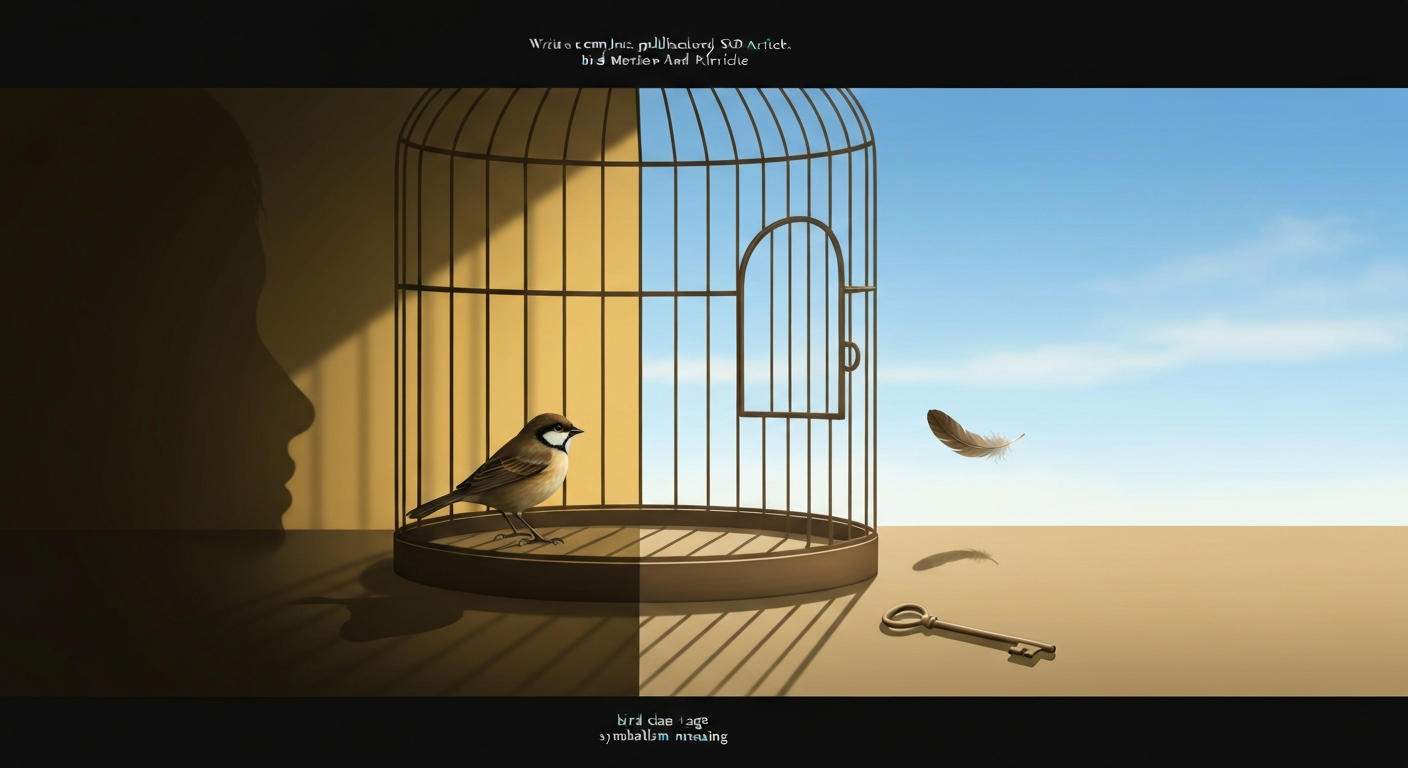
In contemporary illustration, tattoo design, and graphic art, the bird-inside-the-cage drawing typically reads within the oppression-and-hope axis established by Dunbar and Angelou. A focused discussion of bird inside the cage drawing meaning, especially in tattoo and graphic art, helps clarify common readings of entrapment, trapped voice, and liberation. A bird pressing against the bars suggests trapped voice and unfulfilled potential. A bird flying out of an open cage door is almost invariably read as liberation, transformation, or the relief of constraint. Artists who want ambiguity often paint the bird mid-flight, the cage door ajar but not fully open.
| Visual element | Common symbolic reading | Tradition/context |
|---|---|---|
| Closed cage with bird inside | Captivity, confinement, oppression, protected soul | Literary, Western art, Jungian |
| Open or empty cage | Lost innocence, liberation, absence, sexual availability | Dutch Golden Age, Victorian, literary |
| Figure reaching toward cage | Yearning, desire, constraint, thwarted freedom | European genre painting, Symbolist art |
| Bird escaping through open door | Liberation, transformation, regained voice, spiritual release | Contemporary art, tattoo, dream symbolism |
| Ornate/decorative cage | Domesticity, wealth, status, gilded captivity | Asian craft traditions, Victorian parlor culture |
| Broken or rusted cage | Decay, neglect, the passing of captivity or control | Symbolist, Surrealist, contemporary |
The practical side: what cages actually are, and why it matters symbolically
Symbols do not exist in a vacuum, they draw power from the physical reality they reference. Understanding what a bird cage actually does helps explain why the symbol resonates so deeply. A cage provides food, water, shelter, and safety from predators. It also restricts flight, limits social interaction with other birds, and, depending on size and enrichment, can impede natural behaviors like foraging, nesting, and full-wing extension. That ambiguity of function (genuine care alongside genuine restriction) is exactly what makes the cage such a rich symbol for complex relationships: a parent's home, a protective institution, a loving but controlling partnership.
Cage lining, the material placed on the cage floor, is a practical welfare consideration that carries its own minor symbolic dimension. It absorbs droppings, controls humidity, and (when done well) mimics natural substrate. In welfare terms, appropriate lining matters for the bird's physical health, which connects to the broader symbolic question of whether a cage represents genuine care or mere containment. The choice of material signals whether the keeper is attentive to the bird's needs. Common materials include newspaper, paper cage liners, and natural substrates like untreated wood shavings, each with different welfare and aesthetic implications.
| Lining material | Practical function | Welfare implications | Symbolic resonance |
|---|---|---|---|
| Plain newsprint/paper | Absorbs waste, easy to change | Safe, low-cost, widely recommended | Utilitarian care — functional but not enriched |
| Commercial cage liners | Absorbs waste, may include antimicrobials | Generally safe; check for non-toxic inks | Domesticated order; hygiene as control |
| Natural sand/grit paper | Abrasive surface aids nail wear | Debated — can irritate feet if overused | Ambiguous: natural mimicry within an artificial space |
| Untreated wood shavings | Mimics forest floor substrate | Good enrichment if dust-free and untreated | Closest to wildness within captivity |
The activity of keeping birds in cages, what might be called bird-caging as a practice, sits at the intersection of domestication, companionship, and ethical debate. Historically, caging wild-caught birds was common and culturally accepted; today, welfare standards, conservation law, and shifting ethics have changed that picture significantly. The symbolic meaning of caging a bird is therefore not static: in a contemporary context, it increasingly carries undertones of ethical responsibility, not just aesthetic or spiritual meaning.
Bird traps and related motifs: entrapment in folklore and idiom
The bird trap deserves its own symbolic treatment because it represents a different moment in the narrative arc than the cage. A trap is the mechanism of capture, the event before the captivity. In folklore and idiom, the trap emphasizes cunning, danger, and the moment of innocent vulnerability exploited. Expressions like 'falling into a trap' or being 'snared' draw directly from the physical reality of bird-trapping, and they carry connotations of deception and irreversibility. For a focused explanation of bird trap meaning and its symbolic uses, consult the dedicated entry on that topic.
In contemporary legal and ethical terms, trapping wild birds is regulated (and in many cases prohibited) under wildlife protection legislation in most jurisdictions. This practical reality reinforces the symbolic dimension: a trapped bird is not just a metaphor for a human in a bad situation; it is also a reminder that the act of trapping wild creatures is recognized as morally and legally problematic. Folklore that uses the bird trap as a negative symbol is, in this sense, aligned with modern wildlife ethics even if it predates them by centuries.
The 'bird carrying snake' motif, a separate but related image found in heraldry, mythology, and religious iconography across cultures, operates in a different register. Here, the bird is not captive but predatory or triumphant, carrying a creature associated with danger, transformation, or the underworld. In Mexican national symbolism, the eagle carrying a serpent is a founding mythological image. In Hindu iconography, Garuda the divine eagle is perpetually at war with snakes (nagas). This is the bird as power rather than victim, nearly the inverse of the caged-bird motif.
Bird cage dream meanings: how to interpret them well
Dream interpretation is genuinely useful as a tool for self-reflection, but it needs an honest framework. The scientific research on dreams, particularly the content-analysis work of G. William Domhoff and colleagues, and neuroscientific research on the metaphorical, hyperassociative nature of dream cognition, consistently finds that dream content tends to reflect a dreamer's waking-life concerns, emotional states, and cultural context rather than encoding universal fixed meanings. A 2015 open‑access review, 'Metaphor and hyperassociativity: the imagination mechanisms behind emotion assimilation in sleep and dreaming' (Frontiers/PMC), describes dreams as metaphorical and hyperassociative and recommends eliciting the dreamer's associations rather than assigning fixed meanings metaphorical and hyperassociative nature of dream cognition. This is not a reason to dismiss symbolic interpretation; it is a reason to use it as a starting point for personal reflection rather than an endpoint.
With that said, the bird cage is a sufficiently coherent and culturally widespread symbol that certain interpretive directions are broadly useful. Jungian interpreters, drawing on the bird-as-soul tradition documented in Cirlot and the ARAS Book of Symbols, typically read a caged bird in dreams as an aspect of the self (often creative energy, voice, or spiritual aspiration) that feels constrained. The condition of the cage, the behavior of the bird, and the dreamer's emotional response in the dream are all more diagnostically useful than the cage image alone.
Common dream scenarios and their interpretive directions
These are the scenarios that appear most frequently in dream reports involving bird cages. Each comes with an interpretive direction, a set of questions to ask rather than a fixed answer.
- You are inside the cage: This is one of the most emotionally intense variants. It typically maps onto feelings of restriction in waking life — a situation, relationship, or role that feels constraining. Ask: where in my current life do I feel watched, restricted, or unable to move freely?
- A bird is in the cage and you observe it: The bird may represent an aspect of yourself — often creativity, voice, or freedom — that you feel is being suppressed. Ask: what have I been holding back? Who or what holds the key in the dream?
- A bird escapes the cage: The 'bird escaping cage' dream meaning is one of the most positively read scenarios in both Jungian and practitioner frameworks. It commonly signals liberation, a regained voice, or a transition point — moving from a restricted state to an open one. Context matters: if the escaped bird feels joyful and the dreamer feels relief, the liberation reading is strong. If the bird's escape feels alarming or like a loss, the reading shifts toward anxiety about change or loss of control.
- You release the bird yourself: Agency is the key distinguishing feature here. Actively opening the cage door suggests a deliberate choice toward freedom — your own or another's. This can reflect a waking-life decision to let go of something.
- The cage is empty: Following the art-historical tradition, an empty cage in a dream most often signals absence — something or someone gone, an opportunity missed, or a phase of constraint that has ended. Whether that ending feels like relief or grief depends on the dream's emotional tone.
- The cage is broken or damaged: Decay in symbolic objects usually signals that a structure of control or protection has failed or is failing. Ask: what structure in my life is weakening? Is that frightening or liberating?
- A beautiful or ornate cage: When the cage is visually elaborate or luxurious, the dream may be exploring 'gilded captivity' — a comfortable situation that nonetheless restricts. This is the dream equivalent of the idiom 'a velvet trap.'
Dream interpretation checklist: grounding the symbol in your life
Use this checklist before settling on an interpretation. It follows the approach recommended by both Jungian practitioners and empirical dream researchers: contextualize first, symbolize second.
- Note your emotional state during the dream, not just the image. Fear, relief, sadness, awe, and frustration all point the interpretation in different directions.
- Identify who else is in the dream, if anyone, and what their relationship is to the cage or bird. Control, care, and indifference from others in the dream carry distinct meanings.
- Record whether the cage is open, closed, broken, ornate, small, or large. Visual details are interpretively significant.
- Consider what the bird is doing: singing, silent, struggling, calm, flying, or injured. The bird's behavior matters as much as the cage's condition.
- Ask what the caged bird calls to mind in your waking life right now. A current constraint? A relationship? A creative project? A belief system? The personal association typically outweighs the generic symbol.
- Check the cultural context you bring to the image. If you grew up with the Dunbar/Angelou literary tradition, your 'caged bird' will carry different resonances than if you grew up in a tradition where keeping birds was a revered aesthetic practice.
- Avoid single-sentence interpretations. 'This dream means I want to be free' is a starting point, not a conclusion. Press further: free from what, toward what, at what cost?
- If the dream recurs or is emotionally intense, treat it as worth extended reflection rather than quick symbolic lookup. Recurrent imagery in particular tends to track persistent waking-life concerns.
Spiritual vs. secular readings: a side-by-side comparison
| Reading context | What the cage represents | What the bird represents | What release means |
|---|---|---|---|
| Christian spiritual | The body or sinful state; moral/spiritual corruption (Revelation 18:2) | The soul longing for God; also unclean spirits in negative contexts | Death, salvation, or spiritual conversion |
| Buddhist | Attachment, ego, earthly desires | The sentient being trapped in the cycle of suffering | Liberation (nirvana); merit release as enacted symbol |
| Sufi/Islamic mystical | Earthly life and ego | The soul as spiritual seeker | Union with the divine; the journey in Attar's Conference of the Birds |
| Jungian/archetypal | Repression, the unconscious boundary, protective containment | The soul, the self, creative energy or spirit | Individuation, psychological integration, creative release |
| Literary/political (Western) | Social, racial, or gendered oppression | The oppressed voice and person | Equality, freedom of expression, civil liberation |
| Dutch Golden Age art | Domestic space, moral order, erotic allegory | Woman, desire, trained nature | Lost chastity (empty cage) or cultivated virtue (occupied cage) |
| East Asian folk/aesthetic | Appreciated enclosure; crafted beauty; domestic harmony | Songbird as living art; aesthetic object | Meritorious release (Buddhist); or sadness at the bird's death |
Using this guide as a starting point, not an ending point
The bird cage is one of those symbols that rewards attention precisely because it resists a single clean meaning. Every tradition covered here finds something different in the same image, and those differences are informative rather than contradictory: they tell you something real about the values, anxieties, and aspirations of the cultures that produced them. A West African protective bird is not the same as a Dutch erotic allegory, which is not the same as Maya Angelou's symbol of racialized confinement, which is not the same as a Jungian dream motif. Holding all of those meanings at once, without flattening them, is what good symbolic interpretation looks like.
If you are interpreting a specific instance, a dream, a poem, a painting, a personal encounter, the practical move is always to locate it in context first. Whose tradition does this come from? What are the visual or textual cues surrounding the cage image? What is the dreamer's or viewer's emotional response? The frameworks in this article give you the vocabulary and the comparative context; the specific meaning still belongs to the specific moment. From here, you might find it useful to explore the related motifs of bird caging as a practice, what a bird escaping its cage means in extended dream analysis, how bird trap symbolism compares, or how the inside-the-cage perspective looks in visual art and illustration.
FAQ
What is an SEO‑friendly title and meta description for an article about 'bird cage symbolism meaning' and 'bird cage spiritual meaning'?
Title: "Bird Cage Symbolism Meaning: Spiritual, Cultural, Dream & Artistic Interpretations". Meta description (≤160 chars): "Explore bird cage symbolism meaning—spiritual, cultural, dream, artistic, and practical readings with sourced guidance for interpretation."
What are the core symbolic themes of the bird cage motif?
Core themes: freedom vs. captivity (bird as desire for flight vs. cage as constraint); protection vs. confinement (safety/care vs. entrapment); control and dominance (ownership, domestication); vulnerability and loss (exposed or silenced life); domesticity and social roles (household, gendered meanings in art); and transformation (escape, release, or inner change). These themes recur across folkloric, religious and art‑historical sources (Cirlot; museum iconography).
How is the bird cage interpreted in spiritual and religious traditions ('bird cage spiritual meaning')?
Spiritual readings vary by tradition and mustn't be universalized. Examples: Judeo‑Christian: cage imagery can signal moral corruption or exile (e.g., Revelation 18:2). Sufi/Islamic mystical literature: birds represent souls on a spiritual quest (Attar’s Conference of the Birds), so a cage may indicate spiritual obstruction or the need for inner freedom. Jungian/archetypal: bird=spirit/soul; cage=containment of psyche or protective boundary (Man and His Symbols). Cite reputable texts and use caveats about local variation and context when generalizing.
How should 'bird escaping cage dream meaning' be interpreted in dreams?
Common heuristic meanings: liberation, regained voice or agency, transition, or release of suppressed emotion. Research cautions: dream symbolism is highly personal and shaped by waking life (Domhoff; dream content analyses). Interpret by asking: What emotion did the dream evoke? What was happening in waking life? Was the bird species or cage detail striking? Use associative questions rather than one‑to‑one mappings.
What are typical dream scenarios involving bird cages and how to read them?
Scenarios and reading tips: trapped bird—feeling stuck, constrained role; bird escaping cage—liberation, risk, or sudden opportunity; empty cage—loss, abandonment, or liberation already achieved; feeding a caged bird—caretaking vs. enabling dependence. Interpret via context, emotion, and waking associations; avoid pathologizing. Reference dream‑research caution (Domhoff) and Jungian archetypal heuristics for depth reading.
How is the bird‑in‑a‑cage motif used in visual art and drawings?
Artists use the motif as shorthand: closed/crowded cage = oppression or thwarted desire; open/empty cage = liberation or altered status (often sexualized in Dutch genre painting). Compositional cues—proximity to figures, gaze direction, whether bird is active—modify readings. Historical sources: Dutch Golden‑Age iconography and museum notes link parrot/canary and cage states to domestic/erotic allegory (Leiden Collection; E. de Jongh scholarship).