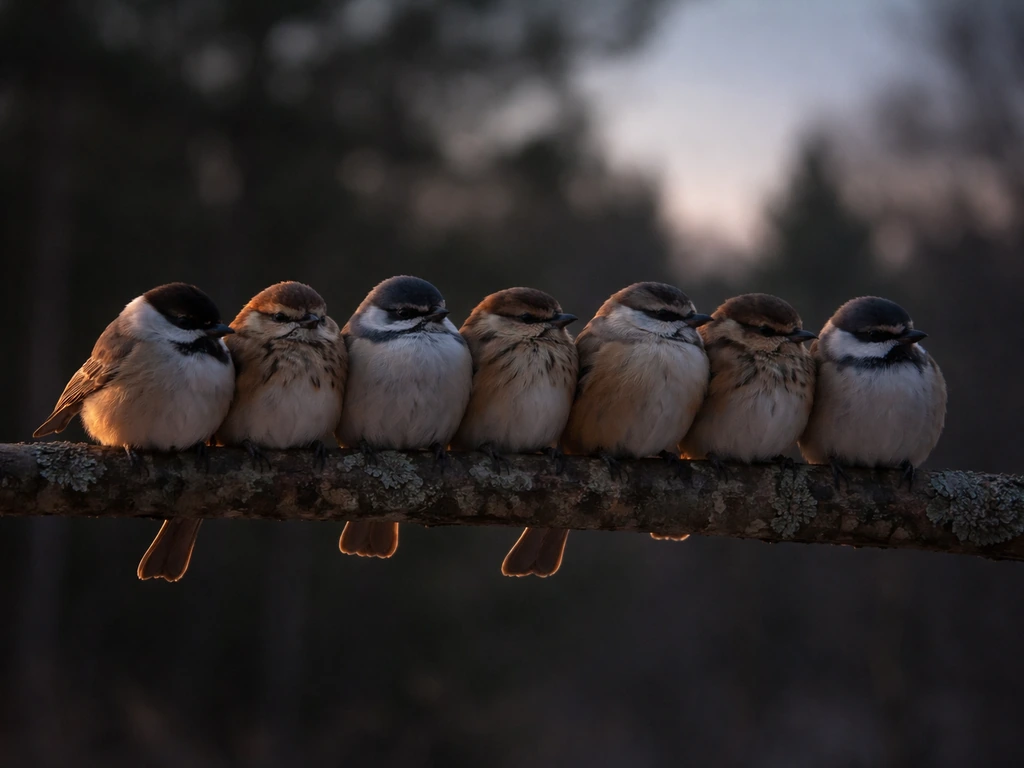
Bird flocking means a group of birds moving, feeding, or resting together as a coordinated unit rather than just happening to be in the same place at the same time. In ornithology, what makes a flock a flock is that coordinated behavior: individuals respond to each other, stay cohesive, and act more like a single organism than a collection of separate birds. Beyond the science, flocking has accumulated centuries of cultural weight, from ancient Roman priests reading divine messages in starling formations to modern dream dictionaries assigning symbolic meaning to birds gathering in the sky. Both layers of meaning are worth understanding, and knowing which one you're actually looking for makes the whole thing a lot easier to work with.
Bird Flocking Meaning: Behavioral and Symbolic Interpretations

Marcus Holloway
22 May 2026
What "bird flocking" actually means
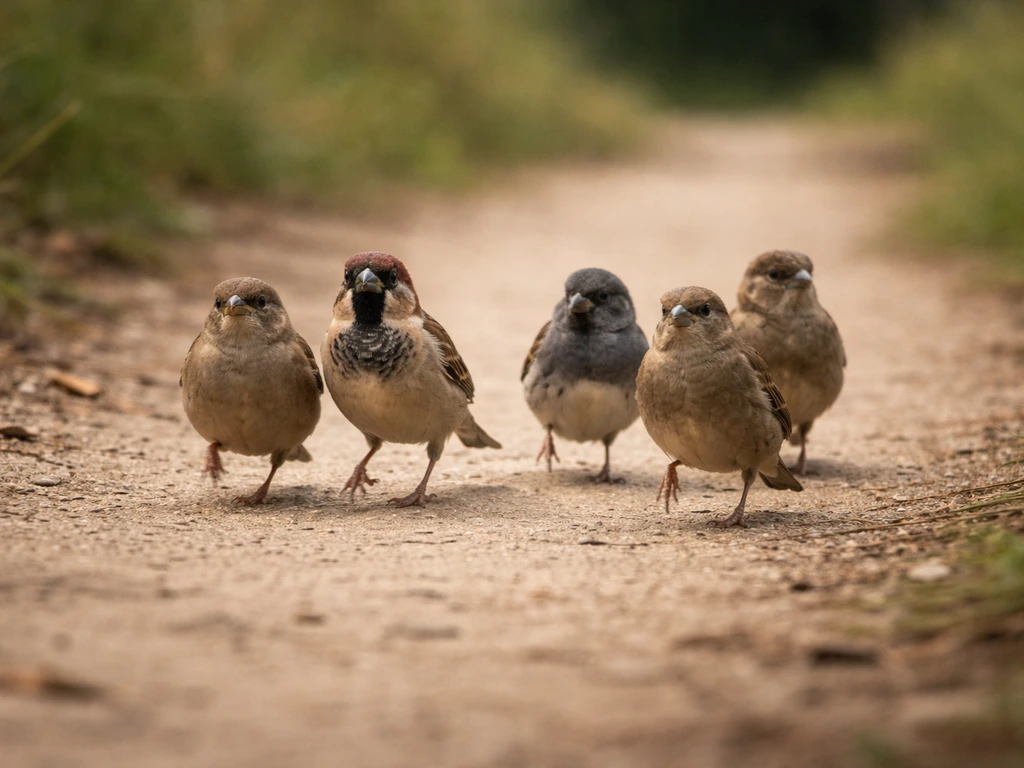
The formal definition is straightforward: a flock is a number of birds of one kind feeding, resting, or traveling together. That's how the Cambridge English Dictionary puts it, and it's a useful baseline. But the word "flock" carries more history than it might seem. Etymologically, "flock" originally described groups of people or troops before it was applied to animals, and by the 19th century it had developed a specific reference to birds. That linguistic overlap is part of why people search for the "meaning" of flocking: the word itself sits at the intersection of literal bird behavior and human metaphor.
In behavioral ecology, the key distinction is coordination. A flock isn't just many birds in the same field; it's birds acting in sync, expanding and contracting together, turning as a unit, responding to the same cues. That's different from a loose association, a breeding colony, or birds that happen to be near each other by coincidence. The most dramatic example is the starling murmuration, where thousands of birds form shifting shapes in the sky, but flocking behavior also shows up in feeding groups, roosting gatherings, and long-distance migration formations. The Starling source notes that nonbreeding-season roosts can number in the thousands, showing pronounced roosting sociality roosting gatherings.
Why birds flock: instincts and survival benefits
The short version is safety and information. Neither one is the sole driver, and both are worth knowing about.
Predator defense is the most well-documented reason. When a hawk or falcon dives into a dense, swirling flock, it has enormous difficulty isolating and targeting a single bird. The coordinated movement of a murmuration is partly a collective confusion tactic: no one bird stands out. Research on starlings specifically supports this, showing that the group's shifting shape makes it genuinely harder for a predator to lock on.
Information transfer is the other major reason. Birds in a mixed-species foraging flock, or a large group of the same species, essentially share what they know. If one bird finds food, others follow. If one spots a threat, the alert ripples through the group. Studies on collective action in birds show that foraging rates improve in groups because individuals can devote less time to vigilance and more time to actually eating. Mixed-species flocks take this further: different species have different foraging styles and alarm calls, which makes the whole group more effective than any single species would be alone.
The mechanics of coordination are also interesting. Birds don't follow a leader. Instead, each bird tracks its nearest neighbors and adjusts its own speed and direction to match them. This self-organizing rule, sometimes called the "chorus line hypothesis" in murmuration research, allows thousands of birds to move as one without any single bird calling the shots. It's a genuinely elegant biological system.
How to recognize different flocking behaviors in the wild
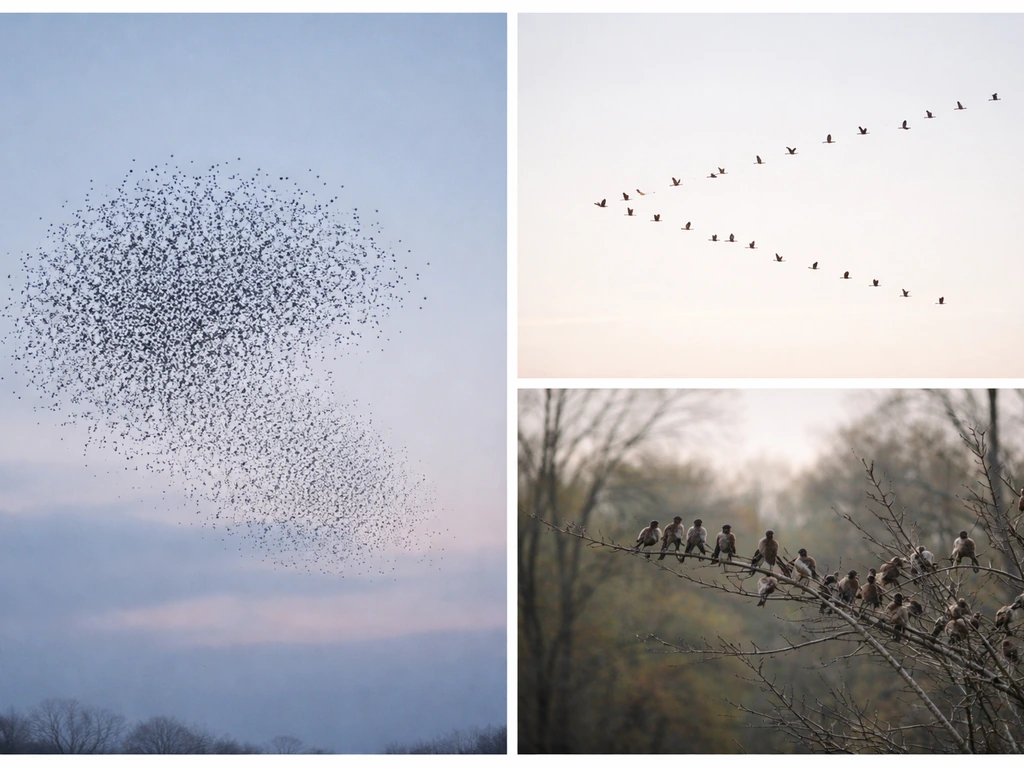
Not all flocking looks the same, and identifying which type you're watching gives you a lot more to work with in terms of what's actually going on.
| Flocking Type | What It Looks Like | Common Species | Key Context Clue |
|---|---|---|---|
| Murmuration / coordinated aerial display | Dense swirling shapes in the sky, rapid direction changes, flock stays cohesive | Starlings (most dramatic) | Often near a roost site at dusk; usually 500+ birds |
| Feeding flock | Birds gathered in a bounded area, similar feeding postures, move together as food depletes | Sparrows, finches, shorebirds, mixed species | Flat open ground, shoreline, or agricultural field; often midday |
| Roosting congregation | Large numbers arriving at the same site repeatedly at dusk or dawn | Starlings, crows, blackbirds | Same tree or area used night after night; nonbreeding season |
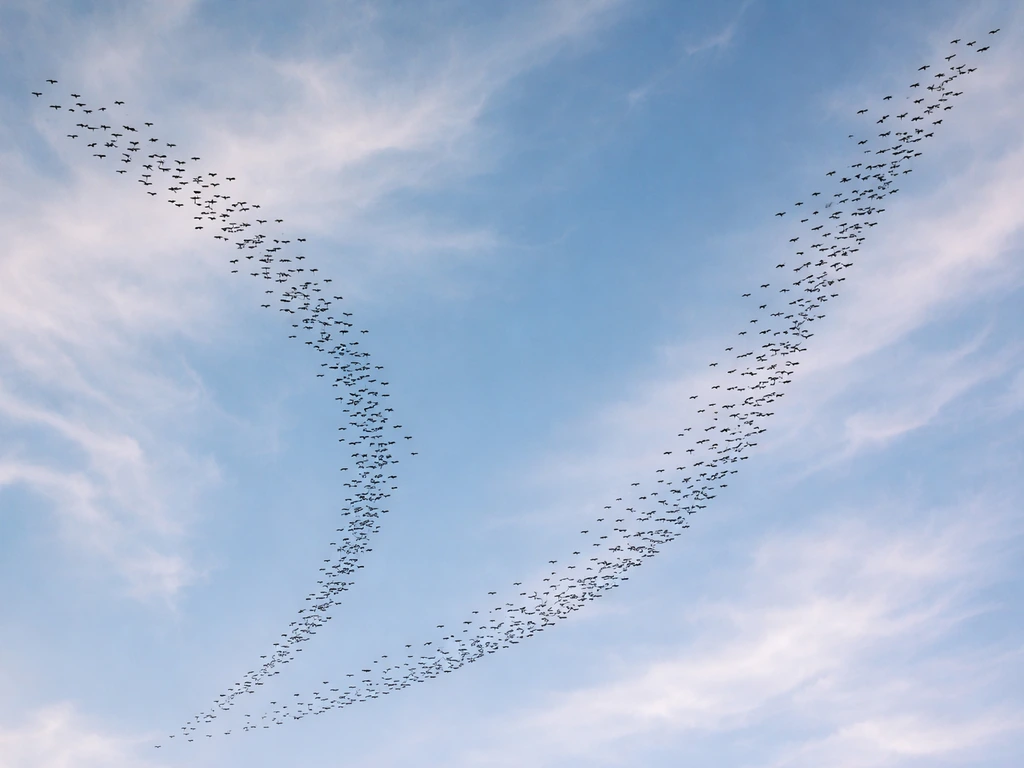
| Migration formation | Lines or V-shapes moving in one direction over long distances | Geese, pelicans, cormorants, cranes | Directional travel; seasonal (spring/fall); often higher altitude |
| Pre-roost staging | Loose to moderately cohesive groups building before moving to a roost | Multiple species | Late afternoon; birds arriving from different directions to one area |
The most reliable first step when you see a flock is to note what the birds are actually doing. Are they feeding and staying put? Commuting directionally? Swirling defensively? Then note the time of day and the season, since those two factors alone will eliminate most of the ambiguity. Audubon's field ID approach recommends noting overall size and shape, bill structure, plumage patterns, and behavior before reaching for a field mark. If you're unsure of species, focus on silhouette and flight style first, then color, then any distinctive markings.
Common myths and spiritual or cultural interpretations
Humans have been reading meaning into bird flocks for a very long time. Ancient Roman religious leaders, called augurs, interpreted the shapes and movements of starling murmurations as messages from the gods: a flock shifting left or right, tightening or expanding, was read as divine approval or warning. This practice was taken seriously at the highest levels of Roman civic and military life. The birds weren't symbolic decoration; their patterns were treated as direct communication from the divine.
That tradition of interpretation never fully disappeared. In various Western folk traditions, large gatherings of black birds, especially crows and ravens, have been linked to omens of death or misfortune. Weather folklore includes claims that certain bird behaviors, including unusual flocking or calling, signal approaching storms. Some of these claims have a loose observational basis (birds do change behavior before weather shifts), while others are pure superstition. The honest answer is that the cultural meaning of a bird flock varies significantly by region, species, and personal or religious background.
In dream interpretation, flocking birds are commonly read as symbols of community, collective movement, or transition, though dream dictionary sources consistently note that the specific meaning depends heavily on context: the species, the mood of the dream, whether the flock felt threatening or uplifting, and what's going on in the dreamer's life. None of these interpretations are factual claims about the world; they're frameworks for reflection. If you saw flocking birds in a dream, the most useful question isn't "what does this mean objectively" but "what does this resonate with for me personally right now."
How flocking shows up in language and idioms
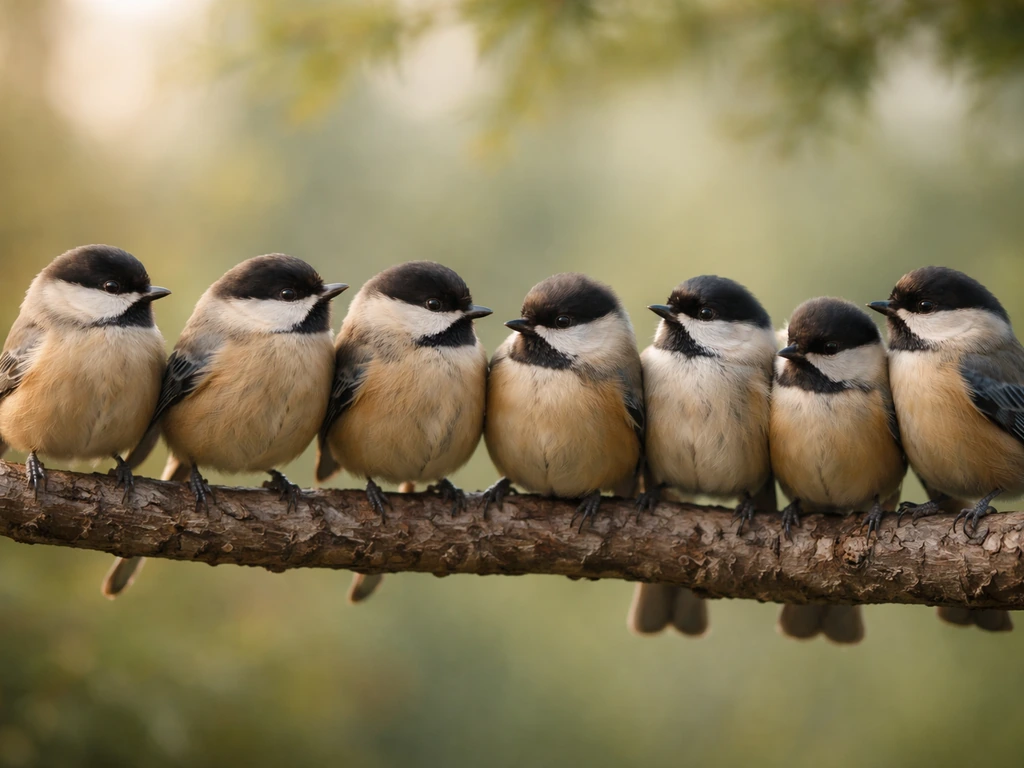
The most famous idiom connected to this topic is "birds of a feather flock together," a well-documented English proverb meaning that people with similar traits, values, or interests tend to associate with each other. The phrase uses flocking as a natural metaphor for social affinity, and it's been in consistent use for centuries. The behavioral truth behind it (that flocking species do tend to flock with their own kind) gives the proverb a satisfying literal grounding.
The verb "flock" itself, meaning to move or come together in large numbers, works in exactly the same way in everyday English: "fans flocked to the stadium," "tourists flock to the coast in summer. " The metaphor relies directly on the bird behavior, which is part of why the literal meaning and the figurative meaning are so easy to conflate in a search query.
When someone searches "bird flocking meaning," they might be asking about starlings in the sky, a dream they had, or why a phrase felt familiar. If you also meant a specific sound, the phrase "bird trill meaning" is the related question for interpreting that kind of call. This site covers all three, and it's worth knowing which one you're actually chasing.
Flocking behavior is related to, but distinct from, other collective bird behaviors that carry their own meanings. In the specific case of starlings, this is where the bird murmuration meaning becomes much more than just “a flock in the sky. ”. A murmuration is a specific type of flocking, primarily associated with starlings.
Roosting is the act of settling for rest or sleep and sometimes produces flock-like congregations. Bird chirping and bird trill refer to vocal behavior that often accompanies flocking but isn't the same phenomenon. Bird trill meaning is often about what species is calling and what context you hear it in, rather than a single universal definition.
To understand “bird chirping meaning,” it helps to look at what the birds are doing in context and which species is calling Bird chirping and bird trill refer to vocal behavior. Each of these has its own cultural and behavioral context worth exploring separately.
When flocking signals something specific
Flocking doesn't happen randomly, and the context around it tells you a lot about what's driving it. Here are the main real-world triggers to consider:
- Migration windows: Large directional flocks, especially in V or line formations, typically appear in spring (March through May) and fall (August through November) in North America and Europe. If you're seeing organized formations moving steadily in one direction, migration is the most likely explanation.
- Season and food availability: Feeding flocks peak when food is concentrated and abundant, whether that's a berry-covered shrub in late fall, a flooded field full of invertebrates, or a seeded lawn. Large staging flocks like Wilson's phalaropes at the Great Salt Lake gather specifically to fuel up before long flights.
- Predator pressure: Sudden dramatic aerial flocking, especially swirling or tight bunching behavior, often means a raptor is nearby. Watch for a hawk or falcon working the edges of the flock or diving through it.
- Pre-roost behavior: Birds gathering repeatedly in the same area at dusk, especially in fall and winter, are likely heading to a communal roost. Starling murmurations are the textbook case, but crows, blackbirds, and grackles do this too.
- Weather changes: Some folk traditions link unusual bird behavior to approaching storms, and there's a biological basis for it: barometric pressure drops before storms can affect insect availability and bird activity. This is observational rather than predictive, but it's not entirely groundless.
- Habitat disturbance: Birds flushing suddenly from a large area and regrouping can indicate a ground predator, a human disturbance, or a sudden environmental change. If a flock scatters and reforms quickly, something startled them.
What to do if you see flocking near your home or in a dream
If you're watching a real flock
Start by observing before reaching for your phone. Note the time of day, the season, what the birds are doing (feeding, flying directionally, swirling, gathering to roost), and roughly how many there are. Then try to identify the species using the All About Birds or Audubon ID framework: size and shape first, then color pattern, then behavior, then habitat. A flock of large black birds gathering at dusk in October is probably European starlings or American crows heading to roost. A V-formation of large birds in spring is probably Canada geese or pelicans on migration.
If you want to go further, check eBird to see what species have been reported in your area recently. You can filter by location, date, and species, which quickly tells you whether what you saw is expected or unusual. If it's unusual, eBird lets you document it with notes on time, location, and weather, which is both useful for your own records and genuinely helpful for citizen science data.
If birds are congregating regularly near or on your property, the question is usually about food, shelter, or roost sites. A large roost can be messy and noisy, and managing it is a practical matter: removing or trimming trees, reducing artificial light at night, or contacting your local wildlife agency if the situation is affecting your home. There's no supernatural significance required to take that practically.
If the question came from a dream or symbolic experience
If you searched "bird flocking meaning" because you had a vivid dream or felt a flocking event was meaningful, that's a completely reasonable place to start. Dreams about birds, and especially flocking birds, tend to reflect themes of community, collective movement, transition, or a sense of being carried somewhere by forces larger than yourself. Whether that resonates has everything to do with your personal life context rather than any universal rule.
The most practical approach is to treat the symbolism as a prompt for reflection, not a verdict. Ask yourself what the flock felt like in the dream: was it reassuring, overwhelming, beautiful, threatening? What's happening in your life that might connect to themes of belonging, movement, or collective change? Dream interpretation works best as a tool for self-examination, not prediction. If you want to explore specific bird symbolism in more depth, knowing the species (or the closest approximation) will get you much further than a general search for flocking meaning alone.
- Observe first: time of day, season, behavior, approximate number of birds, and direction of movement if any.
- Identify the species using size, shape, color, and behavior before reaching for field marks.
- Cross-reference with eBird or Audubon to see what's expected in your area and time of year.
- If the flock is recurring near your home, consider practical factors like food sources, roost trees, and light pollution before assuming anything symbolic.
- If the question is personal or dream-based, focus on what the flock felt like and what themes in your own life it might reflect, rather than looking for a fixed external meaning.
FAQ
Is “bird flocking” ever used to mean birds just happen to be near each other?
In everyday speech it can be loose, but in behavioral terms it implies coordinated movement like staying cohesive, turning together, or responding to shared cues. If the birds are scattered with no matching direction changes, it’s usually a gathering or coincidence rather than true flocking behavior.
How can I tell if I’m seeing flocking or migration?
Flocking can happen during feeding or roosting, while migration is typically directional for longer stretches of time. Look for whether the group maintains a steady travel route over distance, and whether the timing matches seasonal movement, migration corridors, or known local patterns.
What does it mean if the flock is moving fast or swirling but not in a murmuration pattern?
Swirling can still be defensive or responsive, but not all shapes mean a murmuration. Note whether birds are staying cohesive in quick bursts near a predator or whether the movement looks like coordinated foraging shifts, which can produce rapid, collective repositioning without the iconic starling “liquid” effect.
Why do some flocks look organized, but others seem chaotic?
Even within one flock type, coordination level changes with conditions. Wind, visibility, food distribution, and predator pressure can make movement look tighter or looser. If you see abrupt breakoffs, it may reflect birds leaving to feed separately rather than a failure of flocking.
Do mixed-species flocks always mean food is available?
Often they form around foraging opportunity because different species benefit from shared information and complementary feeding styles. But mixed flocks can also form around safety, roost access, or temporarily suitable habitat, so location and time of day matter.
Can flocking behavior happen at night, and how should I interpret it?
Yes. Roosting and evening gatherings can look like flocking, even if the birds are settling rather than traveling. If the birds are landing, calling less, and becoming stationary, it’s more consistent with roosting congregations than active flock coordination.
If I saw a flock near my house, does it always have a symbolic meaning?
No. A practical explanation is usually first: nearby food sources, nesting sites, safe cover from predators, or consistent water. Symbolic interpretations can still be meaningful for you personally, but they are not needed to explain the behavior in the real world.
What’s a common mistake people make when searching “bird flocking meaning”?
People often mix up three different intents: literal identification (what species and behavior), psychological meaning (dream or symbolism), and idiom usage (like social similarity). A quick check is to ask, “Am I trying to understand what birds were doing, what the event means to me, or why the phrase ‘flock together’ exists?”
If it’s a dream, how should I connect it to my real life without overreaching?
Start with the emotional tone and the action in the dream, for example, chasing, following, being surrounded, or trying to leave. Then match it to a current-life theme like belonging, group pressure, career movement, or transition. Avoid treating the imagery as a prediction, use it as a reflection prompt.
When should I document or report birds that seem unusual?
If flocking is extreme, persistent, or associated with illness signs (limping, lethargy, repeated collisions), note date, time, location, weather, and estimated numbers, and consider contacting a local wildlife or birding group. For typical behavior that seems surprising only because it’s large, check recent sightings first to rule out normal seasonal variation.