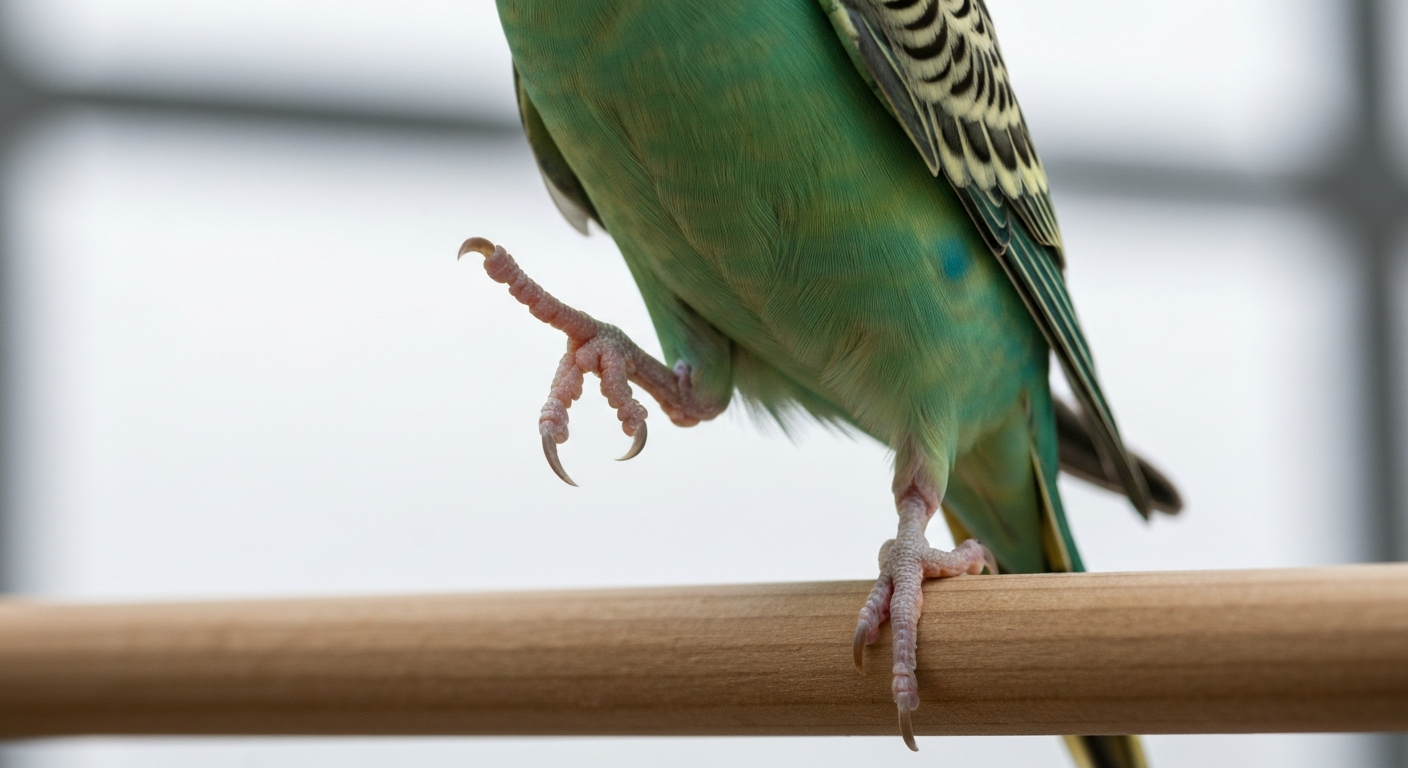
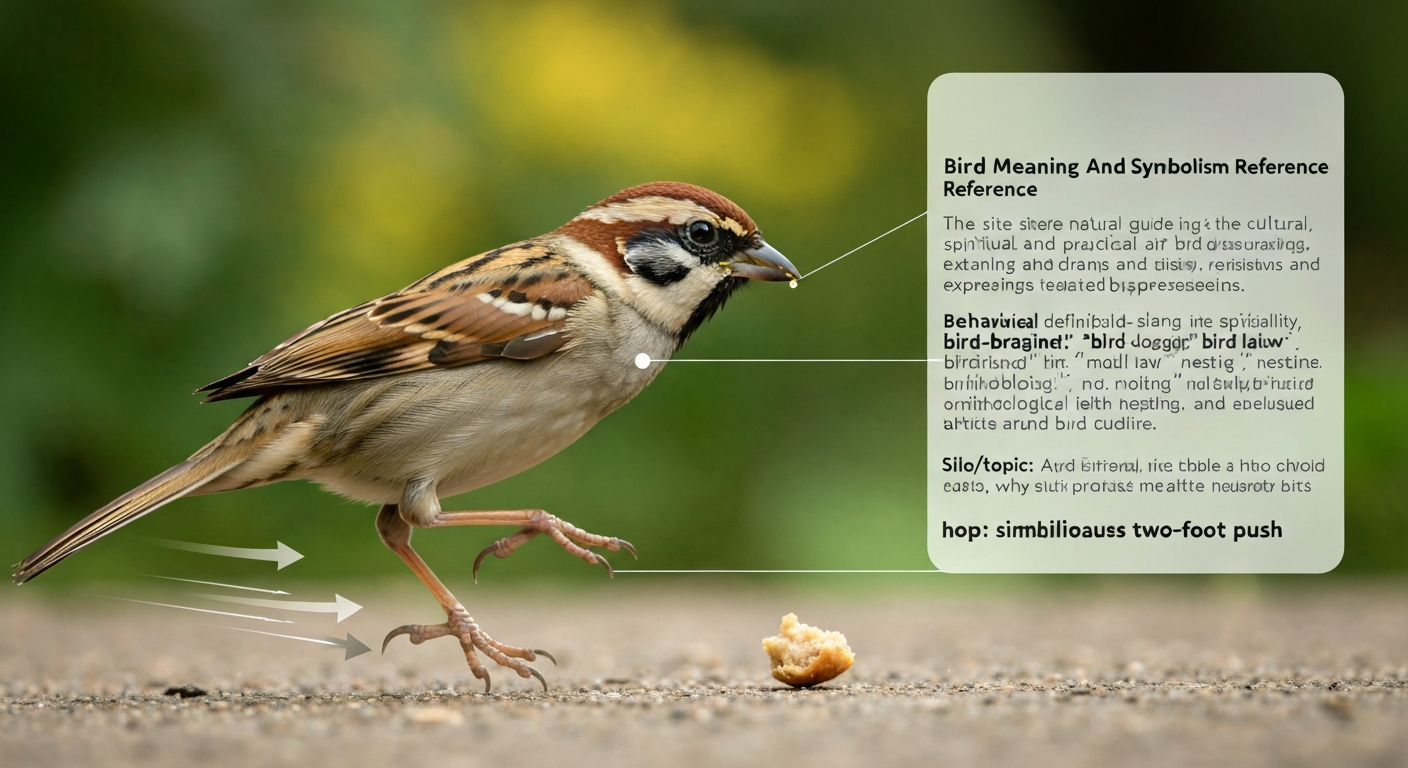
Bird hopping means a bird is moving across a surface using a series of two-footed jumps, with both feet leaving and landing at the same time, rather than placing one foot in front of the other in a walking stride. That single behavioral fact turns out to matter in three very different ways: ornithologically, it tells you something about the species you're watching and whether it's healthy; symbolically and in folklore, a hopping bird carries specific associations in dreams, omens, and cultural tradition; and in language, 'bird hopping' shows up as a metaphor and idiom with its own range of meanings. This article covers all three.
Bird Hopping Meaning: Nature, Symbolism & Health Cues Guide

Marcus Holloway
16 Jul 2026
What 'Bird Hopping' Actually Means
In the most literal, ornithological sense, hopping is a defined locomotor category: both feet push off and land simultaneously, producing a short vertical or stepwise jump. Ethologists list it separately from walking (alternating feet), running (alternating feet at speed), and shuffling (dragging or side-stepping). The EFSA welfare definitions for laying hens include 'locomotion' with hopping listed as a distinct category separate from walking in ethograms and welfare assessments blank" rel="noopener noreferrer">The EFSA welfare definitions for laying hens include 'locomotion' with hopping listed as a distinct category separate from walking in ethograms and welfare assessments.. The Cambridge English Dictionary captures the everyday meaning of 'hop' as moving by jumping on one or both feet at the same time, and that lexicographic definition maps cleanly onto what bird behaviorists mean when they record a hop in an ethogram.
When people type 'bird hopping meaning' into a search engine, though, they're usually asking one of three questions: Why does that bird outside keep hopping instead of walking? What does it mean spiritually or in a dream? Or, sometimes, is there something wrong with my pet bird because it's hopping differently than usual? This article addresses all three, with the ornithological mechanics first because they underpin everything else.
How and Why Birds Hop: The Mechanics
Bird locomotion has been studied in detail using high-speed video and force plates, and the science is clear: hopping is not an accidental or immature version of walking. It's a biomechanically distinct gait. Small birds in particular rely on a spring-loaded locomotion model, sometimes called the spring-loaded inverted pendulum or SLIP framework, where leg stiffness and body mass predict which gait a bird will choose at a given speed. Body size is one of the strongest predictors: smaller, lighter birds with relatively stiff legs tend to default to hopping on the ground, while larger birds with more flexible leg posture more often walk or run.
Kinematic studies, including high-speed video analysis of the black-billed magpie, document the distinct limb mechanics of walking, running, and out-of-phase hopping as separate movement categories with measurably different force-time profiles. Force-plate work on common starlings shows that hopping and short jumps produce different muscle power demands than walking or flight take-offs. In other words, when a sparrow hops toward a crumb, it is not doing a sloppy walk. It is executing a specific, energetically tuned movement strategy.
The Six Main Reasons Birds Hop
- Foraging locomotion: Many small species, including House Sparrows (Passer domesticus, described by Audubon as foraging 'mostly while hopping on ground'), use hopping as their standard ground-feeding gait because it allows rapid direction changes and quick weight shifts.
- Perch-to-perch movement: Hopping along a branch or wire is the most efficient short-distance movement for birds with feet adapted for gripping perches. The two-footed push lets them reposition without flight.
- Balance and postural adjustment: Birds hop to rebalance on uneven surfaces, after landing from flight, or when adjusting position after being disturbed.
- Courtship display: Several species incorporate stylized hops into their courtship routines. Some combine them with wing movements in what field literature calls 'hop-and-flap' displays, which are mechanically distinct from foraging hops.
- Escape behavior: A short hop, sometimes combined with a wing assist, is a common initial escape response before full flight. You'll see this when a ground-feeding bird is startled.
- Juvenile practice: Fledglings developing coordination hop as they build leg strength and practice gait transitions. Increased frequency of hopping in young birds is normal developmental behavior, not a sign of injury.
Field guides from Cornell Lab and similar resources explicitly instruct birdwatchers to note whether a bird hops, walks, runs, or flaps on the ground, because locomotor style is a species-typical identification cue. Some chickadees and sparrows routinely hop; many warblers tend to move with quick steps and flicks. Knowing that a bird's hopping is normal for its species is step one in any meaningful observation.
Hopping vs Similar Movements: A Quick Comparison
Hopping is easy to confuse with other bird movements, especially at a glance or when you're trying to describe something you've just seen. The table below outlines the most commonly confused behaviors and what distinguishes them.
| Behavior | What It Looks Like | Likely Cause | Common Meanings / Significance |
|---|---|---|---|
| Hopping | Both feet leave and land simultaneously; bird moves in short jumps | Normal foraging locomotion, perch adjustment, courtship, escape, juvenile practice | Species-typical movement; healthy in context; symbolically linked to energy and progression |
| Tail shaking / tail feather shaking | Tail fans out or vibrates rapidly; body may stay still | Post-preening settling, courtship signal, territorial display, stress response | Often a communication or reset signal; can be a mood indicator in pet birds |
| Shuffling | Side-to-side or dragging foot movement; low, flat locomotion | Perch adjustment, feather settling, sometimes neurological or foot issue | Worth monitoring if persistent; abnormal shuffling with unsteady posture can indicate illness |
| Tail bobbing with breathing | Rhythmic tail pumping synchronized with each breath, visible at rest | Increased respiratory effort; respiratory infection, obstruction, or distress | Clinical red flag — tail bobbing at rest warrants prompt veterinary attention |
| Twitching | Rapid, involuntary micro-movements of body, wing, or head; not purposeful | Neurological, toxin exposure, extreme stress, or normal alarm response | Occasional brief twitching on alarm is normal; sustained twitching is a health concern |
Telling These Behaviors Apart in the Field
The key practical distinction is intentionality and rhythm. A hop covers ground: the bird moves from point A to point B, however short the distance. Tail shaking and tail feather movement, on the other hand, involve the bird staying roughly stationary while the tail fans, trembles, or pumps. If you're curious about what drives tail feather shaking specifically, that behavior has its own range of causes including post-preening feather settling, courtship signaling, and territorial communication worth exploring separately. For more on what different tail movements signify, see our page on bird tail meaning.
Shuffling is different again: it tends to look low and flat, with the bird sliding or dragging its feet rather than pushing off with both simultaneously. Normal shuffling on a perch (a bird repositioning its grip) is common, but shuffling combined with unsteady posture or an inability to grip properly is worth watching closely. Shuffling as a ground movement in a species that normally hops can be an early indicator something is off.
Tail bobbing synchronized with breathing is perhaps the most diagnostically important behavior to distinguish from all the others. Unlike a voluntary tail shake or a hop's incidental tail movement, respiratory tail bobbing has a mechanical regularity: it rises and falls with each breath. Seeing this in a bird at rest, rather than immediately after vigorous flight, is a red flag for respiratory distress. Poultry veterinary guides (Respiratory tract infection in chickens, PoultryDVM) list tail‑bobbing, gaping/open‑mouth breathing, panting, neck extension and persistent inability to perch as signs warranting immediate isolation and veterinary evaluation Respiratory tract infection in chickens — PoultryDVM (extension/clinical guide). This is fundamentally different from the situational tail bobbing some species do as a normal communication behavior, which is worth understanding on its own terms.
Twitching, meaning small involuntary body tremors or rapid micro-movements not part of a purposeful action, overlaps with the startle response. A single brief twitch when alarmed is normal. Repeated, sustained twitching at rest, or twitching combined with head tilt and incoordination, points toward neurological or toxic causes and needs veterinary assessment. For more on causes and when to seek care, see bird twitching meaning.
Normal Hopping vs Signs of Illness or Injury
Birds mask illness very effectively as an evolved survival behavior, which means locomotion changes are often the first visible sign that something is wrong. A bird that is hopping with purpose, alert posture, and normal weight distribution is almost certainly behaving healthily. The concern arises when the hopping changes character or is accompanied by other signs.
Signs That Hopping Is Healthy
- Hopping is species-typical for that bird (sparrows, robins, and thrushes routinely hop; pigeons and starlings typically walk or run)
- The bird maintains upright, alert posture between hops
- Weight is distributed evenly on both feet during landing
- The bird flies away when approached
- Eyes are clear, plumage is smooth and held close to the body
- Hopping is directed toward food, a perch, or a specific destination
Red Flags to Watch For
Merck Veterinary Manual and clinical reviews of avian disease consistently flag the following as signs that require veterinary or rehabilitator attention. These apply to both wild birds and pet birds:
- Inability to perch or sitting persistently on the cage floor or ground
- Asymmetric hopping, or favoring one leg dramatically
- Ataxia: incoordination, stumbling, or circling between hops
- Fluffed feathers held away from the body at rest
- Head tilt combined with any locomotion change
- Tremors or twitching accompanying movement
- Tail bobbing synchronized with breaths (respiratory distress)
- Lethargy, reduced response to stimuli, or eyes closing during the day
- Open-mouth breathing, gaping, or neck extension at rest
Clinical reviews describe 'sick bird syndrome' as a cluster of subtle behavioral changes, including reduced hopping and inability to perch, that signal serious metabolic, neurological, or infectious disease. Because birds hide illness, by the time these signs are obvious, the bird is often significantly compromised. Early action matters.
Observation Checklist for Birdwatchers and Pet Owners
Whether you're watching a wild bird in the garden or monitoring a pet bird at home, systematic observation before you act is valuable. Here's what to record:
- Posture: Is the bird upright and alert, or low, hunched, and fluffed?
- Frequency: Is it hopping continuously, intermittently, or has it stopped hopping when it normally would?
- Symmetry: Does it land evenly on both feet, or favor one side?
- Environment: Is this normal foraging ground, a perch, a cage floor, an unusual surface?
- Vocalizations: Is the bird calling normally, silent, or making distress sounds?
- Breathing: Is breathing visible at rest? Is the tail pumping rhythmically with each breath?
- Plumage: Smooth and tight, or fluffed and disheveled?
- Duration and time of day: One-off behavior or persistent over hours?
- Recent changes: New food, new cage mate, recent weather event, window strike, or any observed trauma?
- Flight response: Does the bird fly away when you approach, or is it unable to or unwilling to?
When and How to Help: Practical Actions
Not every hopping bird needs intervention. If a wild bird is hopping normally in your garden, the right action is to observe from a distance and let it be. Intervention becomes appropriate when the bird shows multiple red flags from the list above, or is clearly unable to fly away when you approach at close range.
Immediate Steps for an Injured or Distressed Wild Bird
- Observe from a distance first: confirm the bird is genuinely unable to leave, not just foraging calmly.
- If you need to contain it, use a cardboard box or paper bag with ventilation holes. Avoid wire cages, which cause additional injury.
- Keep it warm, quiet, and dark: place a soft cloth (not terry toweling, which catches claws) in the container, and keep it away from pets, children, and noise.
- Do not give food or water unless instructed by a rehabilitator: incorrect feeding causes more harm than the short wait.
- Contact a licensed wildlife rehabilitator immediately. The National Wildlife Rehabilitators Association directory is the standard starting point. State fish and wildlife agencies and local animal-help hotlines can also direct you.
- Transport as soon as possible: minimize handling and do not attempt extended home care without proper permits and training.
For Pet Bird Owners
If your pet bird's hopping has changed, especially if combined with any of the red flags listed above, contact an avian veterinarian rather than a wildlife rehabilitator. Avian vets specialize in companion bird medicine and can assess locomotor changes, perform diagnostics, and treat the underlying cause. Do not wait to see if it resolves on its own if the bird is showing multiple concurrent signs of illness.
Cultural and Spiritual Symbolism of Bird Hopping
Across a range of folk traditions and symbolic frameworks, a hopping bird carries associations of energy, progress, and transition. The image of a bird moving in small but decisive leaps, neither walking slowly nor flying away entirely, maps intuitively onto ideas about cautious forward movement, incremental progress, or a spirit that is present but not yet fully committed to departure. That interpretive template appears in dream symbolism, folklore, and various cultural traditions, though the specifics vary considerably.
Dream Meanings
In popular dream interpretation, a bird that hops in a dream is frequently read as a symbol of small but real progress: you are moving forward, but doing so carefully, one jump at a time. Some interpretive traditions distinguish between a bird hopping toward the dreamer (read as approaching good fortune or a message coming closer) and a bird hopping away (interpreted as opportunity receding or something unresolved). As with all dream symbolism, these meanings are frameworks for reflection rather than fixed truths. The most useful question is what the image personally evokes, placed alongside the broader emotional tone of the dream.
Superstitions and Folk Omens
In various European and North American folk traditions, a bird hopping near a door or window is treated as a messenger omen, sometimes positive (news arriving, a visitor coming) and sometimes a warning, depending on the species. A robin hopping near the front step has been read in British tradition as a good sign, while a crow hopping back and forth on a fence has historically been treated with more ambivalence. These associations are culturally specific and frequently contradict each other across regions, which is worth keeping in mind before assigning a single definitive meaning to any observed behavior.
Cross-Cultural Variations and Caveats
Native American traditions vary enormously by nation, but several associate ground-level bird movement with messages from ancestors or the earth, while airborne birds are more typically linked to sky spirits or higher messages. In some East Asian traditions, birds hopping near a home at the start of a new season are considered auspicious, indicating the arrival of good energy. In West African and diaspora traditions, birds as messengers is a broad and robust theme, and the specific movement of a bird (flying, perching, hopping) can modulate the nature of the message. The common thread across these varied traditions is that movement type carries meaning: hopping specifically suggests something is in transition, neither arrived nor departed.
A reasonable interpretive approach is to treat these traditions as culturally-grounded metaphors worth knowing about, while resisting the urge to collapse them into a single universal reading. What a hopping bird means to you, if you're working from a specific tradition, is best understood within that tradition's own framework.
How 'Bird Hopping' Appears in Language and Writing
The phrase 'bird hopping' isn't a fixed idiom in the way that 'bird-dogging' or 'bird law' are established expressions. Instead, it functions more as a descriptive compound that writers reach for when they want to convey a particular kind of movement: quick, light, incremental, slightly erratic but purposeful. You'll find it in nature writing, poetry, and prose used to evoke nervous energy, tentative approach, or nimble navigation of an obstacle.
Metaphorically, 'hopping from branch to branch' and 'hopping from topic to topic like a bird' both carry the sense of rapid, non-linear movement that doesn't commit to depth. This connects to a broader cluster of bird-movement idioms in English: 'flitting,' 'fluttering,' and 'pecking' all share semantic overlap with hopping as ways of describing distracted or surface-level engagement. Writers researching bird expressions for a character, scene, or metaphor will find that hopping occupies a specific register: lighter than stalking or striding, more purposeful than fluttering, and more grounded than soaring or swooping.
In informal speech, 'bird hopping' occasionally appears as a variant of 'bar hopping' or 'channel hopping,' applied to birding contexts: 'we were bird-hopping all morning along the creek' meaning quickly visiting multiple birding spots. This usage is informal but recognizable in birdwatching communities.
Ambiguous and Missearched Terms: What Did You Mean?
Sometimes people searching for 'bird hopping meaning' are actually trying to find something slightly different, and it's worth clarifying a few commonly confused terms.
'Bird Trunk', A Likely Misquery
If you searched for 'bird trunk' and landed here, the most likely intended term is the crop, which is the muscular pouch in a bird's esophagus where food is stored and pre-digested before moving to the stomach. In some birds, an engorged crop is visible as a rounded bulge at the base of the neck, which could be described as a 'trunk' or 'chest bulge.' The crop is normal anatomy; a very hard, impacted, or sour-smelling crop can indicate a health problem. Another possibility: 'trunk' as a misremembering of 'torso' or 'body condition,' meaning the bird's general body shape and weight. A third possibility is that 'bird trunk' appeared in a crafting or decorative context (a storage trunk decorated with bird motifs), which is entirely unrelated to bird behavior.
Other Queries That Land on This Topic
- 'Bird jumping' — same behavior as hopping; often used interchangeably, though 'hop' implies both feet simultaneously while 'jump' is sometimes used for longer leaps or take-off movements.
- 'Bird bouncing' — typically used to describe the elastic, spring-like quality of hopping locomotion; the same biomechanical SLIP framework applies.
- 'Bird skipping' — a colloquial description of rapid alternating hops that gives a skipping appearance; not a formal ethological category.
- 'Bird not walking properly' — this query usually signals a welfare concern; use the red flags checklist above to assess whether veterinary attention is needed.
Figure and Image Suggestions
The following visual elements would strengthen this article for both general readers and birdwatchers.
- Photo: A House Sparrow mid-hop on a pavement or garden path, with both feet clearly off the ground — caption: 'House Sparrow (Passer domesticus) in mid-hop during ground foraging. Both feet leaving the surface simultaneously is the defining feature of a hop versus a walk.'
- Comparison diagram: A side-by-side illustration of (1) walking gait, alternating feet, (2) hopping gait, both feet simultaneous, and (3) running gait, showing the difference in footfall pattern — caption: 'Three ground gaits in birds: walking, hopping, and running differ in footfall timing and body mechanics.'
- Photo: A robin on a lawn hopping toward a worm — caption: 'Robins use a distinctive stop-hop-pause pattern when foraging, making them a good field example of purposeful hopping behavior.'
- Close-up photo or diagram: Bird tail showing rhythmic bobbing position versus a normal resting tail position — caption: 'Tail bobbing at rest (left) versus normal tail position (right): rhythmic tail pumping synchronized with breathing is a veterinary red flag.'
- Short video suggestion: Slow-motion footage of a sparrow or robin hopping across a surface, ideally shot from side-on to show both-feet-off-the-ground moment — caption: 'Slow motion reveals the brief aerial phase of each hop that distinguishes it from walking.'
- Infographic: The observation checklist formatted as a visual card (posture, frequency, symmetry, environment, vocalizations, breathing, plumage, duration, recent changes, flight response) suitable for printing or saving as a quick reference.
Quick-Reference Summary
| Topic | One-Sentence Summary |
|---|---|
| What hopping is | Both feet push off and land simultaneously in a short jump; a distinct locomotor category, not a sloppy walk. |
| Why birds hop | Foraging efficiency, perch adjustment, courtship display, escape initiation, and juvenile gait practice are the six main reasons. |
| Which birds hop | Small birds (sparrows, robins, thrushes, chickadees) hop most; larger birds (pigeons, starlings) more often walk or run. |
| Healthy vs. concerning | Alert posture, even weight distribution, and species-typical frequency mean healthy; fluffed feathers, asymmetric landing, ataxia, or tail bobbing with breathing are red flags. |
| What to do | Observe first; contain, warm, and darken an injured bird; contact a licensed rehabilitator or avian vet promptly; do not feed without guidance. |
| Symbolic meaning | Hopping in dreams and folklore commonly signals cautious forward progress, a message in transition, or incremental movement toward a goal. |
| In language | Hopping carries connotations of light, quick, non-linear movement; used metaphorically for distracted engagement or rapid location-switching. |
| 'Bird trunk' query | Most likely means the crop (esophageal food pouch) or a visible body-condition feature; not a standard ornithological term. |
Pages Worth Exploring Next
If this article prompted further questions, several related topics on this site go deeper on specific threads. A page on bird symbolism covers the broader cultural frameworks for interpreting bird presence and behavior across traditions. Interpreting bird dreams offers a structured guide to working with bird imagery in your sleep life without over-prescribing meaning. Common bird behaviors gives a wider ethological overview of what birds do and why, covering preening, molting, nesting, and more. If the health sections raised concerns about a wild bird, a dedicated page on when to call a wildlife rehabilitator walks through the decision in more detail. And if the language angle interests you, the bird idioms and expressions section of this site covers expressions from 'bird-brained' to 'bird-dogging' and the cultural history behind them.
Bringing It All Together
Bird hopping is one of those topics that looks simple on the surface and keeps opening up. At its core, it's a biomechanically distinct gait that small birds use for foraging, perch adjustment, courtship, and escape, and it's a species-typical ID cue that experienced birders use without even thinking about it. When hopping changes in character or is combined with signs of distress, it becomes a practical welfare indicator that's worth taking seriously early.
For birdwatchers: note locomotion style as part of your field observations. For pet owners: any change in how your bird moves, especially combined with other symptoms, deserves prompt attention. For dreamers and people seeking symbolic meaning: the recurring theme across traditions is transition and cautious forward movement, which is a useful reflective frame without being a predictive one. And for writers: hopping is a precise, evocative word with a specific movement character that earns its place in the right sentence.
FAQ
What does “bird hopping” literally mean in ornithology and everyday language?
Literally, “hopping” describes a short, often vertical or stepwise ground movement where a bird launches from and lands on its feet in discrete jumps rather than taking continuous walking strides. Ethologists and field guides treat hopping as a distinct locomotor category (separate from walking or running) and the dictionary sense of “hop” (move by jumping on one or both feet) maps directly to how biologists use the term.
Why do birds hop? (biological and biomechanical causes)
Birds hop for several biomechanical and ecological reasons: to move efficiently given body size and leg posture (small passerines commonly hop or use grounded‑running gaits), to forage—covering small distances while searching for seeds or insects, to maneuver on uneven substrates (leaf litter, branches, rocks), to perform short escape jumps or display movements, and as part of hop‑and‑flap take‑offs. Biomechanics research (SLIP/BSLIP frameworks, force‑plate and kinematic studies) shows hopping has distinct limb kinematics and force profiles from walking or flight.
How does hopping differ from related movements (walking, running, shuffling, tail‑shaking, tail‑bobbing, twitching)?
- Hopping: discrete jumps or bounce‑steps with synchronized limb push/land cycles; short/vertical. - Walking: alternating footfalls with continuous ground contact phases; longer stride cycle. - Grounded running/short runs: bounce‑like gait with aerial phases or quick stride turnover — sometimes intermediate between walk and hop for small birds. - Shuffling: very small, sliding foot movements, low lift from the substrate. - Tail‑shaking: active lateral or rapid vertical motion of the tail used in communication or preening—not a locomotor gait. - Tail‑bobbing: rhythmic tail movement timed to breathing; clinically associated with respiratory effort. - Twitching (head/feather twitch): brief neuromuscular flicks often linked to irritation, preening, or nervousness. Ethograms and species accounts routinely list these as separate actions; some behaviours blend (e.g., hop‑and‑flap).
When is hopping normal species‑typical behaviour and when is it a red flag for illness?
Normal: Many small ground‑foraging species (house sparrows, chickadees, some finches) hop routinely while feeding or moving between perches; brief hops during alarm or displays are normal. Red flags: sudden loss of normal hopping ability, repeated stumbling or ataxia, sitting low on perch or on cage floor, persistent reluctance to hop, tremors, fluffed plumage, head tilt/circling, or any concurrent respiratory signs (tail‑bobbing, open‑mouth breathing). Because birds mask illness, subtle changes in locomotion can be early indicators of metabolic, neurologic or infectious disease.
If I see a stunned or grounded wild bird that’s hopping instead of flying, what should I do?
Observe first from a distance. If the bird appears alert and able to perch and hop normally, leave it alone: many birds recover and fly off. If it is injured, bleeding, unable to perch, hypothermic, or showing severe disorientation, place it in a ventilated box kept warm and quiet (do not feed or give liquids) and contact a licensed wildlife rehabilitator or local wildlife agency. Use national/local rehabilitator directories (e.g., NWRA/IWRC) for referrals.
What actions should pet‑bird owners take when they notice changes in hopping or locomotion?
Use an observation checklist: note appetite, droppings, perch posture, balance/coordination, breathing (tail‑bobbing, open mouth), activity level, feather condition and any visible injury. If you observe inability to perch, ataxia, persistent sitting on cage floor, laboured breathing, or other red flags, seek avian veterinary care promptly. For non‑emergency subtle changes, document timing, recent diet/household changes and consult an avian vet — early intervention improves outcomes.
Next Article
Bird Shuffling Meaning: Tail Moves, Health Signs & Symbolism
Bird shuffling meaning: clear, evidence-based distinctions between normal behaviors, health signs, and symbolism.