
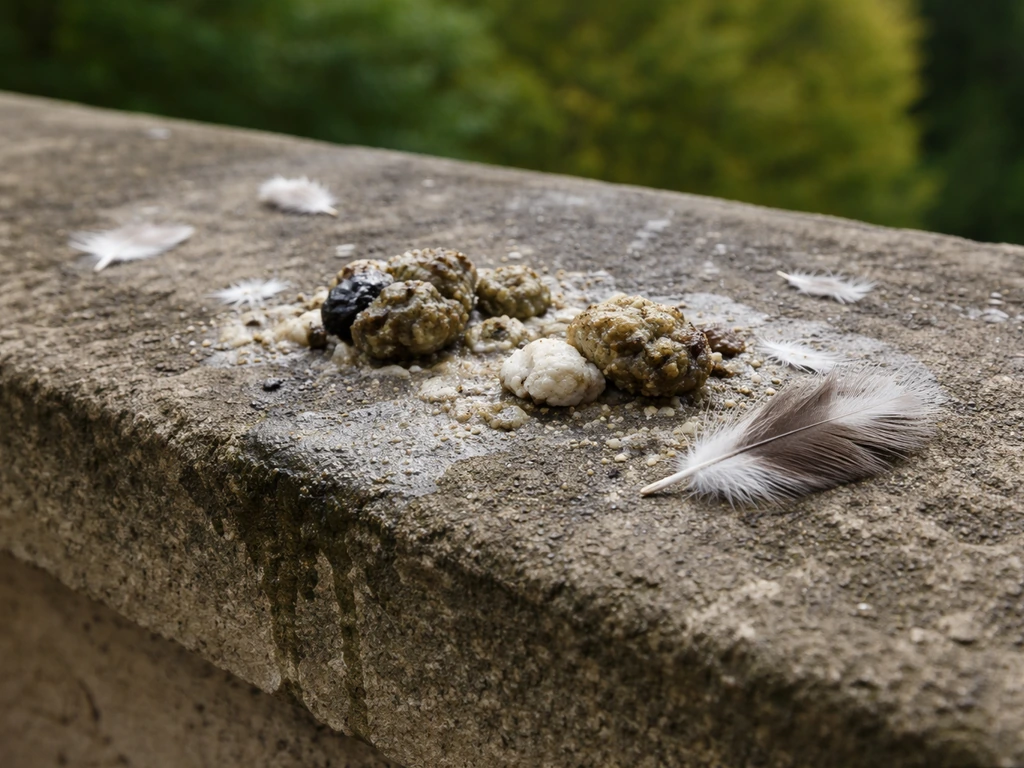
Bird litter refers to the combination of droppings, feathers, and general organic debris that birds leave behind wherever they roost, nest, or feed regularly. In most practical contexts, the term is just a polite or collective way of saying bird waste, covering everything from the white-and-dark splatter on your car to the crusted accumulation under a ledge where pigeons have set up camp. If you found this page because something on your property looks suspicious and you want to know what it is, what to do about it, and whether there is any deeper meaning attached to it, you are in the right place. You may also be wondering what bird poop is called in everyday language, which is often simply referred to as bird droppings or bird waste.
Bird Litter Meaning: What It Is and What to Do

Marcus Holloway
26 Jun 2026
What "bird litter" actually means
The word "litter" on its own means waste or refuse scattered untidily across a space. In the Cambridge English Dictionary, “litter” can also mean waste spread in an untidy way rather than contained bedding-material or a structured waste stream blank" rel="noopener noreferrer">litter can mean waste spread in an untidy way. In US English it leans toward trash (think highway litter), while in UK English it is more specifically anything dropped and left lying around rather than binned. When you attach "bird" to it, the meaning narrows to the biological mess birds leave: droppings, shed feathers, nest material, food scraps, and the general organic debris that builds up where birds congregate. It is closely related to the terms guano (which technically refers to accumulated bird or bat droppings valued as fertilizer, from an Andean word) and simply "droppings," which Collins defines as the dung or feces of animals. Guano meaning is often used to describe accumulated bird or bat droppings, especially when valued as fertilizer.
In everyday use, though, people typically mean one of two things when they search for "bird litter meaning": either they have found a physical mess and want to identify and deal with it, or they have heard the phrase in a symbolic or cultural context and want to know what it implies. Both are worth addressing, because they come up for genuinely different reasons.
The three components of a bird dropping
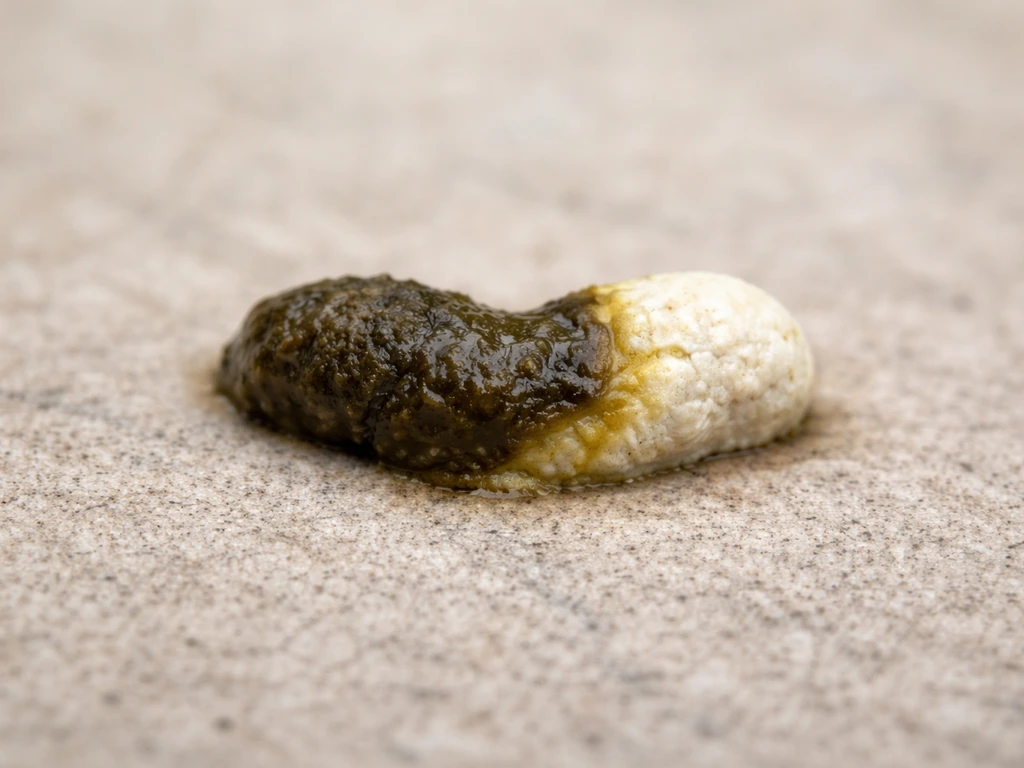
A single bird dropping is actually made up of three distinct parts: the dark fecal matter (digested food waste), the white or cream-colored urates (uric acid crystals, the bird's version of urine), and a small liquid urine portion. Birds combine all three because they have a single exit point called the cloaca. That white chalky cap you see on top of most bird droppings is the urate layer, and it is one of the most reliable visual identifiers that what you are looking at is indeed bird waste.
Bird litter vs. sap, dirt, mold, and insect waste
Before you start cleaning, it helps to confirm what you are actually dealing with. Several things can mimic the look of bird droppings at a glance, and treating them differently matters both for cleanup and for figuring out whether you have a bird problem at all.
| Substance | What it looks like | Key difference from bird litter |
|---|---|---|
| Bird droppings | Dark center with white/cream chalky cap; streaky when fresh, crusty when dry | The white urate cap is the giveaway; has a faint ammonia or sour smell |
| Tree sap / honeydew | Clear, sticky, amber or yellowish; dries to a hard glaze | No white cap, no dark matter; very sticky when fresh; no smell |
| Mold or lichen | Dark or gray-green patches; powdery or fuzzy texture | Grows in flat colonies on surfaces; no raised splatter shape; no white component |
| Insect frass | Tiny pellets or powder, often brown or black; very small scale | Much smaller than bird droppings; granular rather than liquid-splash shape |
| Bat guano | Dark brown to black; crumbly when dry; often no white cap | Lacks the white uric acid cap common in bird droppings; sparkles slightly (insect parts) |
| Mud / dirt | Brown, uniform color; dries to a dull matte finish | No white component; no ammonia odor; smears evenly rather than showing a splash pattern |
The white urate cap is the single most reliable field indicator for bird droppings. If you see that chalky white layer sitting on a darker base, you are almost certainly looking at bird waste. Bat guano, by contrast, tends to lack that white cap and often crumbles into a fine powder that glitters faintly from the insect exoskeleton fragments inside it. Both carry health risks, so if you are unsure, treat the material as hazardous until proven otherwise.
Why you are finding bird litter where you are
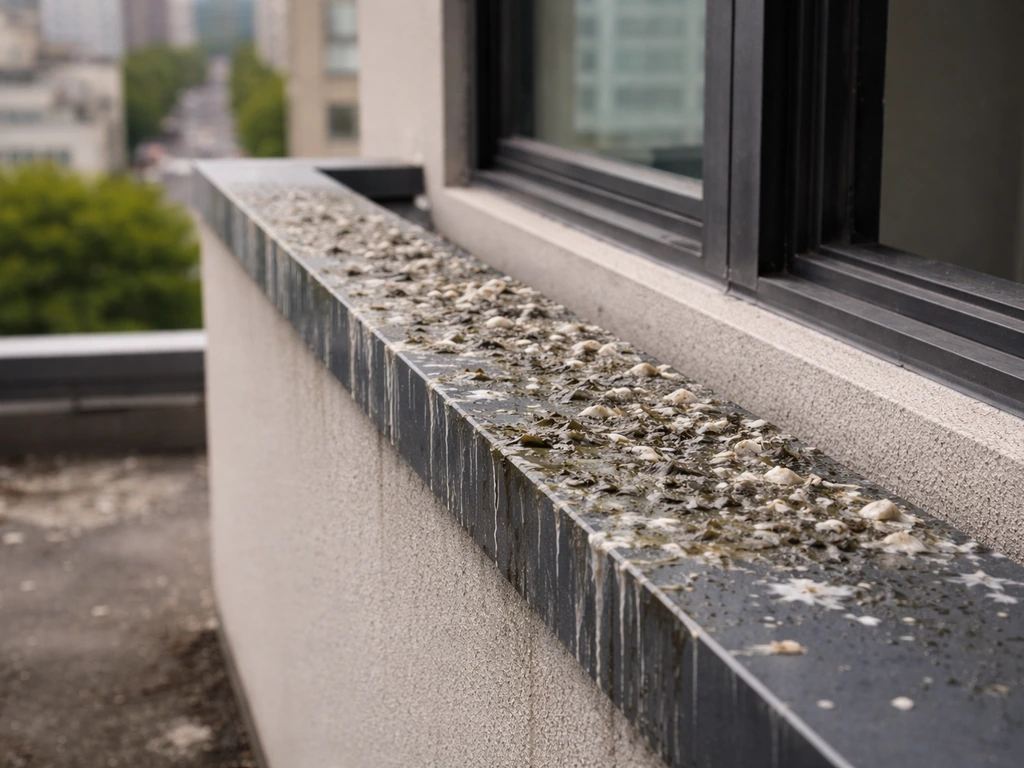
Bird litter does not appear randomly. Where it shows up tells you a lot about what the birds are doing and how serious the situation is.
Roosting
Roosting is the most common cause of heavy accumulation. Birds return to the same perch night after night, sometimes in large communal groups. Ledges, window sills, roof edges, gutters, utility lines, and patio overhangs are classic roosting spots. A few splashes can escalate to a thick crust within weeks if a flock finds your building appealing. Pigeons are the most frequent urban offenders, but starlings, house sparrows, and gulls are close runners-up.
Nesting
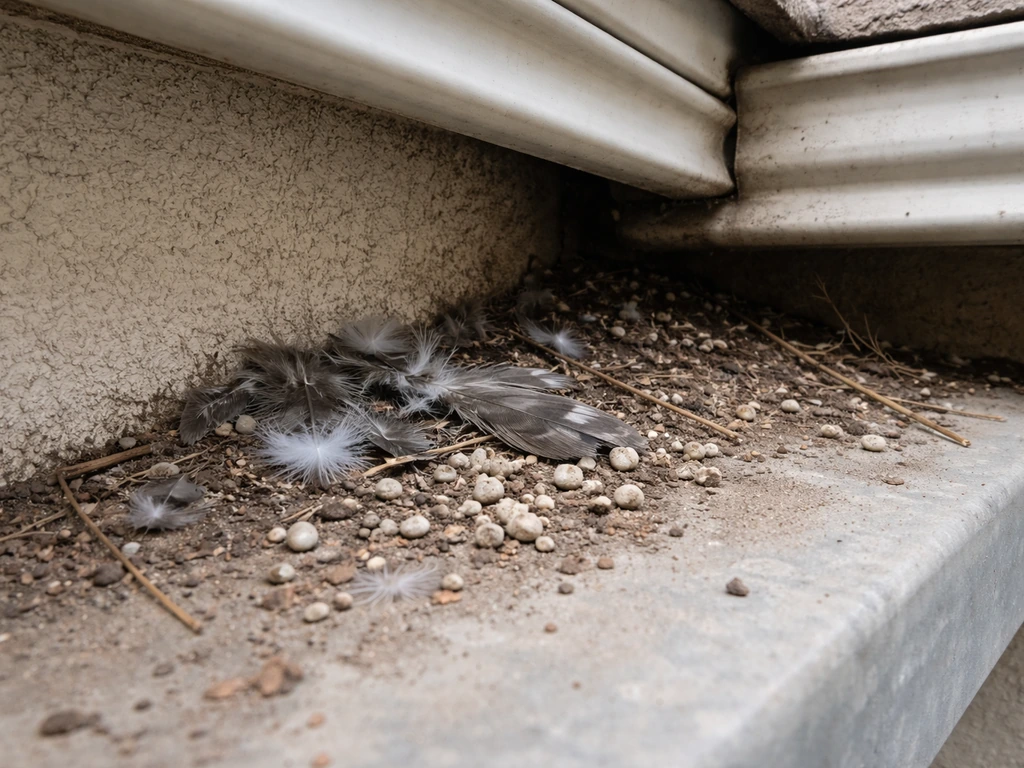
Nesting produces a denser, more localized mess than casual roosting because birds stay put for weeks and chick droppings add volume quickly. You will often find feathers, plant material, and food scraps mixed in with the droppings. Nesting in attic vents, dryer vents, or under solar panels is particularly problematic because the moisture and organic matter can cause structural damage over time.
Feeding
If you have a bird feeder, a fruit tree, or even an uncovered compost pile nearby, you are essentially inviting birds to linger. Birds defecate frequently during and after feeding, so the area directly below a feeder will accumulate waste fast. Seasonal fruiting trees like mulberries or cherries tend to stain surfaces extra badly because the pigment from berries comes through in the droppings.
Seasonal movement and migration
Some accumulation is seasonal and temporary. During spring and fall migration, large numbers of birds may stop over and roost in a location for a few days before moving on. The mess can look alarming but may resolve on its own. If the same surge happens every year at the same time, you are likely in a migration corridor and can plan your deterrence and cleanup schedule around it.
Health and safety before you touch anything
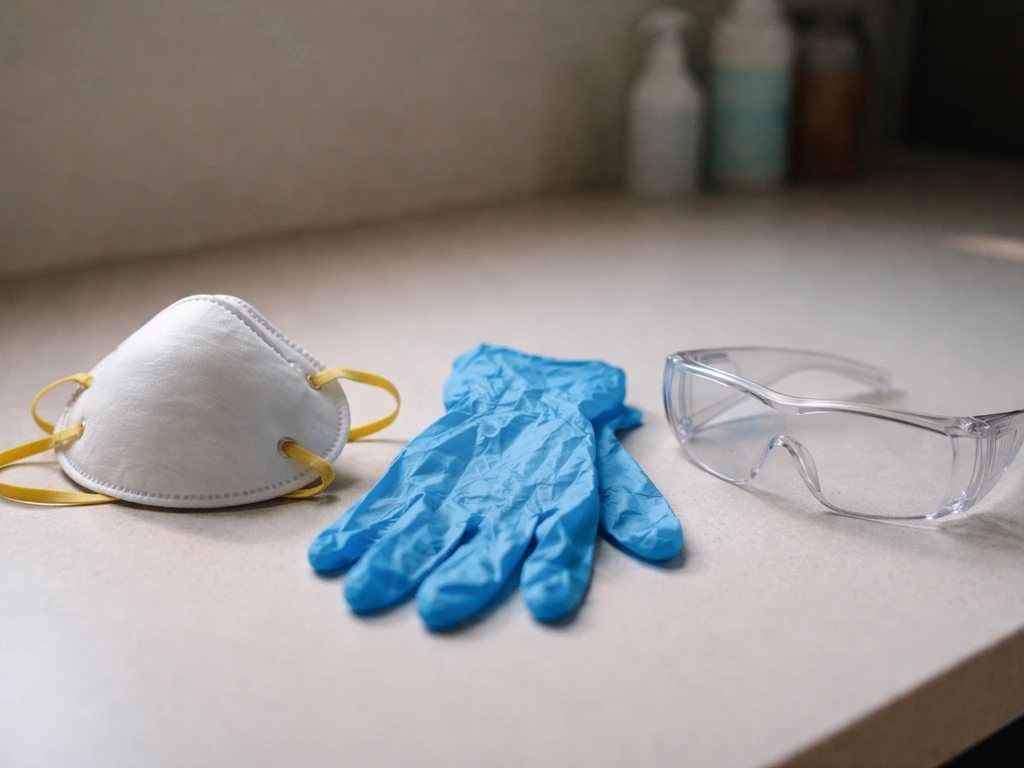
Bird droppings are not just unpleasant. They carry real health risks that are worth taking seriously, especially with large accumulations. The CDC has identified bird and bat droppings as a source of Histoplasma, the fungus that causes histoplasmosis, a respiratory illness caused by inhaling spores disturbed from dried droppings. Psittacosis (a bacterial infection) and concerns around avian influenza are also relevant when dealing with bird waste. The risk goes up significantly with dry, disturbed material because that is when spores and particles become airborne.
Protective gear you actually need
- An N95 respirator or better (a basic dust mask is not sufficient for dried bird droppings)
- Disposable gloves, preferably nitrile
- Safety glasses or goggles if the material could splash
- Disposable coveralls or clothes you can wash immediately afterward
- Closed-toe shoes you can wipe down with disinfectant
What not to do
- Do not use a high-powered water hose to blast the area clean: this aerosolizes particles and spreads contamination
- Do not dry-sweep or use a leaf blower on dried droppings for the same reason
- Do not mix bleach with other cleaning products
- Do not handle material bare-handed even if the amount looks small
- Do not ignore large accumulations: the CDC explicitly recommends professional hazardous waste cleanup for heavy buildups
How to clean bird litter safely
The core principle is: keep the material wet so it cannot become airborne, then remove and disinfect. Here is the step-by-step approach that aligns with guidance from the CDC and public health agencies.
- Put on all your protective gear before you get close to the material.
- Wet the droppings thoroughly with a disinfectant solution before disturbing them. A dilution of 1 part household bleach to 9 parts water works well for hard surfaces. Spray until visibly wet and let it soak for a few minutes.
- Gently scrape or wipe the softened material into a heavy-duty plastic bag. If scraping, keep the area wet throughout the process to prevent dust.
- Seal the bag and dispose of it in your outdoor trash.
- Apply disinfectant solution again to the cleaned surface and wipe down.
- Remove and bag your disposable gloves and any disposable clothing.
- Wash your hands thoroughly with soap and water, then shower if you had significant exposure.
For staining on painted surfaces, vehicles, or stone, time is your enemy: uric acid in the droppings etches surfaces quickly, especially in heat. On a car, fresh droppings should be soaked with a damp cloth for a minute or two before wiping to avoid scratching the paint. Enzymatic cleaners designed for pet waste work well on porous surfaces like wood decking where bleach could cause damage.
Persistent odor after cleaning usually means organic material is still present in cracks or porous areas. An enzymatic cleaner breaks down the proteins causing the smell rather than just masking it. For indoor spaces like attics or crawl spaces with heavy contamination, call a professional remediation company: the CDC is direct about this recommendation when accumulation is significant.
How to stop birds from coming back (starting today)
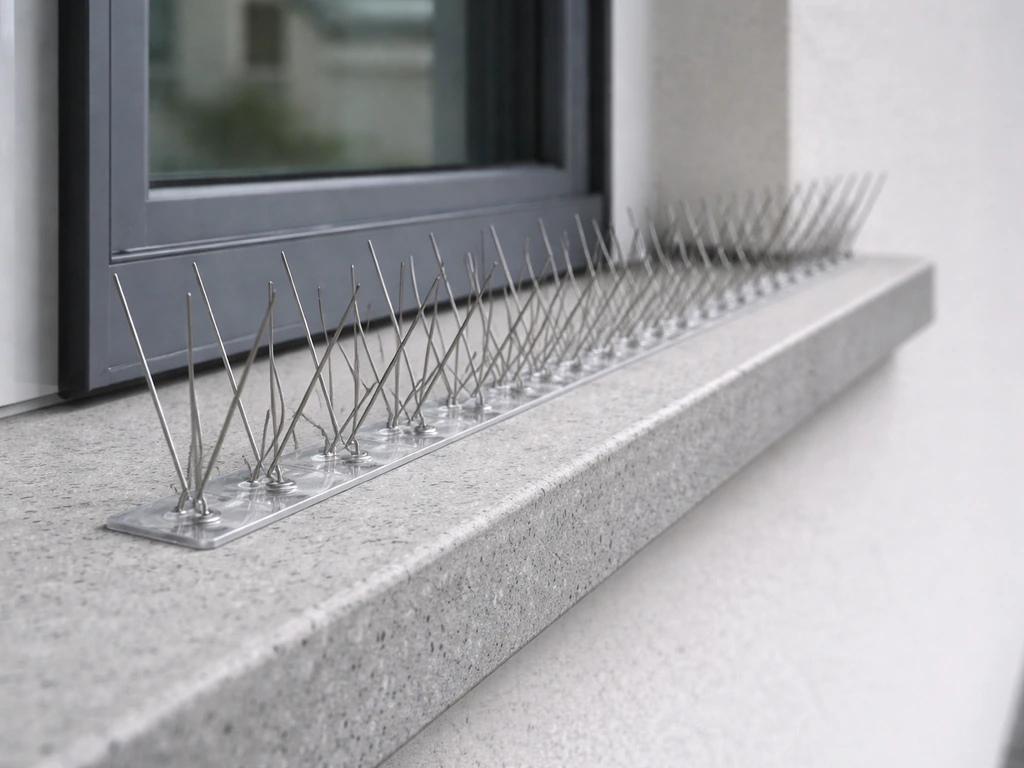
The best long-term solution to bird litter is eliminating the reason birds are choosing your space in the first place. Physical deterrents are generally more effective and more humane than chemical repellents, and most can be installed without professional help.
Physical exclusion and deterrents
- Bird spikes: installed on ledges, roof edges, and window sills; they do not harm birds but make landing uncomfortable. Effective for pigeons, gulls, and starlings.
- Netting: the most comprehensive option for large areas like balconies, under solar panels, or around roof voids. USDA wildlife management guidance endorses structural exclusion using netting as a primary starling control method.
- Slope barriers: angle boards or "porcupine strips" on flat ledges eliminate the flat surface birds need to settle.
- Blocking entry points: cap chimneys, install mesh over vents, and seal gaps larger than 1 inch to prevent nesting inside structures.
- Habitat modification: remove dense ivy, dead palm fronds, and dense shrubs close to the building, as these are preferred nesting/roosting cover. The CDFA identifies habitat removal as a core component of house sparrow control.
Remove what is attracting them
- Move or eliminate bird feeders if you have a significant droppings problem
- Cover compost bins and outdoor food sources
- Keep standing water to a minimum (birdbaths near problem areas should go)
- Trim fruit trees or collect fallen fruit regularly
When to call a professional instead
Call a wildlife management professional if the accumulation is thick (more than a few inches), if you suspect an active nest of a protected species, or if birds appear to be entering a confined space like an attic or wall cavity. In the US, most native birds are protected under the Migratory Bird Treaty Act, which means you cannot remove active nests or harm the birds without a permit. A licensed wildlife operator knows how to handle this legally. If you suspect an active nesting situation, timing matters: removal is generally only permitted outside the breeding season for protected species.
The symbolic and cultural meaning of bird droppings
If you searched "bird litter meaning" with a more interpretive question in mind, you are in good company. Birds have carried symbolic weight in human culture for thousands of years, and their droppings are no exception. The most widespread folk belief across dozens of cultures is that having a bird drop on you is good luck, specifically because it is seen as such an unlikely and random event. Folklore archives document this as a genuine belief across European, Russian, and Caribbean traditions, and you will hear it cited earnestly by people who would otherwise roll their eyes at superstition.
The interpretive tradition around birds goes much deeper historically. Ornithomancy, the ancient practice of reading omens from bird behavior, was practiced seriously in ancient Greek, Roman, Mesopotamian, and Indigenous traditions worldwide. Within that framework, bird droppings would fall under the category of unsolicited signs, things a bird does that were not sought out but happened to you. Traditionally these were read as communications from the divine or as indicators of fortune, almost always positive in the case of droppings, possibly because an unpleasant experience needed a compensating positive spin to be culturally transmitted.
From this site's perspective, the honest reading is this: the "good luck" belief is widespread enough to be culturally real, meaning it genuinely reflects something about how humans have related to birds and chance across history. But it is folklore, not prophecy. If a bird has created a significant mess on your property, the practical response (cleanup, deterrence, health precautions) matters far more than the symbolic one. The two are not mutually exclusive: you can acknowledge the cultural resonance of the event and still get out the bleach solution.
It is also worth noting that "bird litter" sits within a broader family of related terms that this site covers in depth, including the general meanings of bird droppings, the specific term guano, the range of colors droppings can appear and what those indicate, and the broader vocabulary around what bird waste is called in different contexts. If you want to interpret that mess visually, the bird poop color meaning guide covers what different shades typically signal range of colors droppings can appear. All of those topics connect back to a longer cultural and natural history of humans paying close attention to birds and what they leave behind.
FAQ
When does bird litter suggest an actual bird problem versus random droppings?
Not necessarily. One or two spots can be from a passing bird, but repeated buildup at the same roosting points (like window ledges, gutters, or a specific patio area) strongly suggests birds are intentionally returning. If you notice the same locations being hit within the same hours of day for several days, treat it as an ongoing attractant problem.
What should I do if I cannot confidently tell bird droppings from something else?
Yes. White chalky urates on top of darker fecal material are typical of bird droppings, but stale or cleaned-without-removal residue can look smeared or hard. If you cannot confidently identify the white urate cap or the texture resembles fine powder, handle it as potentially hazardous (wear protection, keep it wet, and avoid dry wiping).
Why is dry sweeping or vacuuming bird litter a bad idea?
Do not dry-scrub or use a dry broom or shop-vac on dried material. Dry cleaning can aerosolize particles and spores. Instead, mist the area with water or an appropriate wetting solution to keep it damp, then remove debris using disposable paper towels or damp rags and clean/disinfect afterward.
What cleaning products work best, and can I use bleach everywhere?
Use a pet-waste enzymatic cleaner for many surfaces, especially porous materials, because it targets odor-causing organic matter. Avoid bleach on delicate or porous finishes unless the surface manufacturer approves it, since bleach can discolor or damage wood, stone finishes, and some paints. Always test in a small hidden spot first.
How do I remove bird litter stains from a car without damaging the paint?
For cars and outdoor paint, act quickly because uric acid can etch once it dries. Keep the spot damp for a minute or two, wipe gently, then rinse. If the mark has already dried and looks etched or rough, repeat dampening and use a car-safe cleaner, since aggressive scrubbing can add micro-scratches.
What does persistent smell after cleanup usually mean?
If the odor comes back after the first cleaning, it often means residue remains in cracks, under trim, or in textured porous surfaces. Re-wet the area, remove remaining residue, then apply an enzymatic product that stays in contact long enough for breakdown. If it is indoors (attic, crawl space) or covers a large area, consider professional remediation.
Can bird litter damage structures or vents beyond staining and smell?
Yes, especially when droppings accumulate on roosting ledges, beneath vents, or inside attic spaces. Birds can also carry material such as nesting debris that blocks airflow. If you see droppings around vents, check for active traffic points and watch for new material, not just old spots.
What should I do if the droppings look like birds are nesting or getting into an attic?
If you suspect an active nest or birds are entering a cavity (attic, wall space, soffit), do not attempt removal yourself. In the US, many native birds are protected, and removing active nests or harming birds can require permits. A licensed wildlife management professional can also advise on timing outside the breeding season.
How do I decide whether to clean myself or hire a professional?
If it is fresh and you are confident it is bird droppings, standard household cleanup with protection may be fine for small amounts. When you have thick buildup (often more than a few inches), heavy indoor contamination, or you are dealing with a potential respiratory risk (dry, disturbed residue), professional remediation is the safer choice.
What is the safest way to handle a cleanup interruption or partial spill?
If you have to stop work due to a spill, keep people and pets away, keep the area damp (do not spread dust), and use disposable protection for handling materials. For ongoing cleanup, plan around when you can safely wet and remove debris without letting it dry between steps.