A bird-shaped cloud doesn't mean anything guaranteed, but it can mean something personally significant if you approach it thoughtfully. Most of the time, your brain is doing something it's very good at: finding familiar shapes in random patterns (that's pareidolia, and it's completely normal). But across many cultures and centuries, bird imagery in the sky has also been treated as a message worth pausing for. The honest answer is that both things are true at once. You can acknowledge the neuroscience and still find meaning in the moment, as long as you're not treating a cloud as a prophecy.
Bird Shaped Cloud Meaning: Spiritual Interpretations & How to Read Them

Marcus Holloway
11 Jul 2026
How people interpret bird-shaped clouds

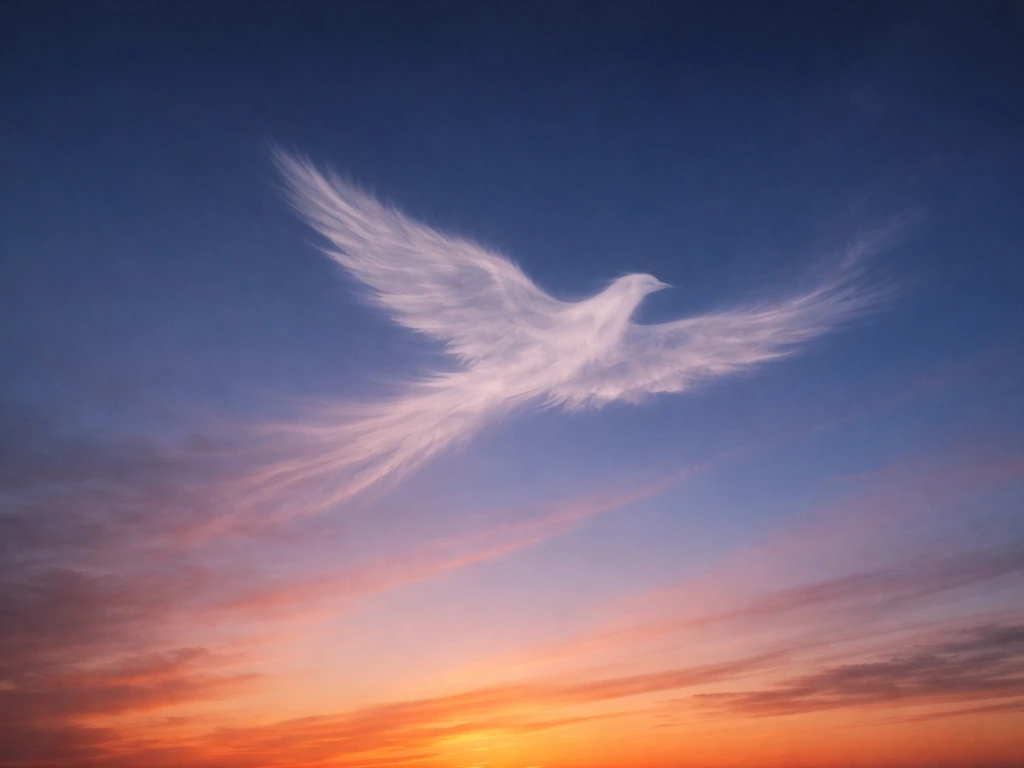
The most common spiritual interpretation of a bird-shaped cloud is that it's a sign: a message from the universe, a deceased loved one, a spirit guide, or simply a nudge from your own intuition. This sits inside a much older tradition called ornithomancy, the practice of reading bird behavior and appearance as omens, which was practiced formally by ancient Greeks and has roots across dozens of cultures worldwide. In that tradition, birds in the sky weren't random scenery. They were messengers, and the direction they flew, the type of bird, and the context all shaped what the omen meant.
Today, most people who report feeling moved by a bird-shaped cloud aren't performing formal augury. They're having a more intuitive experience: they happen to look up, they see something that looks unmistakably like a bird in flight, and it lands with emotional weight. That weight usually has context. You might be grieving, making a decision, or asking a question internally. The cloud arrives and feels like an answer. A bird circling in the sky is often interpreted as a sign of attention, persistence, or a message related to what you are thinking about at that moment bird circling meaning. That feeling is real and worth taking seriously, even if the cloud itself is just vapor shaped by wind.
Spiritually, birds are consistently associated with the same broad themes across traditions: freedom, transition, communication between realms, protection, and news arriving from a distance. The Catholic tradition uses the dove as a symbol of peace and the Holy Spirit. Indigenous traditions across North America associate different birds with different forces, though these associations vary dramatically by nation and shouldn't be flattened into a single interpretation. In general folklore, birds flying overhead have long been read as signs that something is moving, changing, or on its way.
Why clouds look like birds in the first place
There are two things happening when you see a bird-shaped cloud: your brain, and the actual physics of cloud formation. Both are worth understanding because they affect how you interpret what you're seeing.
Pareidolia: your brain filling in the blanks
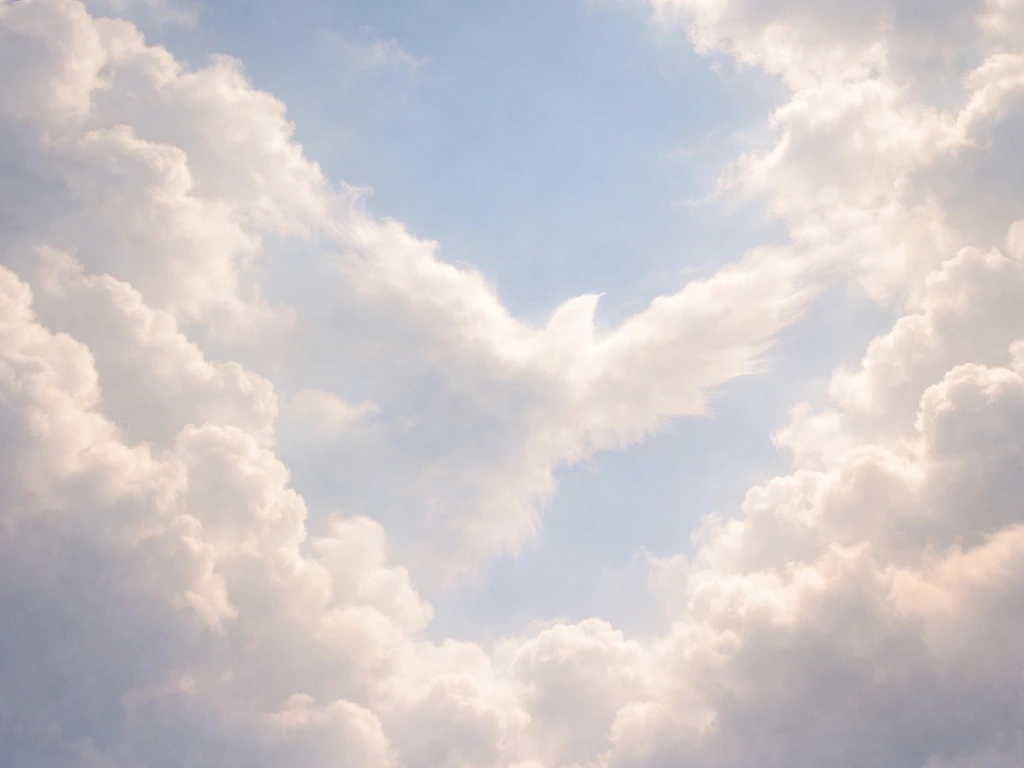
Pareidolia is the tendency to perceive a meaningful image, usually a face or a recognizable figure, in an ambiguous or random stimulus. Clouds are a classic example. Your visual system evolved to detect patterns quickly, especially faces and animals, because recognizing them fast had survival value. So when a cloud has a roughly curved body, two wing-like extensions, and some sense of motion, your brain confidently resolves it as a bird. This isn't a flaw. It's your perceptual system doing its job. Research from 2026 in Scientific Reports confirms that pareidolia recognition maps ambiguous inputs onto familiar categories like animals and faces through normal perceptual processing. Seeing a bird in a cloud is genuinely natural, not mystical on its own.
Cloud types that commonly produce bird-like silhouettes
Not all clouds are equally likely to produce sharp, recognizable shapes. A few specific cloud types are worth knowing:
- Altocumulus lenticularis: These are the lens-shaped clouds that form when stable air flows over mountain ridges or other terrain obstacles. They can look remarkably like a bird with outstretched wings, and they often appear to hover completely still even though air is moving rapidly through them. The WMO International Cloud Atlas specifically documents their smooth, elongated shape driven by orographic (terrain-driven) airflow.
- Cirrus clouds: These high-altitude, wispy clouds are sometimes described as 'feathered' or 'hooked' in official cloud identification guides. A cirrus uncinus (hook cirrus) can look strikingly like a bird with a swept-back wing, especially near sunrise or sunset.
- Cumulus congestus: Tall, billowing cumulus clouds can produce bird-like profiles from certain angles, especially when a towering section catches wind shear and gets sculpted into something asymmetrical.
- Iridescent clouds: When sunlight diffracts through thin clouds with uniformly small water droplets or ice crystals, you get vivid colored edges (cloud iridescence). A bird-shaped formation with iridescent coloring looks especially dramatic and can feel more 'significant,' though the color is purely a diffraction effect.
Lenticular clouds in particular are worth highlighting because they're genuinely unusual-looking and stationary, which makes them feel intentional. People have mistaken them for UFOs. Seeing one that also resembles a bird creates a double layer of strangeness that's easy to read as a sign. The physics: stable airflow hits a ridge, rises and cools, water vapor condenses into that smooth lens shape, and as long as the wind holds, the cloud stays put even as air parcels keep moving through it. The AMS glossary describes lenticularis clouds as commonly associated with orographic origin and (for standing clouds) lee-wave dynamics lenticularis clouds are commonly associated with an orographic origin and, in the standing-cloud case, lee-wave dynamics.
What to actually notice when you see a bird-shaped cloud

If you want to interpret this responsibly rather than just reactively, slow down and observe before you decide what it means. Here's what's worth paying attention to:
- Shape specifics: Does it look like a bird in flight, a bird perching, a flock, or just a vague bird outline? A soaring silhouette reads differently than a hovering one.
- Size: Is this a small, intimate-feeling shape or something that spans a wide section of sky? Scale affects the emotional register of what you're seeing.
- Movement: Is the cloud drifting in a direction, expanding, dissolving, or staying completely still? A stationary cloud (likely lenticular) feels different from one that appears to be flying somewhere.
- Direction of travel: In ornithomantic traditions, the direction a bird moved relative to the observer often determined the omen's valence. Right side was typically favorable in ancient Greek augury; left was less so. You don't have to adopt that system, but noting where the cloud is heading (toward you, away, left, right) adds a layer to personal interpretation.
- Time of day: Dawn and dusk carry spiritual weight in many traditions, partly because light at those times makes clouds more dramatic and partly because those are threshold moments, transitions between states. A bird-shaped cloud at sunrise hits differently than one at noon.
- Cloud type if you can identify it: A lone lenticular near a mountain has a clear meteorological explanation. A single wispy cirrus hook in otherwise clear sky is rarer and might genuinely feel more unusual.
- Your emotional state and context: This is the most important variable. What were you thinking about when you looked up? What question or situation is live in your life right now? Meaning attaches to context.
Spiritual and folklore readings by bird type
If the cloud's silhouette resembles a specific bird, traditional symbolic associations give you a starting point. Some people also search for the bird hanging upside down meaning, but with clouds it helps to start with what you personally associate with the shape and context bird type. These are cultural interpretations, not scientific claims, but they have real depth behind them.
| Bird type in silhouette | Common symbolic associations | Cultural context |
|---|---|---|
| Eagle or large raptor (broad wings, soaring) | Power, vision, spiritual elevation, leadership, clarity of purpose | Widely associated with divine messengers; used in both Indigenous North American traditions and Roman/Greek augury as high-status omens |
| Dove or small rounded bird | Peace, reconciliation, gentleness, a loved one's presence | Dove symbolism runs through Christian, Jewish, and broader Mediterranean traditions; small birds in many cultures represent souls |
| Owl silhouette (rounded head, wide wings) | Wisdom, transition, awareness of what's hidden; also associated with death or endings in some traditions | Owl associations vary sharply by culture; some see owls as protectors, others as omens of change or loss; don't flatten this into one reading |
| Heron or crane (long neck, wide wingspan) | Patience, self-reliance, longevity, careful navigation | Cranes particularly carry positive meanings in East Asian traditions; herons appear in Celtic folklore as guardians of threshold spaces |
| Flock silhouette (multiple birds) | Community, collective movement, change arriving at scale, a shift in environment rather than a personal message | Murmurations and flock imagery across folklore often signal environmental or social change rather than individual omens |
| Generic small songbird | Joy, communication, news coming, lightness | Songbirds across European and Indigenous American traditions often signal messages or the arrival of something welcome |
If you can't identify the bird type from the cloud's silhouette, fall back on the broader shared meaning: a bird in the sky, in virtually every tradition that has ever read the sky for meaning, is associated with transition, message, and the movement between states. A bird swooping meaning is often read as a sign of fast-moving change, attention, or a message arriving at the right moment. Something is in motion. That's the common thread.
It's also worth noting that a bird-shaped cloud is part of a wider family of bird appearances people look to for meaning. A bird circling overhead, a bird falling from the sky, or a bird behaving unusually are all interpreted through similar folklore frameworks. Some people also wonder about the bird falling from sky meaning, but the same idea applies: treat it as a personal reflection rather than a guaranteed prophecy bird falling from the sky. The cloud version is gentler in tone than some of those, more fleeting and atmospheric than a direct encounter.
How to actually use this if it feels meaningful to you
Feeling like a cloud was a sign doesn't require you to build a whole belief system around it. It just requires a moment of honest reflection. Here's a practical sequence:
- Write it down immediately. Note the date, time, where you were, what the cloud looked like, what bird it resembled, and what you were thinking or feeling right before you noticed it. This detail matters more than any symbol dictionary.
- Name the question. If this felt like an answer, what was the question? Write that down too. Often the question reveals more than the sign itself.
- Check for confirmation bias. Ask yourself honestly: would you have read this cloud as a sign if your life were going well and you had no active worries? If the answer is no, that's useful information. It doesn't invalidate your experience, but it means you may be seeking reassurance more than receiving a message.
- Identify the one actionable thing. If you were to treat this as a genuine nudge, what would it be telling you to do? Name one specific, small action. Not a life overhaul. Something you could do in the next 48 hours.
- Do that thing, then observe. Not to test the universe, but to test yourself. Did acting on the intuition feel right? Did the outcome make sense? This is how you calibrate your own sign-reading over time, without outsourcing your decisions to weather patterns.
Journaling works well here because it creates a record you can actually look back at. One of the problems with reading signs is that we tend to remember the hits and forget the misses (that's confirmation bias operating in real time). A written log lets you check your own track record honestly.
Common myths and when to stop reading into it
A few things worth clearing up so you don't go too far down the rabbit hole:
- Myth: Bird-shaped clouds are rare and special. They're not especially rare. Pareidolia means most people who spend time looking at clouds will see birds regularly. If you're looking for bird shapes, you'll find them. That's how perception works.
- Myth: The more dramatic the cloud (iridescent colors, unusual stillness, big size), the bigger the message. Dramatic appearance has physical explanations: cloud iridescence is diffraction, stationary clouds are lenticular lee-wave formations, and large cloud formations are just meteorology. Dramatic visual effects don't scale with spiritual importance.
- Myth: There's a universal meaning for each bird type. There isn't. Owl symbolism alone ranges from wisdom to death to protection depending on the tradition. Any interpretation that claims to be universal is oversimplifying significantly.
- Myth: If it felt meaningful, it was meaningful. Feeling matters, but feeling is also influenced by mood, anxiety, grief, and desire. An fMRI study found that how people interpret ambiguous events as 'signs' depends heavily on their existing belief frameworks, not the events themselves. That means two people looking at the same cloud will have completely different experiences of its significance.
- Myth: Acting on a cloud sign is always harmless. Usually it is. But if you find yourself making major life decisions based on cloud shapes, or feeling frightened by what you read in the sky, that's a signal to step back. Responsible sign-reading is a tool for reflection, not a substitute for judgment.
The ornithomantic tradition itself, as documented by historical sources, was always contextual. Ancient augurs didn't just observe a bird and declare a meaning. They considered direction, type, behavior, the question being asked, and the broader situation. Even the most dedicated historical practitioners built in interpretive caution. Treating any single cloud as a guaranteed prophecy would have seemed sloppy even to them.
The most honest position is this: a bird-shaped cloud is a normal atmospheric event made meaningful by your perception and your context. It helps to remember that similar halo-like ring optical phenomena, such as a glory, come from sunlight or moonlight interacting with tiny water droplets and are sometimes mistaken for rainbow-like effects.
That meaning is yours to explore or ignore. If it prompts you to reflect, journal, or take a small action that aligns with your values, it's been useful. If you are wondering about bird loafing meaning, the best approach is to treat it as a personal reflection cue rather than a fixed omen. If it prompts fear, paralysis, or magical thinking, it's stopped being useful.
The cloud doesn't care either way. Your interpretation is the only part you actually control.
FAQ
Is there any way to tell if a bird-shaped cloud is a lenticular cloud versus just normal drifting clouds?
Look for two traits: it stays nearly fixed relative to the landscape while you watch it, and it has a smooth, lens-like edge rather than ragged, wispy contours. If the “bird” shape breaks apart as the cloud shears or you see fast motion across the sky, it is less likely to be lenticular and more likely to be ordinary cloud structure that your brain is briefly resolving.
What should I do if I keep seeing bird-shaped clouds repeatedly?
Track the context, not the omen. Note what question you are actively thinking about and what decision or emotion was present each time, then compare patterns in your journal. Repetition often reflects heightened attention, not a new external message, so the useful next step is identifying what your mind keeps returning to.
Can the same bird-shaped cloud mean different things depending on my culture or beliefs?
Yes, but use cultural symbolism as a starting prompt, not as a rule. If your background has specific associations (for example, peace, protection, or news), let that guide the reflection question you ask yourself, and keep the interpretation flexible if the emotional “fit” is weak.
Should I identify the exact bird type before interpreting the meaning?
Only if you can do it reliably. Cloud silhouettes often resemble multiple birds, and forcing an exact match can increase confirmation bias. If identification is uncertain, default to the broader shared themes (transition, message, change), then focus on what you felt and what was happening in your life that day.
How do I avoid confirmation bias when a cloud feels like a sign?
Write down (1) what you think the sign is telling you, (2) why you think that, and (3) what would prove it wrong. After a week or two, revisit the notes. If nothing changes or your prediction was vague, treat it as a reflective cue rather than evidence.
What if the bird-shaped cloud makes me feel scared or anxious?
Try a “safety first” check: ask what is the most practical, non-magical action you can take within 24 hours (for example, talk to someone, make a plan, or ground yourself). If you notice urges to ruminate or interpret every event as warning, scale back the sign-reading and focus on normal problem-solving.
Is it reasonable to treat this as meaningful without believing it is supernatural?
Yes. You can frame it as a mirror for your intuition, especially if the cloud arrives while you are making a choice, processing grief, or seeking clarity. The key is to avoid treating it as a guaranteed prediction, and to let the emotional signal prompt an action aligned with your values.
Could similar “bird meanings” apply to other sky shapes like a bird flying versus a bird falling?
Often the same themes (transition, movement, change in timing) apply, but tone matters. Falling imagery commonly gets interpreted as a sudden shift or loss, while circling or gliding imagery often gets read as attention, persistence, or something unfolding. If you are unsure, keep the meaning general and focus on the specific feeling the sight created in you.
What practical steps can I take right after seeing a bird-shaped cloud?
Do a brief observation log before you interpret: write the time, direction you saw it (roughly), cloud type if you can tell, and what you were thinking about when you looked up. Then ask one question in your journal such as, “What change am I already resisting or preparing for?” This turns the moment into reflection you can use.
Next Article
Bird Swooping Meaning: Causes, Safety Steps, Folklore
Discover bird swooping meaning: why birds dive, what to do for safety, and how to interpret folklore and dreams.