A murmuration is the coordinated, shape-shifting aerial display performed by large flocks of European starlings (Sturnus vulgaris), most commonly seen at dusk in autumn and winter as the birds funnel toward their communal roost. The word itself is specific: it describes this swirling, leaderless, cloud-like motion, not just any birds flying together in a group. When people talk about the "meaning" of a murmuration, they're asking two distinct questions at once: what's actually driving the behavior in nature, and what symbolism do humans attach to it? Both are worth answering, and keeping them separate makes each answer much more useful.
Bird Murmuration Meaning: What It Is and Why It Happens

Marcus Holloway
29 May 2026
What a murmuration actually is (and what it isn't)
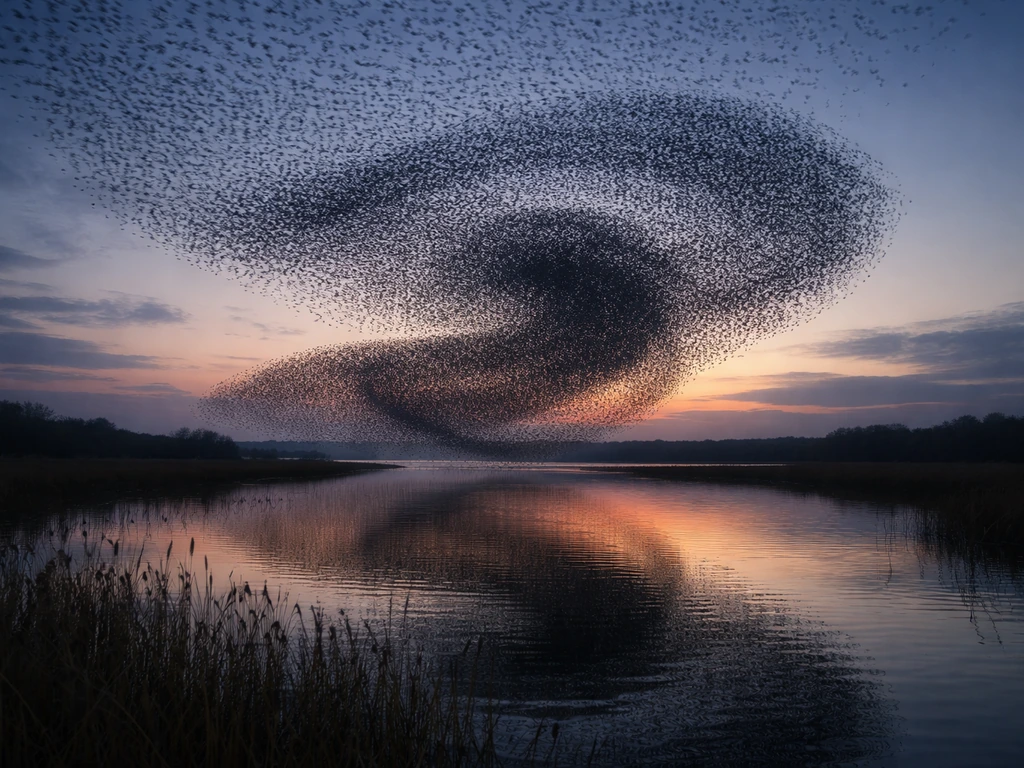
The word "murmuration" has a precise meaning in ornithology. It refers specifically to the collective aerial display of starlings: thousands of birds moving together in dense, rolling, shape-changing formations that look like a living storm cloud. The flock twists, stretches, compresses, and pivots as a single unit, even though no individual bird is in charge. That leaderless coordination is what makes it so striking, and so different from ordinary group flying.
What a murmuration is not: it's not a catch-all term for any flock of birds in flight. Generic flocking, mixed-species feeding flocks, and simple migratory formations are all separate behaviors. It's also not the same as communal roosting, which is what happens after the aerial display ends and the birds settle into their roost site for the night. Because communal roosting is the stage that comes right after the aerial display, it's helpful to understand the bird roosting meaning as well. The murmuration is the aerial approach; the roosting is what follows. You might also notice that related behaviors like bird flocking and bird roosting get discussed alongside murmurations, but they describe different moments in the same evening sequence. If you're wondering about bird flocking meaning, it helps to distinguish everyday flocking from the specific biology and timing behind a murmuration.
What actually causes a murmuration
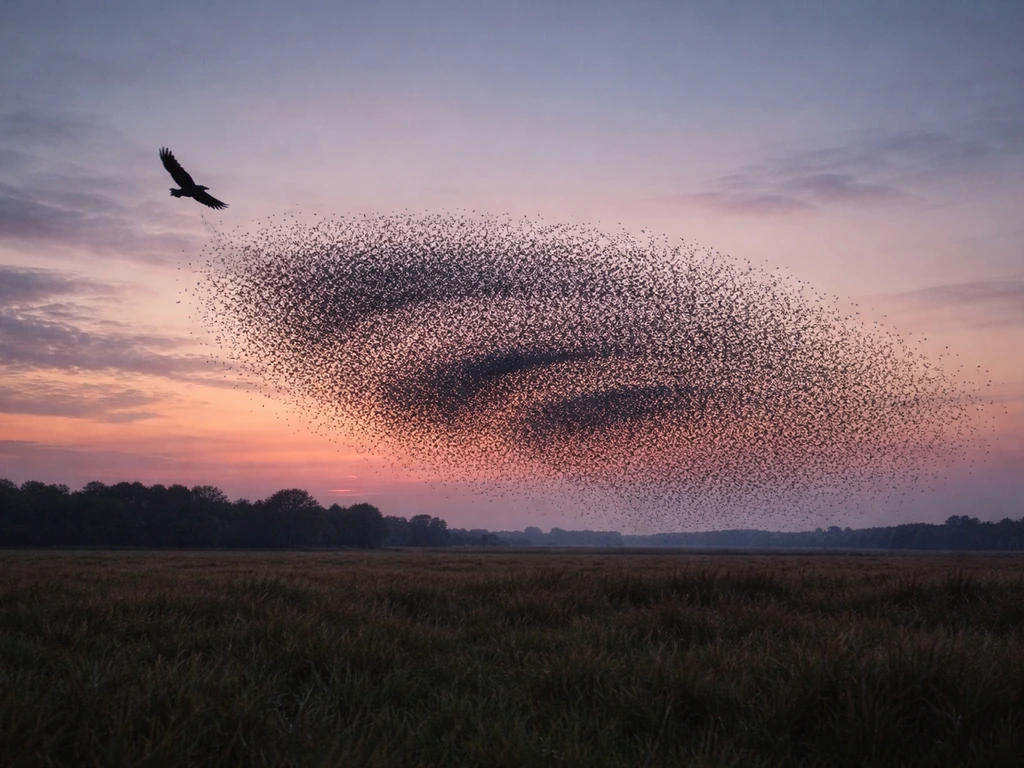
The primary driver is predator avoidance. When a falcon or raptor gets close, the flock responds with rolling "agitation waves" that ripple through thousands of birds at roughly 44 feet per second. The dense, constantly shifting shape makes it almost impossible for a predator to lock onto any single bird, a phenomenon researchers call the "confusion effect." The more compact and unpredictable the flock, the harder the hunt becomes.
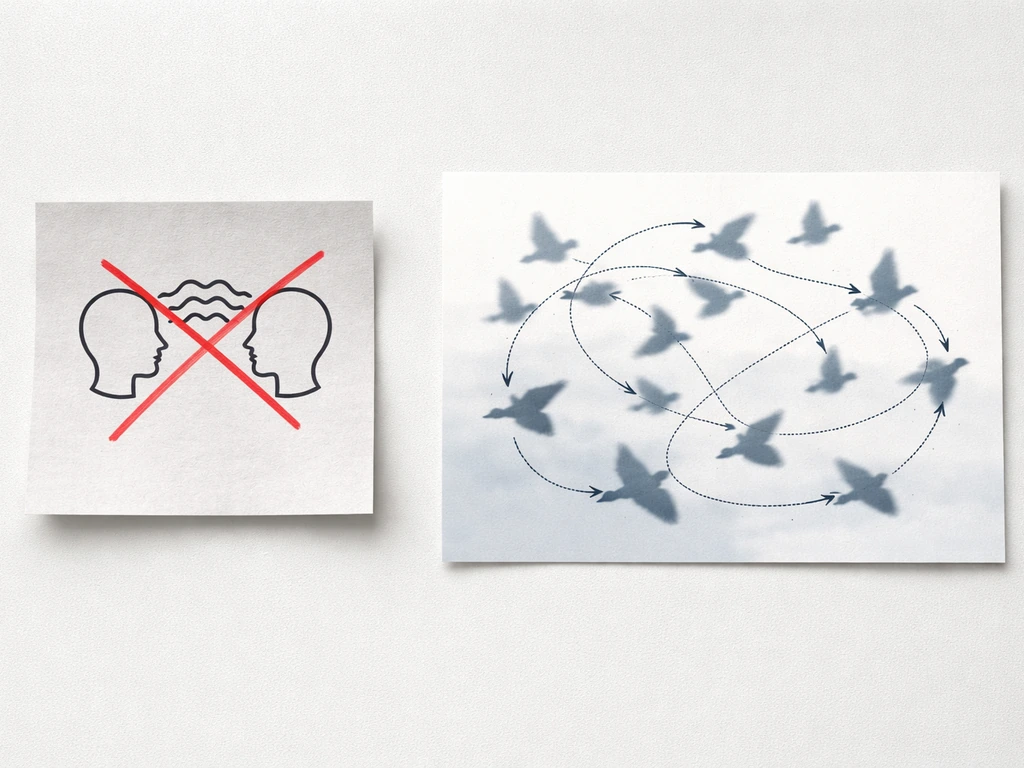
Coordination happens through local rules, not a leader. Each starling watches and responds to roughly six or seven of its nearest neighbors. That simple rule, applied simultaneously across thousands of birds, produces the coherent turns and shape changes you see from a distance. There's no "conductor" bird giving orders; the whole display emerges from individual birds doing the same thing at the same time.
Timing is tightly linked to the roosting cycle. In the UK, murmurations typically start appearing from November onward, as shorter days push birds toward communal roosts. On any given evening, the display usually begins about an hour before sunset, with birds entering the roost roughly 30 minutes before full dark. A murmuration can last anywhere from a few minutes up to around 45 minutes, depending on predator pressure and roost conditions.
How to recognize what you're actually seeing
The bird itself
If you're watching a true murmuration, the birds are almost certainly European starlings. They're chunky, roughly 20 cm (about 8 inches) long, with dark, iridescent plumage that can look glossy purple-green in good light. In flight, they move in tight, quick bursts and turn as a unit. The flock will be dense and numerous, often in the thousands, which is what creates the visible "cloud" effect.
The setting and timing
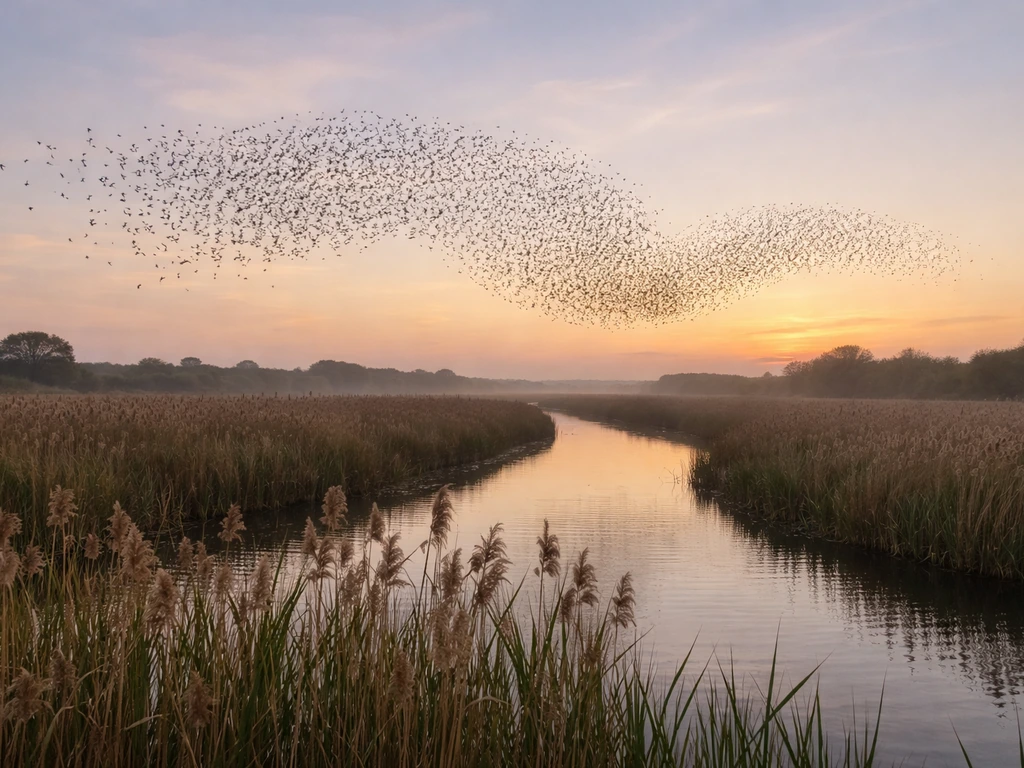
Location matters a lot. In the UK, murmurations are most reliably seen over reedbeds and wetland reserves (the RSPB's Ham Wall in Somerset is a famous spot), as well as urban waterfronts and pier structures. In North America, European starlings are abundant and widespread, so murmurations can appear over open fields, suburban areas, or near water wherever large roosts have formed. The reliable time window is the hour before sunset from late autumn through winter. In the UK, RSPB notes that murmurations are typically seen starting in November as birds gather at suitable roost sites, matching the pre-roost timing through winter the reliable time window is the hour before sunset from late autumn through winter. If you're seeing something similar at midday in summer over a mixed woodland, you're probably watching a different flocking behavior altogether.
Quick field check
- Season: autumn or winter (in the UK, November onward is the core window)
- Time of day: roughly 30 to 60 minutes before sunset
- Bird size and shape: chunky, dark, fast-moving; around 8 inches long with iridescent plumage
- Flock behavior: tight, rolling, shape-shifting; no obvious leader; flock compresses and expands
- Setting: over a known roost site such as a reedbed, pier, or open agricultural land near water
- Predator presence: watch for a falcon or sparrowhawk at the edge triggering visible "wave" pulses through the flock
What people mean when they say murmurations are "meaningful"
Alongside the biology, there's a genuine cultural and spiritual layer to how people interpret murmurations, and it's worth taking seriously even if the science tells a different story. The most common modern interpretation connects murmurations to themes of unity, synchronicity, and collective intelligence. The idea is intuitive: thousands of individuals moving as one, without hierarchy or apparent effort, feels like a visible metaphor for the kind of harmony humans often aspire to. This reading shows up in meditation content, mindfulness writing, and contemporary spirituality fairly frequently.
In some cultural traditions, large gatherings of birds have long been read as omens or messages, positive or negative depending on context. The sudden appearance of thousands of birds in dramatic formation has historically triggered both wonder and unease. Some modern media frames the display as “plague-like” or “terrifying,” but field explanations point to predator-avoidance behavior tied to roosting rather than any message system Some modern media frames the display as “plague-like” or “terrifying”. Some people interpret a murmuration they happen to witness as a personally meaningful sign, connecting it to transitions, collective energy, or spiritual guidance. Those interpretations are legitimate as personal or cultural meaning-making, but they're distinct from what ornithology can tell us.
It's also worth noting the aesthetic dimension: murmurations regularly appear in art, poetry, and literature as symbols of natural wonder, the emergent complexity of living systems, and the tension between individual and collective identity. That's a real kind of meaning, even if it isn't supernatural.
Common myths, and how to think about them clearly
| The claim | What the evidence actually shows |
|---|---|
| Starlings use telepathy or thought transference to coordinate | Early 20th-century ornithologist Edmund Selous speculated about this, but it's not the scientific consensus. Modern research points to local neighbor-interaction rules: each bird responds to about 6-7 nearest neighbors, producing flock-wide coordination without any mind-to-mind communication. |
| Murmurations are omens predicting death, disaster, or the future | Major ornithology and natural history sources consistently tie murmuration timing and behavior to roosting cycles and predator avoidance, not supernatural prediction. The behavior is highly seasonal and predictable for biological reasons. |
| The flock is a single living entity or is delivering a message to humans | Scientific accounts describe leaderless but rule-driven motion in response to real-time pressures like predator proximity and roosting cues. The flock has no collective intention and is not oriented toward human observers. |
| Murmurations symbolize unity in a traditional cultural or spiritual sense | This is a predominantly modern interpretation, appearing mainly in contemporary meditation and spirituality content. There's no single well-documented historical tradition behind it, though the metaphor is culturally resonant and widely used today. |
None of this means personal or spiritual interpretations are wrong. It means they're yours to make, not facts embedded in the behavior itself. The most useful approach is to understand what's actually happening biologically, then decide what, if anything, it means to you personally. Wondering about the behavior itself, like why the flock chirps and murmurs collectively (related to the low-level bird chirping and trill sounds that give the phenomenon its name), is just as rewarding as any symbolic reading. The bird trill meaning behind the name can also help you identify what sounds to listen for during a display bird chirps and murmurs collectively. If you are specifically wondering about the bird chirping meaning, it often relates to communication within the flock and responses to nearby threats.
What to do next if you want to go deeper
Observation checklist for your next sighting
- Note the date and season: is it late autumn or winter? That's the prime window.
- Record the time relative to sunset: murmurations typically start 30 to 60 minutes before dark.
- Describe the location: reedbed, urban waterfront, open farmland near water?
- Estimate flock size: hundreds, thousands, tens of thousands?
- Watch for wave pulses or sudden compressions: these often mean a predator (usually a falcon) is nearby.
- Note when the flock breaks up and drops into the roost: that transition from aerial display to roosting is a distinct behavioral shift.
- Record weather and light conditions if possible: clear, cold evenings often produce the most dramatic displays.
Search terms and resources worth bookmarking
For the science, search "starling murmuration anti-predator," "collective escape starlings falcon," and "starling roost behavior" to find peer-reviewed and natural history sources. The Cornell Lab's All About Birds entry on the European starling is a solid starting point for identification and range information. The RSPB's murmuration and roost guides (including their Ham Wall roost guidance) give practical timing and location advice for UK viewers. For the cultural and symbolic angle, search "murmuration symbolism folklore" alongside the specific tradition you're interested in, keeping in mind that many results will reflect modern spiritual reinterpretation rather than documented historical belief.
If you want to understand the broader behavioral context, it helps to look at bird flocking and bird roosting as related but distinct topics: flocking covers the general mechanics of group flight across species, while roosting focuses on why and where birds gather at night. Understanding both makes the murmuration itself, the spectacular aerial prelude to roosting, much easier to interpret when you see it.
FAQ
If I see a swirling flock of birds, does that automatically mean it’s a murmuration?
Not usually. In the UK, the show is most reliably European starlings, and similar “cloud” patterns in other places are often another flock behavior (or a different species). If you can see dark, iridescent plumage and hear fast clicking or chattering-like calls, that supports starlings, while mixed flocks at other times are more likely to be feeding or general flocking.
How can I tell a real murmuration from ordinary birds flying in a group?
In a true starling murmuration, the flock is leaderless but still highly coordinated, because each bird responds to nearby neighbors. What you should look for is continuous, rolling shape change across the whole group rather than a single flock “turning together” without the same dense compression and re-expansion.
What if I see something that looks like a murmuration at midday or in summer?
If a display starts well before the usual window, or you see it in mid-day summer, don’t assume it’s the same phenomenon. Murmurations are strongly tied to roosting timing, so off-season or off-time events often indicate different causes, like local roost shifts, weather-driven agitation, or another type of flocking response.
Why might the display be shorter or look different on one night compared with another?
A murmuration can be prompted by predator pressure, but it is also shaped by roost conditions. Bad visibility, heavy rain, strong winds, or a change in roost accessibility can shorten the display or make it less “cloud-like.” On those evenings, you may notice fewer birds or a less dramatic compression before the flock settles.
Do murmurations always involve thousands of birds?
Murmurations can include tens of thousands of birds, but size varies by local roost size and conditions. If a site’s roost is smaller, you might see a less dense “roll” pattern or a display that never reaches the huge numbers people associate with famous spots.
What sounds should I listen for during a murmuration?
Often the sound is part of the experience, but it’s subtle and changes with distance. At close range, starlings produce repetitive trills, chips, and agitation calls, and during threat moments the overall chatter can intensify. If you’re far away, wind and background noise can make it hard to separate flock calls from ambient sound.
How does the murmuration connect to roosting, and when should I expect the birds to settle?
Yes, because the birds are entering and settling into a communal roost right after the aerial phase. In practice, that means you can watch for the flock to funnel and then dramatically drop height as it heads toward a specific reedbed or structure, rather than continuing open-air circling indefinitely.
Is it okay to film or watch closely, and what behavior might disturb the flock?
You can, but it helps to reduce disturbance. Avoid loud shouting, sudden movements, or getting too close to viewing areas where birds are actively funneling into the roost, because stress can alter or interrupt behavior. Binoculars or a zoom lens from a distance gives you a better view without interfering.
How should I reconcile the spiritual or symbolic meaning with the science of anti-predator behavior?
The symbolic meanings people attach are personal, but it helps to separate them from field identification. If you want to connect “meaning” with reality, use the science first (species, time window, roost nearby), then map that to your interpretation, for example, as a metaphor for collective coordination rather than a literal message.