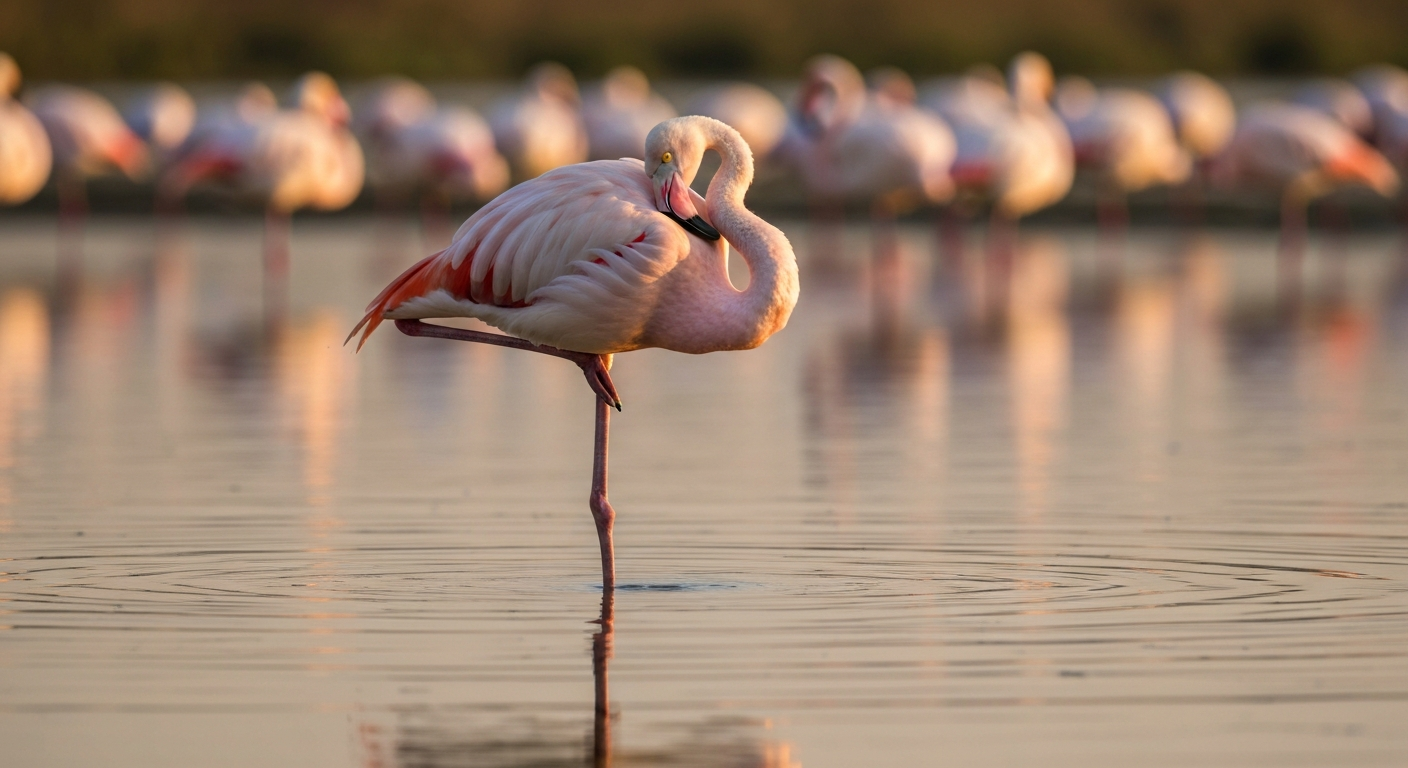
A bird standing on one leg is almost always resting, conserving heat, or simply taking the weight off one limb for a while. It is not injured, dying, or sending a mystical signal. The behavior is well documented across hundreds of species and is driven primarily by thermoregulation (tucking one bare leg against the body to reduce heat loss), a passive tendon-locking mechanism that lets the bird hold the posture with very little muscular effort, and the ordinary need for rest or sleep. That said, context matters: a bird that cannot put both feet down at all, shows swelling, or never alternates legs is a different story, and the guide below walks through exactly how to tell the difference.
Bird Standing on One Leg Meaning: Why Birds Do It Explained

Marcus Holloway
27 Jul 2026
The science behind one-legged standing
Thermoregulation: bare legs are heat windows
Bird legs are largely unfeathered, and unfeathered body parts lose heat to the environment at a rate far higher than feathered surfaces. Researchers have used infrared thermal imaging to map these so-called thermoregulatory windows in wild birds, quantifying how much heat flows out through the legs, bills, and other exposed patches. By pulling one leg up into the belly feathers, a bird effectively covers one of its two biggest heat-loss surfaces, cutting convective and radiative heat exchange roughly in half for that limb. A comparative analysis of 852 bird species found that birds with longer legs relative to their body size, and birds living in colder or windier climates, show higher rates of unipedal stance and back-resting postures, which is exactly the pattern you would expect if leg length and environmental temperature are both driving the behavior.
Interestingly, one pilot field study of shorebirds and flamingos found that one-legged standing actually increased at warmer temperatures in some species, not colder ones. That finding complicates a neat single-cause explanation and reminds us that the behavior is probably serving slightly different purposes depending on the species and situation. Fatigue avoidance, shifting weight to rest one limb, and even vigilance postures linked to sleep may all play a role alongside thermal management.
The tendon-locking mechanism: why it costs almost nothing
Birds have a structural trick in their feet and lower legs called the digital tendon-locking mechanism. When a bird bends its leg at the knee and settles its weight onto its tarsus, flexor tendons running along the bottom of the foot are pulled taut passively by the bird's own body weight. Tiny notches and ridges on the tendon sheaths lock the tendons in the flexed position without requiring sustained muscle contraction. Biomechanical experiments on flamingos using force plates and cadaver manipulations showed that flamingos can hold a one-legged posture while alive using what the researchers called a gravitational stay apparatus, in which the body weight itself stabilizes the stance with almost no active muscle work. For a bird that stands on one leg for hours at a stretch, this mechanical advantage is enormously efficient.
Rest, sleep, and unihemispheric awareness
Many birds sleep while standing, and some do so on one leg. When you see a bird with its bill tucked under its shoulder feathers and one leg drawn up, it is often in a light-sleep state. Some bird species practice unihemispheric slow-wave sleep, where one hemisphere of the brain rests while the other stays alert to threats. Standing on one leg during this state may be a posture of controlled relaxation rather than pure thermal management. Cornell Lab of Ornithology field-cam observers note that the clearest sleep indicators are the bill-tucking combined with one-leg standing and a general stillness, as opposed to the more alert, heads-up one-leg posture birds adopt during preening or feeding breaks.
Which birds do it most, and when
One-legged standing is recorded across hundreds of species, but a few groups stand out as especially well-known for it.
| Species / Group | Frequency of One-Leg Standing | Primary Context | Notes |
|---|---|---|---|
| Flamingos | Very high; observed for hours at a time | Resting and sleeping in large flocks | Gravitational stay apparatus makes it mechanically very efficient; seen in both warm and cool conditions |
| Great Blue Heron / Grey Heron | High, especially when resting mid-day | Resting, sleeping, and vigilance | Long legs make thermoregulation benefit large; bill-tuck often accompanies the posture |
| Egrets (Great, Snowy) | Moderate to high | Resting between foraging bouts | Often seen standing motionless at water's edge |
| Ducks and geese (waterfowl) | Common, especially on cold or windy days | Resting on ice, shorelines, or docks | Thermal benefit is pronounced on cold substrates; they tuck one leg against belly feathers |
| Avocets and stilts | Common | Resting and preening | Long, thin legs; high surface-area-to-volume ratio amplifies heat loss, so tucking one leg is beneficial |
| Godwits and sandpipers (shorebirds) | Common, studied in dunlins specifically | Resting during high tide roosts | Experimental temperature manipulation confirmed shorebirds increase unipedal stance as temperature drops |
| Cranes (e.g., Whooping Crane) | Moderate | Resting and sleep | Counter-current heat exchange in legs documented; infrared studies validated on this species |
| Pigeons and doves | Occasional | Resting on perches or ledges | Less pronounced; shorter exposed leg length reduces the thermal benefit |
Reading the situation: what the bird is actually doing
The same one-legged posture can mean several different things depending on what the rest of the bird is doing. Here is a breakdown of the most common contexts.
Sleeping or deeply resting
Bill tucked back under wing or shoulder feathers, eyes partially or fully closed, body feathers fluffed slightly, very little movement. This is the classic rest posture. The bird is not in distress. If you approach slowly, it will likely open its eyes, assess you, and either stay put or fly off normally.
Preening
A bird may shift its weight to one leg while using the other foot to scratch its head or while reaching awkward angles with its bill. This is momentary and not a sustained posture. You will see the tucked leg come down and change sides frequently.
Alertness and feeding breaks
A heron standing in shallow water on one leg with its head up and eyes open is simply taking a break between foraging strikes, or managing heat while it scans for prey. The one-legged posture here is often held for shorter periods and alternates with both-feet-down wading.
Injury or illness
This is the case that genuinely warrants concern, and it looks distinctly different from normal resting behavior. See the section below for a clear comparison.
Normal behavior vs. injury: how to tell them apart
Veterinary and wildlife rehabilitation literature is clear that a genuinely injured or ill bird presents with additional signs beyond simply holding one leg up. The key is not to interpret the leg position in isolation but to read the whole bird.
| Sign | Normal Resting Behavior | Possible Injury or Illness |
|---|---|---|
| Leg alternation | Switches legs periodically; uses both legs when disturbed | Consistently avoids weight-bearing on one specific leg; does not alternate |
| Response to approach | Alert, moves away or flies normally when approached | Reluctant or unable to move; does not attempt to flee |
| Bill and feather condition | Bill tucked cleanly; feathers smooth or deliberately fluffed for warmth | Feathers ruffled and unkempt; bird appears dull or 'puffed up' even in warm conditions |
| Visible abnormalities | Leg looks normal; no swelling, wounds, or abnormal angles | Visible swelling, scabbing, open wound, abnormal toe position, or bent limb |
| Weight bearing | When both feet are down, bird stands normally | Limps, knuckles over on toes, or holds foot off ground even when not resting |
| Duration and context | Posture changes with activity; bird forages, preens, moves normally otherwise | Same leg held up for extended period regardless of activity or disturbance |
| Eye and overall condition | Eyes bright and responsive | Eyes dull, half-closed, or sunken; bird appears lethargic |
Clinical conditions to be aware of include pododermatitis (commonly called bumblefoot), a bacterial infection that causes swelling and scabbing on the foot pad, as well as fractures, tendon injuries, and avian neuropathies. Clinical review chapters on avian orthopaedics and pododermatitis (BSAVA/Clinical Avian Medicine references) review these conditions and outline diagnostic steps (palpation, radiographs, tendon tests) and treatment approaches. These conditions are documented in captive and wild birds and are diagnosed through physical examination, palpation, and in clinical settings, radiography. Veterinary sources also note that when one leg is injured, the opposite leg can develop secondary lesions from compensatory overloading, so examining both limbs is important during any assessment.
What to do if you think a bird is injured
If you observe a bird that shows the injury signs described above, the practical steps below give you a safe and legal framework for responding. Do not attempt to treat or house a wild bird yourself unless you are a licensed rehabilitator.
- Observe at a distance first. Watch the bird for at least 15 to 20 minutes before concluding it cannot move. A resting bird may look very ill but simply be asleep.
- Look for the full picture. Check for the combination of signs in the table above, not just the one-leg posture.
- Contact a licensed wildlife rehabilitator. In the United States, the National Wildlife Rehabilitators Association (NWRA) and the Wildlife Center of Virginia both maintain directories. Your local wildlife agency can also refer you.
- Understand the legal framework. Under U.S. federal regulations (50 CFR Part 21), you may transport an injured migratory bird to a licensed rehabilitator or veterinarian without a permit for the purpose of that transport, but you cannot keep the bird or treat it yourself. A veterinarian who receives such a bird must transfer it to a federally permitted rehabilitator within the required timeframe.
- Do not chase or stress the bird. If it is injured and you try to capture it, the stress of being chased can be fatal. Get professional help first.
- Photograph and document if possible. A clear photo of the bird and its posture, including any visible leg abnormalities, is enormously helpful for the rehabilitator or veterinarian who will assess it.
- If you need to contain the bird safely for transport, use a cardboard box with ventilation holes, keep it dark and quiet, and do not offer food or water unless specifically instructed by a rehabilitator.
Watching and photographing birds in the field
One-legged birds are excellent photographic subjects precisely because they tend to be still. A few practical tips make the difference between a blurry record shot and a genuinely useful image, whether your goal is identification, documentation for a rehabilitation report, or simply a beautiful photo.
- Approach slowly and at an angle rather than head-on; direct approaches trigger flight much sooner.
- Use the longest focal length lens or zoom available to you. Keeping distance reduces stress on the bird and gives you a cleaner background.
- Shoot at eye level where possible. For shorebirds and ducks this often means crouching or lying on the ground.
- Capture the whole bird including both legs when documenting a possible injury, not just a tight crop on the face or plumage.
- Note and record the behavior in writing: time, temperature, weather conditions, whether the bird alternated legs, and how it responded to your presence. This context is as valuable as the photograph itself for any rehabilitation or banding report.
- If the bird has a leg band, photograph the band clearly (color, position, any visible alphanumeric code) and note which leg it is on. Band reports submitted to the Bird Banding Laboratory in the United States contribute directly to population research.
Monitoring tools and feeders can help you observe birds regularly from a fixed, less disruptive position. Camera-equipped feeders and garden cameras allow you to watch resting postures repeatedly, which makes it much easier to build a baseline sense of what normal resting looks like for the species in your area, so that anything genuinely abnormal stands out.
Leg and foot anatomy: a quick orientation
You do not need a degree in ornithology to read a bird's leg posture, but knowing the basic anatomical terms helps you understand why the thermoregulation and tendon-locking science works the way it does, and it gives you precise language when describing what you see to a vet or rehabilitator.
What looks like a bird's knee bending backward is actually the ankle joint. The true knee is up high, usually hidden under the body feathers. The long visible section of leg below the apparent backward-bending joint is the tarsometatarsus, a fused bone unique to birds. Below that are the toes, and the whole arrangement is built for efficient, low-energy support. The relative proportions of these segments vary considerably across species, which helps explain why heat-conservation behavior differs so much between, say, a flamingo and a pigeon. For precise terminology of the toes and other parts, see the page on what bird feet are called.
Glossary of key terms
| Term | Plain-language definition |
|---|---|
| Tarsus (tarsometatarsus) | The long, fused lower-leg bone visible as the main 'leg' shaft in most birds; formed from the fusion of ankle and foot bones. This is the primary heat-loss surface addressed by unipedal stance. |
| Tibiotarsus | The bone above the tarsometatarsus, analogous to the shin; often partially feathered. It connects at the apparent 'knee' joint (which is actually the ankle). |
| Metatarsus | The foot bones fused into the tarsometatarsus in modern birds; in anatomical shorthand sometimes used to refer to the lower portion of that fused structure. |
| Talons | The sharp, curved claws of raptors (hawks, eagles, owls). In non-raptors the equivalent structures are simply called claws or nails. |
| Webbed feet | Feet in which adjacent toes are connected by a membrane of skin (palmate webbing in ducks and geese; totipalmate in pelicans). Webbing aids swimming and also functions as a heat-radiating surface in warm conditions. |
| Hallux | The first toe, analogous to the human big toe; points backward in most perching birds and is critical for gripping branches. Absent or reduced in some ground-dwelling species. |
| Plantar tendon (digital flexor tendon) | The tendon running along the underside of the foot that, via the locking mechanism, passively holds the toes curled when the leg is bent. The basis of both perch-grip and low-energy one-leg standing. |
| Pododermatitis (bumblefoot) | A bacterial infection of the foot pad causing swelling, redness, and scabbing; a common clinical cause of genuine unilateral weight-bearing abnormality in both captive and wild birds. |
| Unipedal stance | The technical term for standing on one leg; the posture studied in comparative and behavioral ecology literature. |
| Urohidrosis | Defecation onto the legs as an evaporative cooling mechanism, documented in storks and New World vultures; reduces leg surface temperature by several degrees Celsius. |
Leg bands and bird banding: what that band on the leg means
If the one-legged bird you are watching has a small metal or colored plastic ring around its leg, that is a bird band, and it is there deliberately. Bird banding (called bird ringing in the UK and much of Europe) is a scientific and conservation practice in which trained, federally permitted researchers fit uniquely numbered or color-coded bands to wild birds so that individual birds can be tracked across their lifetimes, migrations, and territories. See our guide on bird banding meaning for details about why bands are used, what different band types indicate, and how reporting contributes to research and conservation. Bands are sized precisely so that they do not restrict movement or cause injury, and they are applied under strict regulatory oversight.
In the United States, the Bird Banding Laboratory (BBL) at the USGS coordinates banding data. If you see a banded bird, you can report the band number, the date, and the location to the BBL through their online reporting portal at reportband.gov. Your report may contribute to migration research, survival studies, or habitat management decisions. The position of the band (left or right leg, upper or lower segment) and its color often carry specific meaning in color-banding studies, and researchers publish decoding guides for their study populations. The site has detailed coverage of how banding works, what different band types mean, and how to interpret what you see.
Cultural meanings and dream interpretations
Across cultures and traditions, a bird standing on one leg carries a range of symbolic readings, though it is worth being clear upfront that these are interpretive frameworks rooted in folklore and spiritual traditions rather than scientifically tested claims. That caveat aside, the symbolism is genuinely interesting and worth knowing. For a different cultural perspective, see our short piece on bird luger meaning.
Balance, patience, and stillness
In many Western and East Asian traditions, a bird standing on one leg is a symbol of balance, especially the difficult balance of holding composure under pressure or maintaining equilibrium when circumstances are uncertain. The heron in particular appears in this context in Celtic, Chinese, and Japanese symbolism, often representing patience, solitude, and the ability to stand firm in changing conditions. The flamingo's unipedal stance in African and South American cultures carries similar associations with grace under sustained effort.
Threshold and transition symbolism
In some shamanic and indigenous traditions, a bird on one leg is described as standing between two worlds, one foot in this reality and one withdrawn from it, a posture of liminal awareness. This reading maps loosely onto what we now know about unihemispheric sleep in birds, one hemisphere resting while one remains alert, though that correspondence is coincidental rather than evidence that ancient observers understood bird neuroscience.
Dream interpretations
In contemporary dream-interpretation traditions, dreaming of a bird standing on one leg is broadly associated with themes of resilience, resourcefulness, and the capacity to conserve energy for what matters most. Some interpreters link it to a period of deliberate waiting before decisive action. As with all dream symbolism, the meaning depends heavily on the dreamer's own associations with the specific bird species and the emotional tone of the dream. A flamingo standing on one leg in a warm, peaceful scene carries very different resonance than a lone heron on one leg in fog. These readings are best treated as starting points for personal reflection, not prescriptions.
Quick-reference: species, posture, and likely reasons
| Species | How often you see it | Most likely reason | Additional clues to watch for |
|---|---|---|---|
| Flamingo | Very frequently; can be sustained for hours | Thermoregulation + passive mechanical support | Large flocks often do it simultaneously; both warm and cool conditions |
| Great Blue Heron | Frequently at rest and mid-day | Thermoregulation and sleep | Bill tucked under wing; minimal movement for extended periods |
| Snowy Egret / Great Egret | Often between foraging bouts | Resting; thermal management | Head alert and upright means resting-vigilant rather than sleeping |
| Mallard / Canada Goose | Common on cold days, especially on ice | Heat conservation from cold substrate plus body | Often in a group; frequently alternate legs |
| American Avocet | Common during roost periods | Thermal management (long, thin legs) | Usually at high-tide roosts with other shorebirds |
| Dunlin / Sandpiper | Common at roost | Temperature-driven; studied experimentally | Increases with temperature drop; bill-tuck accompanies sleep |
| Whooping Crane | Moderate | Rest and sleep; counter-current heat exchange documented | Usually in wetland habitats; tall bird, very visible posture |
| Pigeon / Dove | Occasional | Short-term resting | Rarely sustained for long; leg alternation common |
Further reading and related topics on this site
The anatomy and behavior covered here connect to several related topics explored in depth on this site. Bird leg and foot anatomy, including what the different structural regions are called and how they vary across species, is covered in detail in the bird legs and bird feet reference pages. For a clear explanation of bird feet meaning and terminology, see the bird feet reference page on this site. For a focused explanation of terminology and function, see bird legs meaning. If you spotted a band on the bird you were watching, the bird banding and bird leg band meaning pages explain the full system of how banding works, what different band types and colors mean, and exactly how to submit a band recovery report. For readers curious about monitoring bird activity at home, the bird buddy lights reference page covers what the indicator lights on smart feeder devices mean and how to interpret their behavioral alerts.
Understanding one-legged standing is ultimately a small but satisfying example of how much a single observed behavior can open up: from the physics of heat exchange and the mechanics of tendons, to the ecology of shorebird roosts, the legal framework protecting injured wildlife, and the symbolic weight that cultures around the world have placed on a bird at rest. The biology and the symbolism both hold up to scrutiny, as long as you keep them in their proper lanes.
FAQ
Briefly — why do birds stand on one leg?
Short answer: birds stand on one leg for several non‑exclusive reasons that vary by species and context. Main scientific explanations are thermoregulation (tucking an unfeathered limb to reduce heat loss), biomechanical/passive support (some species can lock structures to hold weight with little muscle effort), fatigue avoidance or alternating weight bearing, and resting or sleep behaviors (including unihemispheric sleep in some species). Observers should interpret the posture in context — species, behaviour (preening, sleeping, feeding), environment and whether the bird alternates legs. (See Pavlović et al. 2019; Chang & Ting 2017; Tattersall et al. 2018.)
How does thermoregulation explain one‑leg standing?
Legs and bills are often unfeathered and act as thermal "windows." Tucking a leg against the body reduces convective and radiant heat loss from that surface. Infrared studies show measurable leg‑surface cooling and reduced heat flux when birds adopt postures or behaviors that protect or moisten legs (e.g., urohidrosis in storks). Thermal effects depend on leg surface area, ambient temperature, wind and species morphology. (See Tattersall et al. 2018; Cabello‑Vergel et al. 2023; PLoS ONE 2015 methods.)
What biomechanical or anatomical mechanisms let birds stand on one leg with low effort?
Some birds (notably flamingos) use passive mechanical configurations — limb joints and tendons arranged so body weight is supported with little active muscular contraction (a 'gravitational stay' or tendon‑locking effect). The avian digital tendon locking/perching mechanism also reduces the muscular cost of sustained foot postures. These features make prolonged unipedal stance energetically inexpensive in many species. (See Chang & Ting 2017; Quinn & Baumel 1990.)
Which species commonly stand on one leg and in what contexts?
Common taxa: flamingos (long, frequent unipedal rest), herons/egrets, many waders and shorebirds (avocets, stilts, godwits), ducks and other waterfowl. Contexts include resting/sleeping (tucking head/eyes closed), preening or resting on a perch/leg, and thermoregulatory behaviours at water margins. Frequency and temperature responses vary by species — some show increased unipedality in cold, others show more at warmer temps, so species‑specific sources matter. (See Cornell Lab species pages; Harker & Harker 2011; Pavlović et al. 2019.)
How can an observer tell normal one‑leg standing from signs of injury or illness?
Normal one‑leg behavior is typically temporary, alternates between legs over time, occurs alongside resting or preening behaviours (head tucked, relaxed posture), and the standing leg/foot appears normal. Concerning signs: persistent non‑alternating leg elevation for long periods, visible swelling, wounds, abnormal toe positioning, inability to bear weight when forced to stand on the other leg, lame gait, or other systemic signs (lethargy, visible distress). If you see pathology, consult a wildlife rehabilitator or veterinarian. (See Cornell Lab accounts; clinical avian medicine references.)
When should you intervene or call a rehabilitator/veterinarian?
Intervene or contact a permitted wildlife rehabilitator/veterinarian if the bird shows: obvious injury (open wound, fracture), inability to stand or fly, blood, a leg or foot that is swollen or deformed, or prolonged distress. For migratory birds, U.S. regulations allow temporary transport of injured/sick birds to a permitted rehabilitator or vet and specify transfer rules — follow local wildlife agency guidance. For non‑injured birds simply standing on one leg while resting, do not intervene. (See Clinical Avian Medicine guidance; 50 CFR part 21 eCFR.)
Next Article
Bird Luger Meaning: What It Likely Means and How to Verify
What 'bird luger' means, concise verdict, plausible readings, research steps, and usage tips for writers & readers.