A bird hanging upside down usually means one of two things: it is doing exactly what it evolved to do, or something is wrong. Nuthatches, chickadees, certain warblers, and hanging parrots invert themselves routinely while foraging, playing, or moving along branches, and for those species an upside-down posture is as unremarkable as a robin pulling a worm. For a bird that does not normally hang inverted, however, the same posture can signal neurological illness, poisoning, physical injury, or fatal collision trauma. Culturally, the image has attracted centuries of symbolic weight: reversal, transformation, liminality, and surrender appear across folklore, dream interpretation, and Jungian psychology. This article works through all of those layers, starting with what is actually happening in the tree or on the wire, then moving outward to what people have made of the sight.
Bird Hanging Upside Down Meaning: Natural, Symbolic & Practical
Natural behavior vs. symbolic meaning: the quick take
Before reading any deeper meaning into a bird hanging upside down, it is worth running through a fast mental checklist. Is the bird moving? Is it alert, responding to noise, and capable of flying away? Is it a species known for acrobatic foraging? If the answers are yes, yes, and yes, you are almost certainly watching normal behavior. If the bird is motionless, unresponsive, limp, or trembling, that shifts the picture toward distress, and the practical sections below become the priority. The symbolic and spiritual interpretations discussed later in this article are historically attested and culturally meaningful, but they are best appreciated once you have ruled out a bird that needs help.
| Scenario | Most likely explanation | Action needed |
|---|---|---|
| Nuthatch or chickadee hanging on bark/branch tip | Normal foraging or gleaning | None, enjoy the view |
| Hanging parrot or lovebird suspended from cage/branch | Normal resting or locomotion posture | None |
| Unfamiliar species hanging limply, not moving | Possible injury, illness, or toxicosis | Assess and contact wildlife rehabilitator |
| Bird found beneath a window, stunned | Window collision trauma | Follow Audubon window-strike protocol |
| Bird hanging from wire or fencing material | Accidental entanglement | Contact wildlife rescue immediately |
| Bird in torpor (e.g., hummingbird, oddly angled) | Hypometabolic sleep state | Do not disturb; monitor for recovery |
How birds physically hang upside down
Birds that hang inverted are not fighting gravity so much as exploiting a mechanical advantage built into their feet and tendons. Most perching birds (passerines) have a specialized flexor tendon system: when the leg bends at the knee and ankle, the toes automatically curl and grip without any active muscle effort. This is the same mechanism that keeps a sleeping bird on a branch overnight. For species that forage on vertical or inverted surfaces, leg musculature, claw curvature, and tail-prop adaptations reinforce that grip further. Nuthatches, for example, have proportionally long hind claws and strong leg muscles that allow them to brace against bark while their heads point straight down. Parrots add a third point of contact by gripping with the beak, a locomotor strategy a 2022 peer-reviewed study in PMC coined 'beakiation,' describing it as a novel gait that genuinely expands the locomotor repertoire of living birds.
Suspensory postures have been formally quantified in at least some species. A peer-reviewed positional-behavior study of introduced monk parakeets in an urban landscape, published in the journal Animals (MDPI), defined and measured 'hang,' 'suspensory,' and 'uprighting' postures, finding that parrots use inverted hanging as a regular part of arboreal activity, not as an exception. That kind of quantitative documentation matters because it moves the observation from anecdote to reproducible science, which is the standard this site aims for when it uses the word 'normal.'
Foraging and gleaning: the most common reason
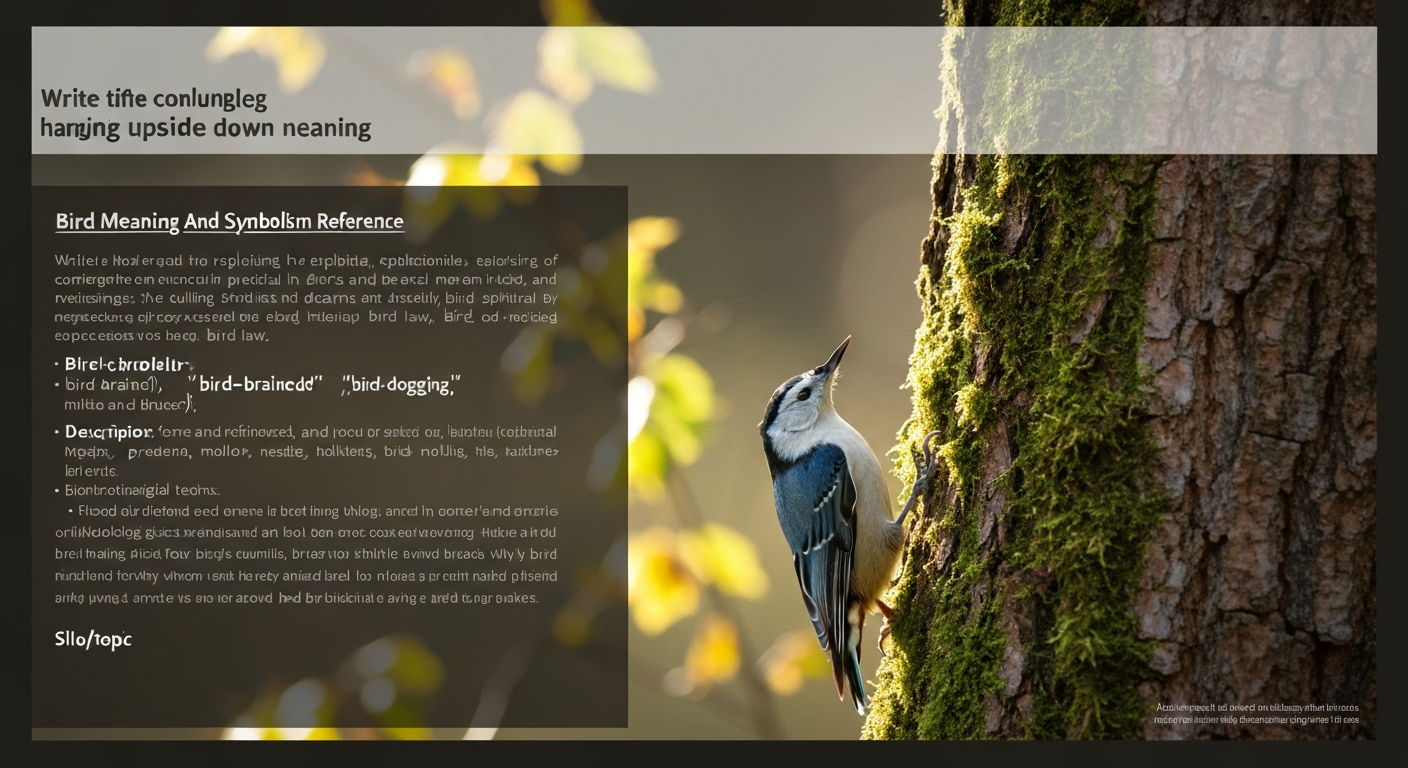
The single most frequent reason a bird hangs upside down in the wild is food. Gleaning, the act of picking insects, larvae, spiders, or seeds directly off surfaces like bark, leaves, or branch undersides, often requires a bird to invert or side-hang to reach spots that upright posture cannot access. The white-breasted nuthatch is the textbook example documented by the Cornell Lab of Ornithology: it descends tree trunks head-first as its default foraging mode, probing bark crevices from angles that other birds simply cannot reach. That niche separation is ecologically meaningful because it means nuthatches are not competing directly with woodpeckers or creepers that work the same bark but from different orientations.
Chickadees and some warblers, including the yellow-throated warbler as documented in eBird accounts, will creep along the undersides of branches and hang briefly to probe foliage for invertebrates. These postures are usually fleeting, a second or two at most, which is partly why they seem surprising when you notice them. Because the behavior is quick, casual observers sometimes interpret it as abnormal when it is simply efficient. If you are tracking a bird that regularly forages in a particular tree, watching long enough to see the full foraging sequence usually clarifies the picture.
Play, stretching, and social acrobatics
Not every inversion is about food. Parrots in particular are well documented as using acrobatic postures during social interaction, object manipulation, and what researchers and keepers broadly describe as play. Hanging upside down from a perch while vocalizing, swinging, or interacting with a companion is a normal behavioral expression for many parrot species and is generally a positive welfare indicator in captive birds, suggesting the animal is active, exploratory, and unstressed. Corvids (crows, ravens, jays) also perform acrobatic maneuvers that include brief inversions, often during play or when investigating novel objects.
Stretching is another benign cause. Birds stretch their wings and legs regularly, and a bird that is gripping a horizontal branch and extending one wing and leg downward in a lateral stretch can briefly appear to be 'hanging' from an observer's angle. This is functionally identical to a human hanging off a pull-up bar to stretch the shoulders: it is about maintaining range of motion, not signaling anything unusual. Similarly, juveniles learning to perch and balance sometimes end up in awkward, temporarily inverted positions as they figure out how their feet and gravity interact.
Species known for upside-down and acrobatic perching
It would be a mistake to generalize broadly across all birds, so here is a grounded list of taxa where inverted or acrobatic postures are well documented, along with a note on how far that documentation extends. The Cornell Lab's All About Birds and eBird community-science database, as well as peer-reviewed positional-behavior studies, are the main sources underpinning these examples.
| Species or group | Typical inverted behavior | Documentation basis |
|---|---|---|
| Nuthatches (family Sittidae) | Head-down trunk descent; hanging upside down while foraging bark | Cornell Lab All About Birds; field guides |
| Chickadees and titmice (family Paridae) | Branch-tip hanging; gleaning undersides of leaves | eBird community observations; field guides |
| Yellow-throated warbler and some other warblers | Creeping and hanging on branch undersides | eBird (Cornell Lab) |
| Hanging parrots (genus Loriculus) | Prolonged inverted roosting and sleeping posture | Ornithological literature; aviculture records |
| Monk parakeet and other parrots | Suspensory locomotion; 'beakiation'; arboreal hanging | Peer-reviewed Animals (MDPI) study; PMC beakiation study |
| Corvids (crows, ravens, jays) | Brief inversions during play and object investigation | Behavioral field observations; cognitive-ecology literature |
A few important limits on that table: the presence of upside-down posture in one species does not mean all members of a related family behave the same way. A house sparrow hanging limp from a feeder tray is not doing what a nuthatch does on bark. Context, species identification, and behavioral cues all matter. Community-science platforms like eBird and the Macaulay Library contain photographic and audio records documenting these postures in the field, which is useful if you want to cross-reference what you saw with confirmed sightings.
Roosting and sleeping upside down
Most birds sleep right-side up with their heads tucked under a wing, held on a branch by the passive tendon-locking mechanism described earlier. True inverted roosting is rare but real in a handful of species. Hanging parrots (genus Loriculus) are the clearest example in ornithological literature: they genuinely roost in a fully inverted position, dangling from a branch like a small feathered bat. This posture is sustained, not accidental, and is considered an adaptation rather than a curiosity.
Hummingbirds add another wrinkle through torpor, a hypometabolic state that Cornell Lab's All About Birds describes in species like the broad-tailed hummingbird. In torpor, a hummingbird's body temperature drops dramatically, its breathing slows, and it becomes nearly impossible to rouse. An observer who finds a hummingbird hanging from a feeder port or perched at an odd angle and completely unresponsive may be witnessing torpor rather than death or injury. The practical rule: do not warm, handle, or attempt to feed a torpid hummingbird. Move away, wait 20 to 30 minutes, and reassess. If it does not rouse by mid-morning after overnight torpor, that warrants wildlife rehabilitator contact.
When hanging means something is wrong
This is the section that matters most if you are looking at a bird right now. A bird that is hanging limply, cannot right itself, is trembling, or is unresponsive to nearby movement is displaying potential clinical signs of neurological illness, poisoning, traumatic injury, or near-death. These are not symbolic indicators; they are veterinary warning flags documented in sources including the Merck Veterinary Manual and clinical avian medicine literature.
Neurological illness and toxicosis
Lead poisoning, organophosphate exposure, other heavy metals, and severe hypoglycemia all produce overlapping clinical signs in birds: ataxia (loss of coordinated movement), weakness, tremors, head-pressing, seizure activity, and collapse. According to the Merck Veterinary Manual's toxicology section, a bird affected by lead or cholinesterase-inhibiting compounds may fall from a perch, hang limply, sit in bizarre postures, or appear completely disoriented. Clinical avian medicine guidelines described in sources like the International Veterinary Information Service emphasize that differentiating intentional acrobatic inversion from pathological collapse requires evaluating responsiveness, the ability to fly and right itself, the presence of tremors or ataxia, and any known exposure history (nearby rodenticide use, lead shot, treated seed).
Window strikes and collision trauma
Window collisions are among the most common causes of birds being found stunned or dead near buildings, and the Audubon Society provides detailed step-by-step guidance for assessing and responding to collision victims. A bird that has struck a window may be found slumped at the base of the glass, sitting abnormally still nearby, or, in some cases, hanging from a ledge or screen it grasped reflexively before losing consciousness. Internal injuries from collision are not visible externally, so a bird that appears to recover and fly away briefly may still die hours later. The recommended protocol is to place the bird gently in a ventilated cardboard box in a quiet, dark space (to reduce stress) and contact a licensed wildlife rehabilitator within the hour. Do not offer water or food.
Entanglement and electrocution
A bird truly hanging from a wire, netting, or fencing material may be entangled rather than perching. Power-line electrocutions and collisions with utility infrastructure are a documented cause of avian mortality, quantified and analyzed in peer-reviewed research published through PMC. If you see a bird suspended motionlessly from fencing, netting, or man-made infrastructure, assume entanglement until proven otherwise and contact a wildlife rescue organization rather than attempting to free it yourself: improper handling of an entangled bird can worsen injuries or break bones.
Distress warning signs at a glance
- Limpness with no grip response when approached
- Inability to right itself after being observed for several minutes
- Tremors, repetitive head movements, or seizure-like twitching
- Eyes partially or fully closed in daylight without the calm, relaxed posture of a roosting bird
- No flight response to a slow approach within 2 to 3 feet
- Visible blood, asymmetrical wing droop, or obvious limb injury
- Found directly beneath a window, power line, or netting
If three or more of those signs are present, treat the situation as a wildlife emergency. The National Wildlife Rehabilitators Association and local Audubon chapters maintain directories of licensed rehabilitators by region. In the United States, transporting a wild bird without a permit is regulated under the Migratory Bird Treaty Act, so contacting a licensed rehabilitator rather than keeping the bird is both the safer and the legally correct action.
Spiritual and symbolic meanings across cultures
Once you have established that the bird is safe and healthy, or if you encountered the image of an upside-down bird in a dream, a piece of art, or a cultural context rather than in your backyard, the symbolic dimension opens up. The meanings are real in the sense that they are historically attested in scholarship and folklore, even if they are not predictive in the way a weather forecast is. What follows is a representative survey grounded in documented cultural and scholarly sources, not a prescriptive reading of what your experience 'must' mean.
Reversal, liminality, and the upside-down world
Inversion as a symbol of reversal and transformation appears across many traditions and time periods. Academic treatments of the 'world turned upside down' trope, including a scholarly paper archived at the University of Southampton, document how inverted imagery signals the suspension of normal order: rules flipped, hierarchies dissolved, a threshold between one state and another. The Tarot card The Hanged Man (card XII in the major arcana) is perhaps the most widely recognized Western instance: the figure hangs inverted from one foot, usually interpreted not as punishment or death but as willing suspension, a deliberate pause that enables a new perspective. That distinction, between being trapped and choosing to see from a different angle, is central to most symbolic readings of inversion.
Jungian and depth-psychology readings
Carl Jung's concept of enantiodromia, described in his Collected Works and Symbols of Transformation, refers to the tendency of things to become their opposites as a necessary part of psychological development. Inversion imagery fits that framework naturally: what is turned upside down is in the process of becoming something new. Jungian-informed dream interpreters who encounter an upside-down bird often read it as the psyche signaling a need to relinquish control, surrender a fixed perspective, or acknowledge a transformation already underway. Sigmund Freud's Interpretation of Dreams, available in the public domain through Project Gutenberg, also treats inversion and reversal as meaningful dream motifs, typically linked to reversal of emotional relationship or wish fulfillment through opposition. These are frameworks for interpretation, not scientific predictions, and they are most useful when a person finds the imagery personally resonant.
Omens, augury, and cultural bird symbolism
Birds have been read as omens in almost every documented culture that has left records of the practice. Ornithomancy, the reading of bird behavior as divine or prophetic signs, is detailed in scholarly works on ancient Mediterranean traditions, including academic discussion reviewed through Oxford Academic. For example, ornithomancy in the ancient Mediterranean is examined in Birds in the Ancient World: Winged Words, review / academic discussion (Oxford Academic) Birds in the Ancient World: Winged Words — review / academic discussion (Oxford Academic). Indigenous traditions across North America, Mesoamerica, and elsewhere have their own systems for interpreting bird encounters, and a peer-reviewed study published through PMC on bird conservation and cultural values in Indigenous Mexican communities illustrates how bird behavior (calls, flight patterns, presence) functions as an ecological and omen-like indicator in living traditions today. It would be reductive to collapse all of those systems into a single symbolic meaning, but the pattern of treating unusual bird behavior as a message worth attending to is remarkably consistent across cultures.
For a bird specifically hanging upside down, the cultural readings that appear most consistently in folklore and spiritual literature cluster around: a message from the spirit world delivered through unusual means, the presence of a soul in transition (connecting the image to death and the threshold between life and what follows), and an invitation to reconsider a situation from the opposite angle, literally and metaphorically. These readings are worth taking seriously as cultural phenomena even if you approach them skeptically, because they tell us something real about how human minds process the unexpected.
Dream interpretations
Dreams featuring birds hanging upside down tend to be interpreted in contemporary symbolic and spiritual literature through the same reversal framework: something in the dreamer's waking life is inverted, unresolved, or in a state of transition. A bird specifically, as a symbol of freedom, perspective (altitude), and communication across many traditions, adds a layer: the dreamer's own freedom or perspective may feel constrained or flipped. Whether you find that useful depends on your relationship to dream symbolism generally. The honest caveat, consistent with the Jungian and Freudian primary sources, is that no single dream image has a fixed meaning independent of the dreamer's personal context and associations.
A note on pareidolia and meaning-making
Peer-reviewed research on pareidolia and apophenia, reviewed in PMC publications, documents the well-established human tendency to find patterns and meaningful signals in ambiguous or random stimuli. The review 'Pareidolia in clinical and non‑clinical populations, review (PMC)' summarizes neuroscience and psychological evidence on pareidolia and apophenia, including proposed neural mechanisms and individual differences that explain why observers impose meaning on ambiguous stimuli blank" rel="noopener noreferrer">Pareidolia in clinical and non‑clinical populations — review (PMC). Seeing an unusual bird posture and immediately reading it as a personal omen is a cognitive process with a scientific name, and acknowledging that does not invalidate the experience. It means that the meaning you find may say something genuine about your current emotional or psychological state, even if the bird itself is simply a nuthatch doing what nuthatches do. This is the same interpretive space occupied by bird-shaped cloud sightings and other ambiguous natural encounters: the pattern-recognition is real, the question is what you do with it.
How this fits with other unusual bird sightings
A bird hanging upside down is one of several visually striking avian behaviors that prompt both ornithological and symbolic questions. A bird falling from the sky raises immediate concern about illness, collision, or flock dynamics (murmurations can produce apparent falls), while also carrying heavy symbolic weight around endings and transitions. A bird circling overhead activates different associations, from the thermal-riding efficiency of raptors to omen traditions around vultures and hawks. For more on the causes and interpretations of a circling bird, see bird circling meaning. A bird swooping toward a person tends to be either a territorial defense behavior (particularly in nesting season) or, symbolically, a message directed specifically at the observer. For more on interpreting a close approach, see bird swooping meaning for behavioral and symbolic explanations. Bird loafing, the term for a bird that is simply standing still and resting, is frequently misread as injury when it is actually normal thermoregulatory or digestive behavior. For a concise explanation of bird loafing meaning and how to distinguish it from injury, see bird loafing meaning. Each of these sightings, like the upside-down posture, benefits from the same two-step approach: establish the natural explanation first, then engage with the symbolic dimension if that is what you came for.
Birds in language: inversion and the words we use
It is worth noting that the broader culture of bird-derived language reinforces just how deeply birds are embedded in human meaning-making. Terms like 'bird-brained' (implying foolishness, though modern neuroscience has substantially revised our understanding of avian intelligence), 'bird-dogging' (tracking something persistently, originally from hunting), and even the deliberately absurd legal concept of 'bird law' in American popular culture all point to the same phenomenon: birds are so constantly present in human observation that they become vehicles for expressing ideas about behavior, intelligence, and social norms. An upside-down bird fits that tradition perfectly. It is visually arresting, behaviorally surprising, and immediately invites interpretation, which is exactly why it has accumulated symbolic meaning across so many different cultural contexts.
What to do if you find a bird hanging upside down
If you have read this far and you are still not sure whether the bird you found is okay, here is the practical sequence I would follow. First, identify the species if you can: a nuthatch or chickadee hanging on bark near a feeder almost certainly does not need your help. Second, observe from a distance for two to three minutes without approaching: a healthy acrobatic bird will move, respond to ambient sound, and fly if startled. Third, if the bird is motionless and unresponsive, look for the distress indicators listed earlier in this article. Fourth, if any distress signs are present, do not attempt feeding or warming. Place the bird in a ventilated cardboard box, keep it in a quiet, dim, warm (but not hot) space, and contact a licensed wildlife rehabilitator. Fifth, document what you saw with a photo or note if possible, including location, time, and any nearby hazards (windows, feeders, power lines), because that information helps the rehabilitator assess the situation faster.
- Identify the species: is it known for acrobatic or inverted postures?
- Observe from a distance for 2 to 3 minutes without disturbing the bird
- Check for distress signs: limpness, tremors, no flight response, visible injury
- If distressed, place the bird in a ventilated cardboard box in a quiet, dark, warm space
- Contact a licensed wildlife rehabilitator; do not feed or give water
- Document the location, time, and nearby hazards to help the rehabilitator
Birds hold an unusual position in both natural history and human culture: they are common enough to be everyday companions and strange enough, in certain moments, to stop us in our tracks. A bird hanging upside down is one of those stopping-point moments. Most of the time it is a nuthatch doing what nuthatches have always done, or a chickadee snatching an insect from a leaf underside. Sometimes it is a bird in trouble that needs your calm, informed response. And occasionally, in a dream or a moment of personal significance, it is an image that the mind reaches for to express something about reversal, transition, or the value of seeing the world from a different angle. All three of those readings are legitimate. Knowing which one applies is the whole game.
FAQ
What are the common natural (behavioral) reasons a bird might hang upside down?
Many birds hang or suspend themselves intentionally as normal behavior: foraging (e.g., nuthatches and chickadees probe underside of branches while inverted; see Cornell Lab species pages and eBird records), play and social acrobatics (parrots and some passerines), stretching or preening, roosting or sleeping in unusual positions (some small birds tuck and appear inverted), and species‑specific locomotor routines such as suspensory gaits in parrots. Sources: All About Birds (Cornell Lab), eBird, peer‑reviewed studies of parrot positional behaviour (PMC, MDPI).
Which species are most likely to be seen hanging upside down as normal behaviour?
Sittidae (nuthatches), many small insectivorous passerines (certain warblers, chickadees), and multiple parrot lineages (some known as 'hanging parrots' or those using beak‑assisted locomotion). Community‑science media (eBird, Macaulay Library) and field guides document these species routinely using inverted postures (see Cornell Lab pages and linked studies).
How can I tell if an upside‑down bird is performing normal acrobatic behavior versus showing signs of illness or injury?
Check responsiveness and control: normal acrobatic birds are alert, grasp securely, right themselves when disturbed, move purposefully, and show normal plumage and breathing. Concerning signs include lethargy, inability to right, tremors/ataxia, abnormal posture, open‑mouthed breathing, visible injury, or failure to fly when prompted. Triage guidance and clinical indicators are described in wildlife‑rehab and avian medicine sources (IVIS, Merck Veterinary Manual).
What health issues can cause a bird to hang limply or fall into an odd position?
Neurologic disease (trauma, toxins such as lead or organophosphates), metabolic collapse (hypoglycaemia), seizure activity, severe hypothermia/torpor in tiny species, or blunt‑force injury (window strikes, electrocution) can produce collapse, ataxia or flaccid hanging. For toxicoses and clinical signs see Merck Veterinary Manual and veterinary avian neurology literature. Documentation of torpor in hummingbirds is in Cornell Lab life‑history accounts.
If I find a bird hanging upside down and possibly injured, what practical first steps should I take?
Observe safely from a short distance first. If the bird is alert and can perch/move, leave it or monitor; if stunned, injured or immobile, contain it gently in a ventilated box lined with a soft towel, keep it warm and quiet, and contact a licensed wildlife rehabilitator or veterinarian promptly. Avoid forceful handling, feeding, or giving water unless instructed. Audubon and local wildlife‑rehab guides provide step‑by‑step collision and stunned‑bird advice. Legal note: handling protected species may be regulated—check local wildlife agency rules before intervening.
Could an upside‑down bird be a sign or omen? How do cultures interpret this?
Many cultures read unusual bird behaviour as omen‑like; historical ornithomancy and ethnographic studies show culturally specific meanings. Symbolic readings for inversion commonly include reversal of fortunes, new perspectives, surrender/suspension, liminality or transformation. Some traditions may associate an inverted or dead bird with death or transition, but meanings vary widely by culture. For balanced coverage cite ethnographic, historical, and Indigenous scholarship rather than generalising (see Oxford Academic review and ethnobiological studies).