"Bird style meaning" is an umbrella phrase that pulls together several distinct but related threads: the literal anatomical and behavioral vocabulary of birds (gape, pinion, molting, preening, eye-pinning, nesting), the visual-perspective idioms tied to how birds see the world (bird's-eye view, side view), the figurative expressions English has borrowed from bird life (bird-brained, bird-dogging, bird law), and the deep cultural, spiritual, and dream symbolism that birds carry across human history. This guide organizes all of those threads in one place so you can find exactly the definition or context you need, whether you are reading a field guide, decoding a dream, writing an essay, or just curious about where a phrase came from.
Bird Style Meaning: Literal, Figurative & Cultural Uses

Marcus Holloway
14 Jul 2026
How to use this guide
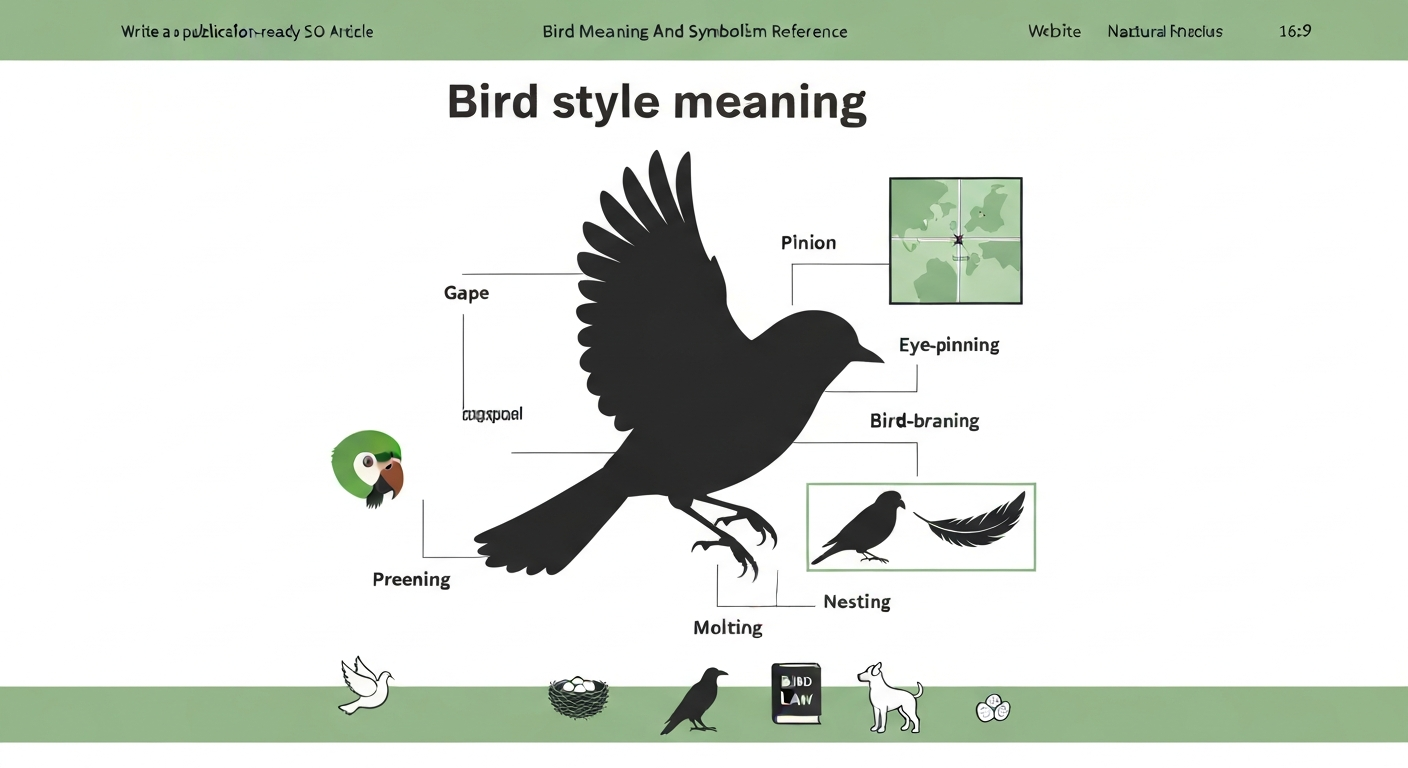
The article is organized from the concrete outward. It starts with anatomy and behavior (the physical facts of bird bodies and what they do), moves through visual and observational perspectives, then into idioms and slang, and finishes with cultural and dream symbolism. Each section is self-contained, so you can jump to whatever you need. The quick-reference table below gives you a one-line definition for every major term covered. If a term has its own dedicated page on this site, the section heading is where you would find that deeper link.
Quick-reference table: bird terms and their meanings
| Term | Category | Plain-language meaning |
|---|---|---|
| Gape | Anatomy / behavior | The opening of a bird's mouth; the maximum width a bird can open its bill |
| Pinion | Anatomy | The outer part of a bird's wing, especially the large primary flight feathers at the wingtip |
| Eye-pinning | Behavior (parrots) | Rapid constriction and dilation of the pupil used as a social signal; also called eye-flashing |
| Preening | Behavior | Bill-grooming of feathers to align barbs, spread oil, and remove parasites |
| Molting | Behavior / lifecycle | The cyclical, predictable replacement of feathers across a bird's annual cycle |
| Nesting | Behavior / lifecycle | Construction of a nest, incubation, and provisioning of young from nestling to fledgling stage |
| Bird's-eye view | Visual perspective / idiom | An overhead or aerial vantage point, as if seen by a bird in flight; used in cartography, design, and everyday speech |
| Bird side view | Visual perspective / field ID | The broadside or profile view of a bird; the standard pose in field-guide illustration |
| Bird gazing | Observational practice | The act of watching birds attentively, sometimes with meditative or spiritual intent |
| Bird-brained | Idiom / slang | Foolish or scatterbrained; stems from folk (and incorrect) assumptions about small bird brain size |
| Bird-dogging | Idiom / political term | Pursuing or tracking persistently; in modern activism, attending events to ask targeted public questions |
| Bird law | Pop-culture / slang | A joking faux-legal specialty popularized by the TV series It's Always Sunny in Philadelphia; not a formal legal field |
| Bird eye meaning | Related term | The significance or symbolism of a bird's eye; also used in field ID for notable eye coloration or eye-ring markings |
| Bird view meaning | Related term | An elevated or overview perspective; close relative of 'bird's-eye view' |
Sibling terms at a glance
This site covers several closely related bird-style terms in dedicated articles. Here is a concise definition of each so you can orient yourself before diving deeper into any one of them.
- Bird eye meaning: In ornithology, the eye is a primary field-identification feature (color, size, presence of an eye-ring or stripe). Symbolically, the bird eye represents perception, vigilance, and clairvoyance across many folk traditions.
- Bird view meaning: A generalized phrase for any elevated overview perspective. It overlaps with 'bird's-eye view' but is often used more loosely to mean a broad, high-level understanding of a subject.
- Bird eye view meaning: The standard aerial or overhead vantage point, as if you were a bird looking straight down. It is the formal idiom used in cartography, urban planning, illustration, and photography.
- Bird eye pinning meaning: Specific to parrots and some other psittacines, eye pinning describes the rapid, visible contraction and expansion of the pupil as a behavioral signal communicating excitement, interest, or sometimes agitation.
- Bird gape definition: The gape is the opening of the mouth from corner to corner; in ecological literature, 'gape-limited predator' describes a species whose prey size is constrained by how wide its bill can open.
- Bird gazing meaning: The practice of watching birds with sustained attention, which ranges from practical birdwatching and field identification to contemplative or spiritual observation of bird behavior and movement.
- Bird pinion meaning: The pinion is the outermost section of a bird's wing, where the primary flight feathers (the largest feathers) are anchored. In historical and literary English, 'on swift pinions' is a poetic phrase for rapid flight.
- Bird side view meaning: The profile or broadside view of a bird, which is the orientation most field guides use for their primary illustrations because it exposes the most identifiable features simultaneously.
Anatomy and behavior: the literal vocabulary of bird style
Before any figurative meaning can work, you have to understand what birds actually do. Most of the idioms and symbolic readings covered later in this article draw their power from real, observable bird behavior. The terms below are the core vocabulary of bird anatomy and behavior that any curious reader, birdwatcher, or writer is likely to encounter.
Gape
The gape is simply the opening of a bird's mouth, measured from the corner of one side of the bill to the other at maximum opening. Merriam-Webster defines it primarily as the act of opening wide, and in ornithological literature it becomes a technical measurement. The concept of a 'gape-limited predator' explains why a heron can swallow a large fish that a warbler cannot: prey size is physically constrained by how wide the bird's gape can stretch. Nestlings also use their gape conspicuously, opening wide and displaying brightly colored mouth linings to trigger feeding responses from parents. So when you see 'gape' in a field note or ecological study, it means the literal mouth opening, not a metaphor for surprise.
Pinion
The pinion refers to the outer part of a bird's wing, specifically the section that carries the primary flight feathers. These are the longest, stiffest feathers on the wing and the ones doing the most aerodynamic work in flight. In older English texts and poetry, 'pinion' often stands in for the wing or for flight itself (think 'swift pinions'). In practical falconry and aviculture, to 'pinion' a bird means to clip or surgically remove the outer wing segment to prevent flight. Wikipedia's disambiguation note correctly flags that 'pinion' covers both the anatomical structure and that husbandry practice, which is worth knowing if you encounter the word in different contexts.
Eye-pinning
Eye-pinning, also called eye-flashing or eye-blinking, is a behavior specific to parrots and some other psittacines. The pupil rapidly constricts and dilates in a visible, rhythmic cycle. According to companion-bird behavior resources, the behavior itself is neutral: it signals heightened emotional arousal, but whether that arousal is excitement, interest, fear, or aggression depends entirely on the context. For a focused explanation of bird eye pinning meaning, see the dedicated entry on this site. You read eye-pinning alongside the bird's posture, feather position (fluffed or sleeked), vocalizations, and what just happened in the environment. A parrot that is pinning its eyes while leaning toward you and chattering is probably excited. The same pinning while feathers are raised and the bird is backing away suggests something different. The Fear Free veterinary program covers this as a core avian body-language concept precisely because misreading it can lead to bites.
Preening
Preening is feather maintenance carried out with the bill. The Cornell Lab's Bird Academy describes it as a multi-step process: the bird runs feathers through its bill to realign displaced barbs, applies oil secreted by the uropygial (preen) gland near the tail base to waterproof and condition the feathers, and removes feather lice and other parasites in the same pass. For rules on using and crediting bird photos, audio, and video, see FAQs – Macaulay Library (Cornell Lab of Ornithology). Birds spend a substantial portion of each day preening. Social species, including many parrots and corvids, engage in allopreening, where one bird preens another, which also serves a bonding function. In everyday English, 'preening' has become a metaphor for self-grooming vanity, but the actual bird behavior is practical maintenance, not vanity.
Molting
Molting (or moulting in British English) is the systematic replacement of feathers on a predictable annual or biannual schedule. All About Birds at Cornell Lab explains that feathers are physically degraded by UV exposure, abrasion, and use, so birds must replace them regularly to maintain flight performance and insulation. Species differ in how and when they molt: some molt all at once (making them temporarily flightless), others replace feathers in a staggered sequence so they can always fly. Molt sequence and the resulting plumage stages are significant for birdwatchers because many species look very different in fresh versus worn plumage, and young birds go through multiple plumage cycles before reaching adult appearance. Getting the molt cycle right is a core identification skill.
Nesting
In ornithology, 'nesting' covers everything from nest construction through the full breeding cycle: egg laying, incubation, hatching, the nestling stage (young birds in the nest), and the fledgling stage (young birds recently out of the nest but still dependent). Cornell Lab's NestWatch program uses precise stage definitions to help citizen scientists record breeding data accurately. A 'nestling' is a young bird that cannot leave the nest; a 'fledgling' has left the nest but is not fully independent. These distinctions matter if you find a young bird on the ground, since the correct response differs depending on the stage. Figuratively, 'nesting' in human culture describes the urge (especially among expectant parents) to prepare and organize a home, a borrowing that maps closely onto the bird behavior.
Visual perspectives: how birds see and how we describe what they see
Several of the most durable bird-style expressions in English are about perspective, specifically about the elevated, wide-angle way a flying bird perceives its landscape. These terms cross from literal ornithology into everyday language, design, cartography, and philosophy.
Bird's-eye view
Merriam-Webster defines a bird's-eye view as a view from above, as if seen by a flying bird, and traces the phrase back several centuries in English. Merriam‑Webster's entry 'blank" rel="noopener noreferrer">BIRD'S‑EYE VIEW Definition & Meaning – Merriam‑Webster' defines bird's‑eye view as a view from above, as if seen by a flying bird, and traces the phrase back several centuries. In practice, it describes any overhead or aerial perspective: a bird's-eye-view map shows a city as if you were looking straight down at it from altitude. The phrase has also become entirely metaphorical: to get a 'bird's-eye view' of a problem means to step back and see its overall structure without getting lost in the details. Cartographers, architects, illustrators, and drone photographers all use the term as standard professional vocabulary. The phrase is closely related to 'bird view meaning,' which is a looser, more colloquial version of the same concept. If you want a concise definition, see the dedicated entry on bird eye view meaning. See the dedicated entry for bird eye meaning for focused definitions and examples.
Bird side view
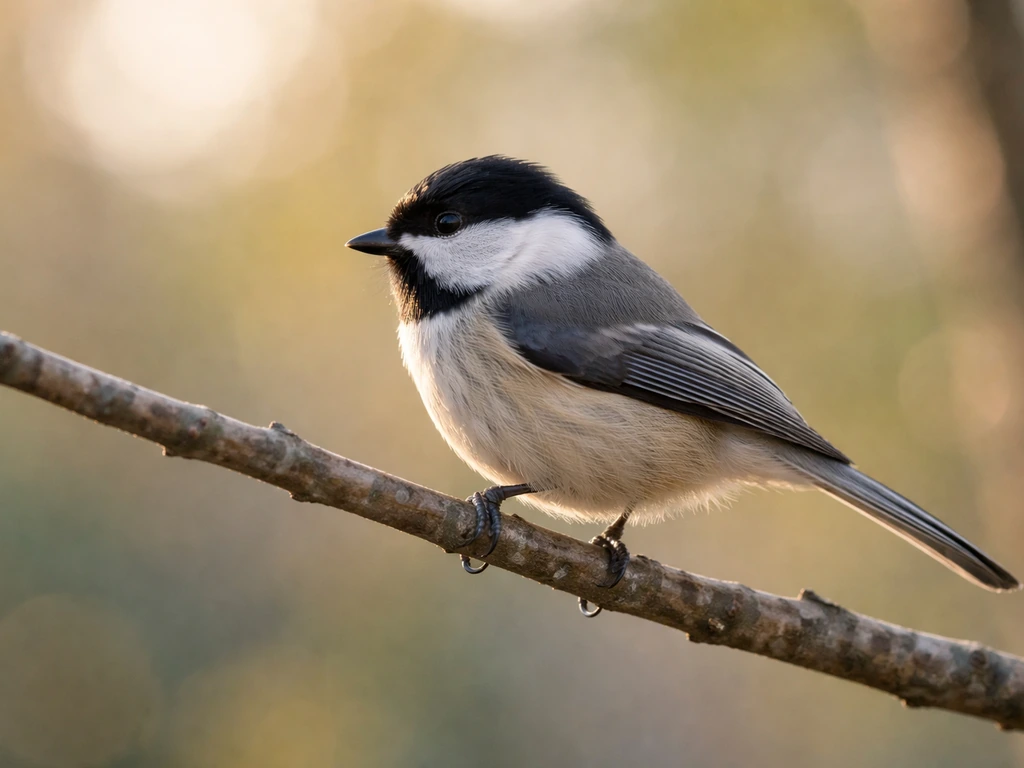
The side view, also called the broadside or profile view, is the most information-rich angle for identifying most bird species. Field guides from Peterson through Sibley to modern digital platforms lead with the broadside illustration because it simultaneously shows head shape, bill profile, eye position, wing shape at rest, leg length, and tail length. Pete Dunne's tradition of GISS (General Impression of Size and Shape) identification relies heavily on the profile silhouette: an experienced birder can identify many species at a glance from shape and posture alone before seeing any field marks. When you encounter 'bird side view meaning' as a search term, the reader is usually either working through a field guide or trying to understand why illustrations are drawn that way.
Bird gazing and observational perspectives
Bird gazing sits at the intersection of field observation and contemplative practice. At its most practical, it is simply sustained attentive watching of birds in the field, which is what good birders do before reaching for binoculars or a guide. At its more reflective end, bird gazing is the kind of watching that has fed poetry, folklore, and spiritual traditions for centuries: the quality of attention you bring to a heron standing absolutely still at a pond edge, or a murmuration of starlings shifting shape over a field at dusk. Many cultural and spiritual meanings attributed to birds (discussed in the final section of this guide) were originally derived from long, attentive observation of real bird behavior, so gazing and symbolism are not entirely separate activities. For a concise definition of bird gazing meaning and how it differs from casual birdwatching, see the dedicated bird gazing entry on this site.
Idioms, slang, and common expressions
English is unusually rich in bird-derived idioms, and most of them carry meanings that have drifted far from their literal origins. The three that come up most often in general cultural and political contexts are bird-brained, bird-dogging, and bird law.
Bird-brained
The Etymonline entry for 'bird-brain' dates the pejorative sense (meaning foolish, scatterbrained, or lacking in concentration) to the early twentieth century, when folk assumptions about the small size of bird brains led to the phrase being used as an insult. The irony is that modern neurobiology has thoroughly overturned the premise: corvids (crows, ravens, jays) demonstrate problem-solving, tool use, and long-term memory that rival many mammals, and parrots show comparable cognitive abilities. The insult survives in the language even though its factual basis has collapsed. If you see 'bird-brained' in text today, it means scatterbrained or foolish, period, and has no scientific content.
Bird-dogging
The term comes from hunting: a bird dog is a dog trained to find, flush, and retrieve game birds. The core meaning transferred to any persistent tracking or following behavior. In contemporary political and activist contexts, the ACLU and organizations like Indivisible have used 'bird-dogging' to describe the grassroots tactic of attending candidate public events to ask pointed, on-the-record questions designed to pin candidates to specific positions. The UK House of Commons Library has published explainers on the tactic, noting both its legitimate democratic function and the controversies it has generated (particularly after 2016 sting operations in the US targeted activists practicing it). So 'bird-dogging' in a political article is a precise tactical term, not a vague metaphor.
Bird law
'Bird law' as most people encounter it today is a pop-culture joke from the long-running American TV series It's Always Sunny in Philadelphia, where the character Charlie Kelly regularly claims expertise in 'bird law' as a faux-legal specialty. There is no recognized field of law called 'bird law,' though actual wildlife and environmental law does cover birds (the Migratory Bird Treaty Act in the US being a well-known example). The phrase functions as a cultural shorthand for absurd or made-up authority, and if someone invokes 'bird law' in conversation, they are almost certainly referencing the show rather than a real legal concept.
Other common bird expressions
- A little bird told me: information received from an anonymous or informal source; dates back to the Bible (Ecclesiastes 10:20) and Elizabethan English.
- Kill two birds with one stone: accomplish two objectives with a single action; one of the most common idioms in English.
- The early bird catches the worm: those who start earlier have an advantage; documented in John Ray's 1670 collection of English proverbs.
- Rare bird (rara avis): an unusual or exceptional person or thing; borrowed from Latin, originally used by the Roman poet Juvenal.
- Birds of a feather flock together: people with similar characters or interests associate with each other; traced to William Turner's 1545 Rescuing of Romish Fox.
- Sing like a canary: to give information freely, especially to authorities; draws on the canary's well-known vocal output.
Cultural, spiritual, and dream symbolism of birds
Birds have held symbolic weight in human cultures on every continent for as long as there are records. The meanings attributed to them are not arbitrary: they flow from observable facts about bird behavior and biology (flight, song, migration, the ability to move between earth and sky) that humans across cultures have found meaningful and metaphorically productive. What shifts from culture to culture is which birds are emphasized and what specific meanings attach to them.
Flight, freedom, and the soul
The most widespread bird symbolism across cultures is the association between birds and the soul or the afterlife. The capacity for flight, which allows birds to move freely between the ground (the human world) and the sky (understood in most traditions as the realm of the divine or the dead), makes birds natural symbols for the soul's journey. In ancient Egyptian religion, the ba, one of several soul concepts, was depicted as a human-headed bird. In many Indigenous North American traditions, eagles and other raptors carry prayers upward to spiritual realms. In Greek and Roman tradition, birds served as omens whose flight patterns and calls could be read as messages from the gods (the practice of augury). Norse mythology features Huginn and Muninn, Odin's two ravens who fly the world daily and report back, embodying thought and memory.
How symbolism shifts by species
Individual species carry very different symbolic freight, and those meanings often vary by culture. A few examples illustrate the range:
| Bird | Common symbolic meaning | Cultural context |
|---|---|---|
| Owl | Wisdom, death, or ill omen | Wisdom in Greek/Roman tradition (Athena's owl); death omen in many Indigenous and South Asian traditions; ambivalent in Celtic folklore |
| Raven / Crow | Intelligence, transformation, trickery, death | Trickster figure in Pacific Northwest Indigenous cultures; death omen in Western European folklore; sacred messenger in Norse myth |
| Eagle | Power, freedom, divine authority | National symbol of the United States; associated with Zeus/Jupiter in Greco-Roman tradition; sacred in many Indigenous cultures |
| Dove | Peace, love, purity, the Holy Spirit | Widely shared across Abrahamic traditions; secular symbol of peace in modern Western culture after Picasso's lithograph (1949) |
| Robin | Hope, new beginnings, the soul of a dead relative | Strong folkloric association with souls of the departed in British tradition; harbinger of spring in North American culture |
| Crane | Longevity, good fortune, fidelity | Prominently positive in Chinese and Japanese culture; associated with immortality in Taoist tradition; origami cranes linked to wish-granting |
| Peacock | Beauty, pride, immortality, spiritual vision | Associated with Hera/Juno in classical tradition; symbol of immortality in early Christian art; national bird of India with Vedic significance |
| Kingfisher | Calm seas, marital fidelity, prosperity | The halcyon myth in Greek tradition; prosperity symbol in Chinese culture; associated with stillness and precision in many European traditions |
Birds in dreams
Dream interpretation involving birds draws on the same symbolic reservoir as waking folklore, filtered through the specific tradition or interpretive framework a reader applies. In Jungian psychological terms, birds in dreams are frequently read as symbols of thought, intuition, or aspiration (the psyche's upward movement). In folk dream traditions across Europe and the Middle East, a bird entering a house could signal an incoming message or a death in the family, depending on the species and behavior. In contemporary dream interpretation guides, the emotional register of the dream (was the bird free or caged, singing or silent, alive or dead) is considered as important as the species. The honest position here is that dream symbolism is interpretive rather than predictive: a bird in your dream does not have one fixed meaning, but the symbols your dream uses do connect to real cultural and psychological patterns that are worth exploring.
Omens and superstitions
Bird omens are among the oldest and most persistent superstitions in human culture. The Roman practice of augury, in which trained priests read the flight patterns, calls, and feeding behavior of birds to determine divine will before major decisions, was an official state institution for centuries. Many of these folk beliefs persist informally: a bird flying into a window, a robin tapping on glass, an owl calling at night, a single magpie (one for sorrow in the British counting rhyme) are all still reported as prompts for superstitious unease in contemporary surveys. The key to reading these encounters, whether you find the symbolism meaningful or not, is understanding the tradition behind it. Most bird omens encode observations about bird behavior that were meaningful to agricultural communities watching for seasonal change, weather shifts, or disruptions in the local environment.
Practical interpretation tips
Whether you are interpreting a bird encounter, a phrase in a text, a symbol in a dream, or a term in a field guide, a few principles keep the process grounded: For another relevant comparison, see bird view meaning.
- Identify the context first: is the term being used literally (ornithology, anatomy, behavior) or figuratively (idiom, metaphor, symbolism)? The same word can operate very differently depending on the sentence it is in.
- Check the tradition: bird symbolism varies significantly by culture, region, and era. An owl means something very different in classical Athenian culture than in a nineteenth-century British village.
- Use behavioral observation as an anchor: even when interpreting symbolism, the observable behavior of the bird involved often explains why the symbol developed in the first place. Understanding that ravens are genuinely intelligent problem-solvers enriches the Norse symbolism rather than diminishing it.
- Read posture and context together: for behavioral terms like eye-pinning or preening, a single signal never tells the whole story. Always look at the surrounding behavior, as behavioral ecologists and companion-bird guides consistently emphasize.
- Distinguish pop-culture usage from traditional usage: 'bird law' is a TV joke; 'bird-dogging' is a real political tactic; knowing the difference prevents misreading.
- Trust reputable sources for species-level detail: for molt sequences, nest stages, gape measurements, and field ID, Cornell Lab's All About Birds and dedicated field guides are the standard references in North America.
FAQ
What is a good search‑friendly title and concise meta description for an article on “bird style meaning”?
Title: "Bird Style Meaning: Literal, Figurative, Visual & Cultural Uses of ‘Bird’". Meta description: "Clear definitions and examples of literal (anatomy, behaviour, nesting) and figurative (idioms, bird's‑eye view, symbolism) uses of ‘bird’ — with field‑guide terms, usage tips, images, and links to ornithology, idioms, and symbolism resources."
What does “bird style” mean in a literal, ornithological sense?
Literally, “bird style” isn’t a single technical term but refers to bird‑related anatomical features and behaviours commonly used in writing and field notes: gape (mouth opening used in feeding), pinion/pinion feathers (outer flight feathers), preening (feather grooming and oiling), molting (periodic feather replacement), nesting (building, incubating, provisioning), and species‑specific displays (e.g., eye‑pinning in parrots). These are observable, well‑documented phenomena in ornithology and field guides (Cornell Lab, Merriam‑Webster definitions and field literature).
What are concise plain‑language definitions for the sibling keywords (gape, pinion, preening, molting, nesting, eye‑pinning)?
- Gape: the open mouth of a bird; “maximum gape” is how wide it can open and affects what prey it can eat. - Pinion / pinion feather: the outer part of the wing made up of primary flight feathers crucial for flight. - Preening: using the bill to align feathers, spread oil from the preen gland, and remove parasites — routine feather maintenance. - Molting: the cyclical loss and replacement of feathers; timing and sequence help ID age and season. - Nesting: the set of behaviors to build a nest, incubate eggs, and raise young (stages include nest building, incubation, nestling, fledgling). - Eye‑pinning: rapid pupil constriction/dilation (common in parrots) used as social signalling — must be read with posture and vocalizations to interpret intent.
What is the literal meaning and common use of the visual‑perspective terms (bird's‑eye view, side view, bird gazing)?
- Bird’s‑eye view: an overhead/aerial vantage — used in maps, photography, and description to mean an elevated plan or overall perspective (standard dictionary entry). - Side view (broadside/profile): the lateral outline of a bird used in field guides for shape and plumage comparison. - Bird gazing (birdwatching): observing birds in the field, often emphasizing behavior, habitat, and flight style rather than only plumage details.
What figurative meanings and idioms with “bird” should readers know?
Common idioms and figurative uses: - Bird‑brained: foolish or scatterbrained (pejorative; historical folk idea about small brains). - Bird‑dogging: an activist tactic of attending events to ask pointed questions of public figures (metaphor from hunting dogs that flush birds). - Bird law: pop‑culture joke (not a real legal specialty), popularized by TV. - Other idioms: ‘free as a bird’ (liberation), ‘early bird’ (promptness), ‘nest egg’ (savings). Meaning shifts with context — from insult, to tactic metaphor, to affectionate or poetic usage.
How does cultural, spiritual, and dream symbolism of birds differ from literal meanings?
Symbolism varies by culture and tradition but often draws on bird traits: - Freedom and transcendence (birds as soul‑carriers or messengers). - Omens or guides in folklore (specific species carry different meanings). - In dreams, birds can represent desires, communication, or spiritual messages; context (species, flight vs. caged, injured vs. soaring) strongly alters interpretation. Use reputable folklore and dream‑symbol references cautiously and pair symbolic readings with personal and cultural context rather than universal claims.
Next Article
Bird Side View Meaning: Body Language, Symbolism, and Tips
Learn bird side view meaning in nature and art: body language cues, symbolism, and practical interpretation tips.