"Bird watch" means exactly what it sounds like: watching birds. In everyday English, it's simply an informal two-word spelling of "birdwatching" or "birding," which Cambridge defines as the hobby of watching wild birds in their natural environment. Oxford, Collins, Merriam-Webster, and Britannica all treat "birdwatching" and "bird-watcher" as standard dictionary entries with no mystical or secondary meaning attached. So if you landed here wondering whether the phrase carries some hidden significance beyond the hobby itself, the short answer is: the term is about the activity. Any deeper interpretive layer around what birds symbolize or what a specific sighting might "mean" is a separate conversation, and we'll get to that too.
Bird Watch Meaning: What It Is and How to Start

Marcus Holloway
14 Apr 2026
What "bird watch" actually means (and the confusion around it)
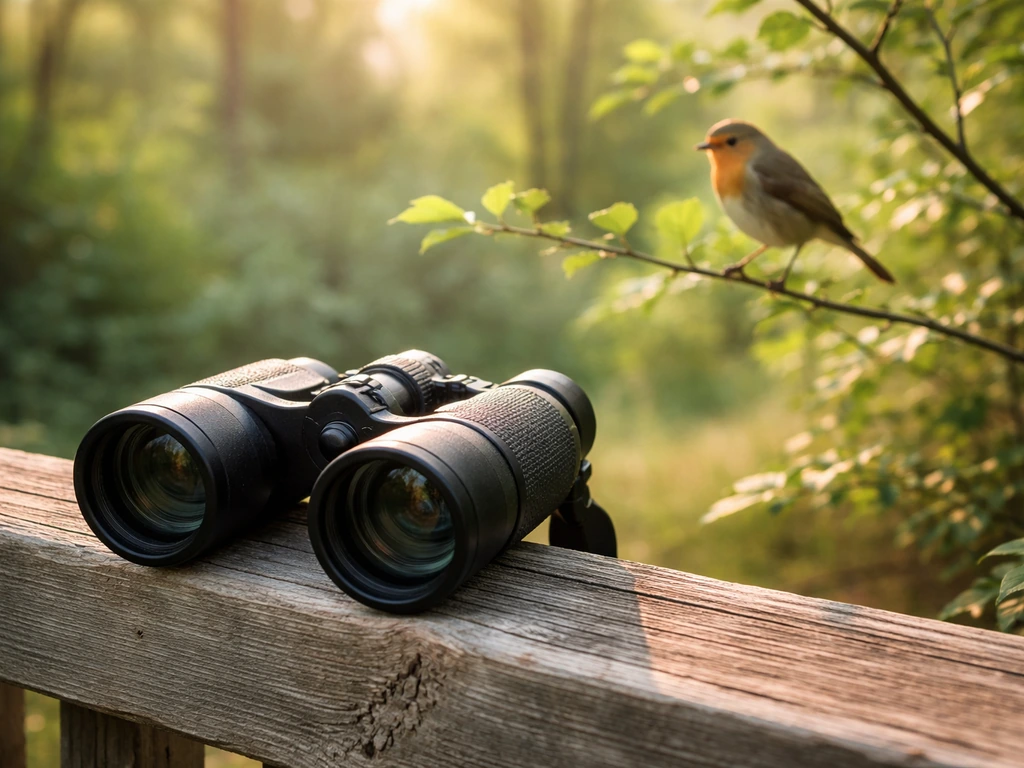
The phrase "bird watch" is most commonly a casual spelling variant of "birdwatch" (one word) or "birdwatching" (the noun form of the hobby). All three forms refer to the same thing: going outside, observing wild birds, and learning to identify them. Whether someone writes "bird watch," "bird-watch," or "birdwatch," they almost always mean the hobby. You might also see the verb form used loosely, as in "I like to bird watch on weekends," which is grammatically the same as "I like to birdwatch."
Where confusion creeps in is when people search for "bird watch meaning" hoping to find something more interpretive, like what it means spiritually to watch a bird, or what it signifies when birds seem to follow or visit you repeatedly. That's a different question entirely, and it belongs more to folklore and symbolism than to dictionary definitions. This article covers both angles clearly, so you're not left guessing which one applies to you.
It's also worth separating "bird watch" from a few genuinely different terms that show up in bird-related language. For example, bird watching slang covers informal or colloquial uses of the phrase in specific subcultures, which is its own rabbit hole. And a bird walk typically refers to a guided group outing for observing birds, not just any casual stroll. These distinctions matter if you're trying to be precise about what someone means when they use these terms.
What you actually do when you go birdwatching
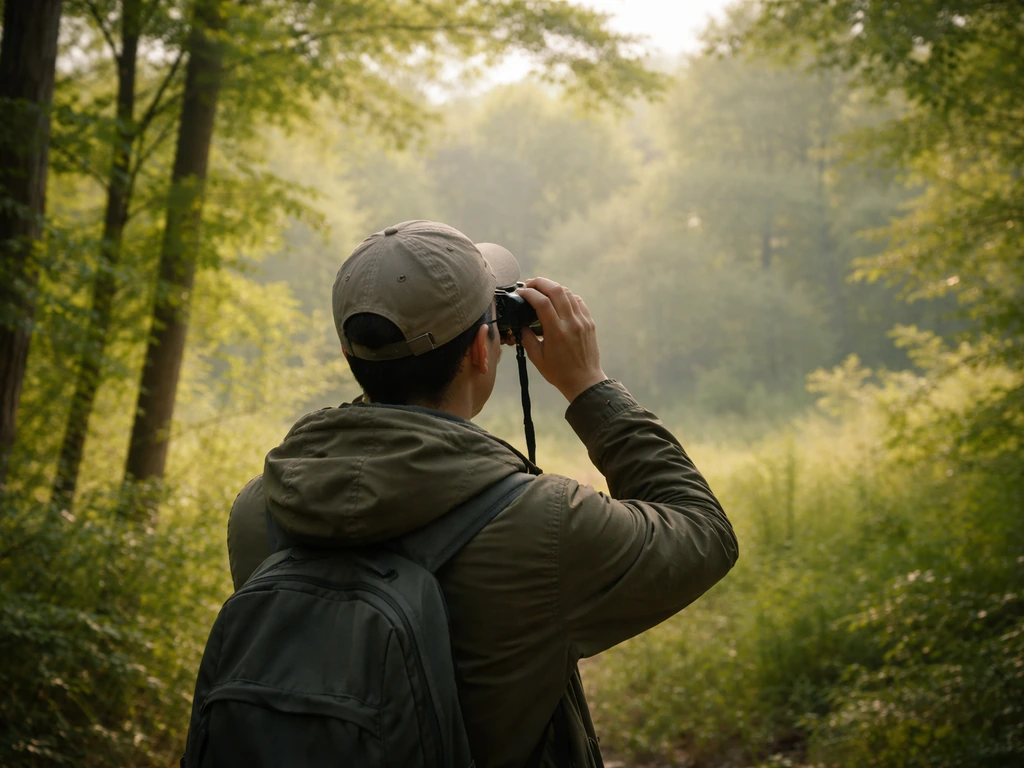
Birdwatching is fundamentally about developing observational skills. According to Audubon, the core of the hobby is watching what's out there and learning to identify species, not chasing rare birds or filling life lists (at least not at first). The practice involves slowing down, scanning your environment systematically, and learning to notice details you'd normally walk right past.
In practical terms, here's what a birdwatching session looks like. You arrive at a location, ideally with binoculars and a field guide or app. You stand or sit quietly and scan the trees, shrubs, water, and sky in a methodical way rather than just glancing around randomly. When you spot a bird, you take in its size, shape, color patterns, and behavior before it moves. You note what it's doing, whether it's foraging, perching, flying, or calling. Then you try to match what you saw to a known species.
Sound is just as important as sight. Many experienced birders identify species by ear before they ever spot them visually. Learning a handful of common calls in your region makes you dramatically better at detecting birds that are hidden in dense vegetation. This is where apps like Merlin Bird ID (from Cornell Lab) become genuinely useful: they can listen in real time and flag which species are likely calling nearby. Cornell Chronicle also reports that Merlin Bird ID can identify birds by sound in real time and supports identification using photo or question-based inputs.
Recording what you see is also part of the practice. Many birdwatchers log their observations through eBird, Cornell Lab's citizen science platform, where you can submit complete checklists of every species you identified during an outing. This transforms your personal hobby into a contribution to real wildlife data.
How to start birdwatching today
Gear: keep it simple
You don't need much to get started. Audubon recommends three essentials for beginners: a field guide relevant to your region, a weather-proof notebook, and an easy-to-use birding app. That's genuinely it for day one. Binoculars help enormously, but even a basic pair in the 8x42 range is sufficient to start. The Audubon Bird Guide app is free, covers over 800 North American species, and uses real-time sighting data from eBird to show you what birds are likely near you right now. Merlin Bird ID works similarly and can identify a bird from just a few simple questions: What size? What color? What was it doing?
Where to go
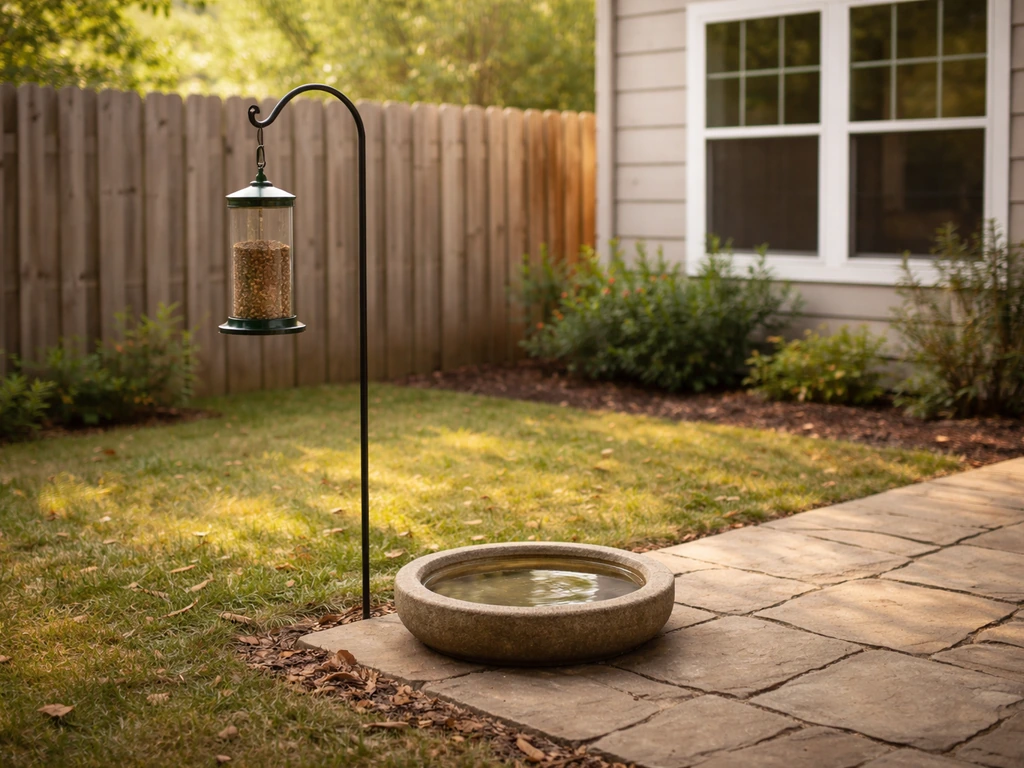
Start with wherever birds already are near you. Your backyard, a local park, a shoreline, or even a cemetery (birds love the quiet) are all valid starting points. You don't need to travel to a nature reserve on your first outing. eBird's hotspot map shows you exactly where other birders in your area have been seeing the most species, which is a practical shortcut when you're ready to explore further.
If you're setting up a feeder at home, placement matters for safety. Audubon and the U.S. Fish & Wildlife Service both recommend placing feeders either within 3 feet of a window or more than 30 feet away. The logic: birds close to the glass don't build enough momentum for a fatal collision if they fly toward the reflection, while birds far away are less likely to confuse it for open sky. Also, if you have cats, keep them indoors. Audubon is direct about this: outdoor cats are a serious and preventable threat to birds visiting feeders.
When to go
Early morning is universally the most productive time for birdwatching. Bird activity peaks in the first few hours after dawn, when birds are feeding and calling actively. Audubon's guidance for specific sites like Riverlands Migratory Bird Sanctuary suggests arriving before 10 a.m. for spring and summer birding. In general, aim for the first two to three hours after sunrise. Late afternoon is a secondary window. Midday tends to be quieter, especially in summer heat.
Ethical basics
The American Birding Association's Code of Birding Ethics makes a few things clear. Observe from a distance so your presence doesn't stress or disturb the birds. Limit the use of audio recordings to attract birds, especially in heavily birded areas and for rare, threatened, or endangered species. Read the site guidelines before you visit a managed wildlife area. The RSPB's beginner guide echoes this: wildlife is sensitive to disturbance, and responsible access protects both the birds and the site for everyone else. Being a thoughtful bird watcher means the birds' wellbeing comes before your perfect photo or checklist entry.
How to identify birds quickly in the field
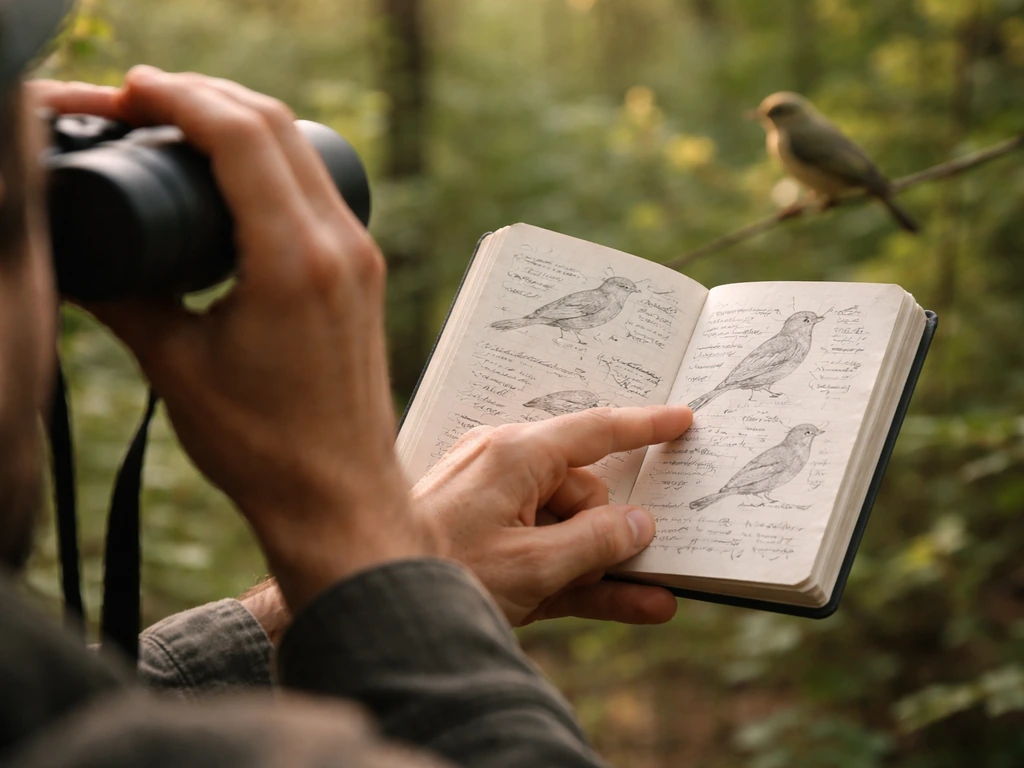
Cornell Lab's All About Birds teaches a method built around "field marks," which are the specific visual patterns that distinguish one species from another. Cornell Lab’s All About Birds PDF mirror describes the “4 Keys” to bird identification: size and shape, color pattern, behavior, and habitat the “4 Keys” to bird identification (size & shape, color pattern, behavior, habitat). Size, body shape, bill shape, wing patterns, tail length, eye rings, and leg color are all field marks. The key is to use multiple clues, not just one. A bird with a red chest could be a robin, a house finch, or several others depending on its size and bill shape. Never try to identify from a single trait.
A practical approach for beginners:
- Note the bird's size relative to something familiar (sparrow-sized, crow-sized, pigeon-sized).
- Look at the bill: is it thick and seed-cracking, thin and insect-probing, or hooked like a raptor's?
- Check for any obvious color patches on the head, wings, or tail.
- Watch the behavior: does it creep up tree trunks, hop on the ground, or hover over water?
- Listen to the call or song and try to describe it in words (a buzzy trill, a whistled two-note, a harsh chatter).
- Open Merlin or your field guide and match what you observed using all of the above clues together.
Merlin's step-by-step identification workflow walks you through exactly this kind of question sequence and then produces a list of species likely to match in your area. For sound ID, its real-time audio recognition is genuinely impressive and works well even for beginners who can't yet describe what they're hearing.
Why birds feel meaningful to so many people
Across cultures and centuries, birds have held symbolic weight that goes well beyond their biological role. The ancient practice of reading omens from bird behavior even has a formal name: ornithomancy, which Wikipedia defines as taking divination or omens from birds. This wasn't fringe superstition in its time. It was a structured interpretive system used by Roman augurs, Greek priests, and indigenous cultures worldwide. A bird flying to the right was considered auspicious in Roman tradition; an owl calling near a house was taken as a death omen in many European folk traditions.
Today, these ideas persist in softer form. People notice a cardinal after a loved one dies and feel comforted by the idea that it carries a message. Someone sees the same hawk repeatedly and wonders if it's a sign. These responses are deeply human. They reflect pattern recognition, emotional need, and a long cultural inheritance of treating birds as liminal creatures, beings that exist between the earthly and the spiritual, between this world and the next.
Part of what makes birds such potent symbols is their behavior: they move freely between earth and sky, appear and disappear without warning, and their songs carry across invisible distances. Many cultures have mapped these qualities onto ideas about communication from the dead, divine messengers, or embodied souls. Understanding this doesn't require believing it literally. It just helps explain why bird walking meaning and other bird-related expressions carry weight that purely mechanical creatures never quite achieve.
How to interpret bird sightings without over-mystifying them
Here's where a lot of people go sideways. A bird appears at a meaningful moment, and the natural impulse is to connect the two. The problem is that this connection is almost always driven by confirmation bias, which is the documented cognitive tendency to search for, interpret, and recall information in a way that supports what we already believe or want to believe. The Environmental Literacy Council notes that perceived accuracy of omens is strongly influenced by exactly this kind of psychological pattern.
There's also the frequency illusion at work, sometimes called the Baader-Meinhof effect. Once you learn that, say, a red cardinal is supposed to symbolize a visit from a deceased loved one, you start noticing cardinals everywhere. Not because they appear more often, but because your brain is now filtering for them. The birds were always there. The meaning was layered on afterward.
None of this means you should discard symbolic interpretations entirely. Folklore and personal meaning are valid parts of human experience. But use them responsibly:
- Treat symbolic interpretations as emotionally meaningful, not as predictive or factual claims about the world.
- Be cautious about making decisions based on bird omens, whether financial, medical, or relational.
- Acknowledge that the same bird species symbolizes different (sometimes opposite) things in different cultures, which should signal that no single interpretation is objectively correct.
- Distinguish between cultural traditions worth understanding and claims worth acting on.
On a related note, it's worth flagging a term that occasionally gets confused with birdwatching in search contexts: bird shot, which Merriam-Webster defines as small-sized shot used for hunting birds. It has nothing to do with birdwatching as a hobby or any symbolic meaning. If you arrived here after a search mixing those terms, that's the clarification you needed.
Birdwatching vs. birding: is there a difference?
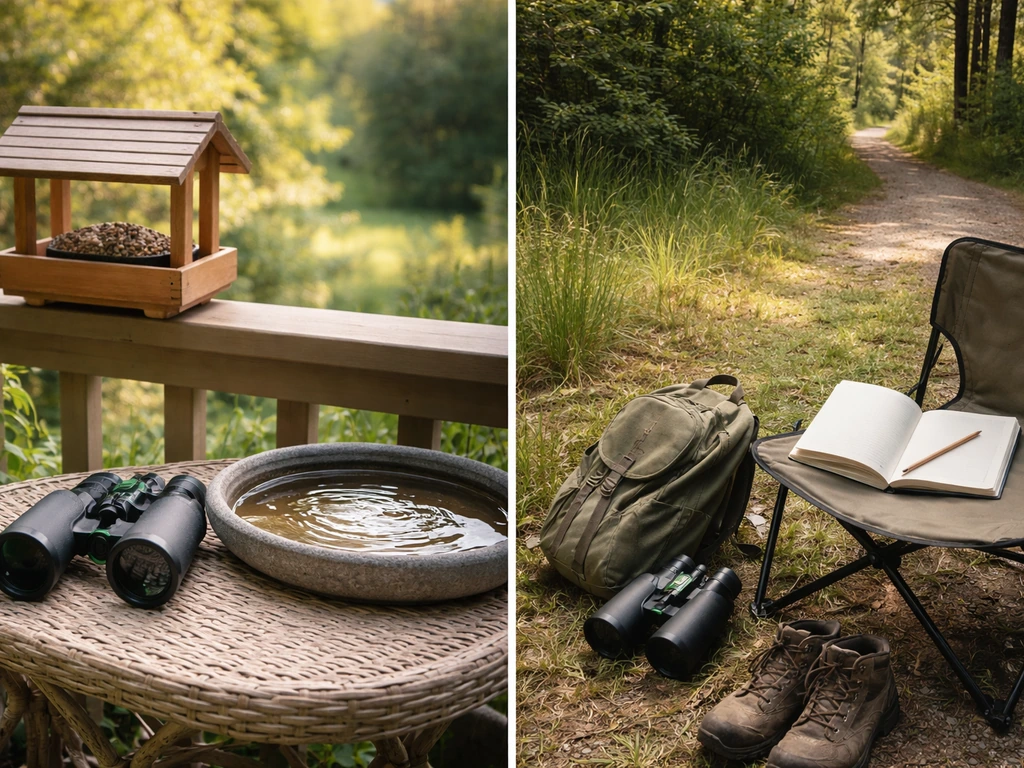
Some people draw a distinction between "birdwatching" (casual, backyard-level, more relaxed) and "birding" (active, travel-oriented, species-list-focused). In practice, the two terms are used interchangeably by most people and most organizations, including Audubon and Cornell Lab. The hobby is the same regardless of what you call it. The only meaningful difference is intensity of engagement, not any definitional boundary.
| Term | Typical usage | Intensity level | Common tools |
|---|---|---|---|
| Birdwatching | Casual observation of birds, often near home | Low to moderate | Binoculars, field guide, notebook |
| Birding | Active pursuit of species, often traveling to find specific birds | Moderate to high | Binoculars, scope, eBird, Merlin |
| Bird walk | A guided group outing for observing birds at a specific location | Varies | Whatever the group brings |
| Ornithology | Scientific study of birds, involving research and data collection | Professional/academic | Scientific instruments, banding gear, academic databases |
The practical takeaway: whatever level of engagement you're aiming for, the foundational skills are the same. Observe carefully, identify methodically, record honestly, and respect the birds and the habitat. Everything else is just scale.
FAQ
Is “bird watch” ever used to mean something other than the hobby or “birdwatching” in everyday writing?
In normal usage, “bird watch” is simply a spelling variant of “birdwatching” (or “birdwatch”). If someone uses it in a non-hobby context, it’s usually because they meant another phrase, like “bird walk” (a guided outing) or “bird shot” (hunting ammunition), not because “bird watch” has a separate built-in meaning.
What should I do if I see a bird clearly but can’t get the ID from an app or guide?
Use a field-marks approach instead of relying on one feature. Recheck bill shape and behavior (foraging style, hopping vs. walking, perch height, flight pattern), then compare only against the species list your location and season narrow to. Apps can be wrong when multiple similar species overlap in your area or when lighting distorts colors.
Do I need binoculars, or can I start with just my phone and eyes?
You can start without binoculars, but a basic pair helps a lot with bill shape, subtle wing bars, and small color details that apps assume you can observe. If you rely only on a phone photo, try taking multiple shots and note the bird’s behavior and call, since a still image often misses key field marks.
Is it okay to use playback or recorded bird calls to attract birds?
Use it sparingly and usually only when conditions are quiet and you have a good reason. Ethical guidance discourages heavy use, especially for rare, threatened, or endangered species, because playback can stress birds, disrupt natural behavior, and increase risk of injury from repeated disturbance.
How do I avoid disturbing birds while still getting a good look or photo?
Keep distance and watch your impact. If birds stop feeding, flush repeatedly, or change their behavior noticeably, back off or change angle. Also avoid approaching from downwind when possible, and don’t crowd nests or roosting spots, even if they seem tolerant at first.
What time of day is best if I only have 30 to 60 minutes to go out?
Choose the first two to three hours after sunrise if you can. Early morning typically combines active feeding and calling, which improves both sight and sound identification. If you miss that window, late afternoon is your next-best option, while midday is often slower, especially in summer.
Is “bird watch meaning” sometimes used to ask about spirituality or omens, and how should I interpret that?
Yes, people sometimes search for “bird watch meaning” when they mean symbolic significance, like comfort after a loss or “signs” in repeated sightings. A useful approach is to treat it as personal meaning rather than a literal forecast, and to be aware of confirmation bias (you notice the “meaningful” sightings more once you expect them).
Why do I start seeing the same species everywhere after I learn its “symbol”?
That’s often a frequency illusion, meaning your brain starts filtering for that specific bird because you now attach meaning to it. The bird population hasn’t usually changed, your attention has. If you want a reality check, compare your sightings with local seasonal patterns from a bird guide or eBird hotspot.
How should I handle “what does this bird mean?” when I’m posting online or talking to others?
Separate what you observed (species likelihood, location, date, behavior) from what you feel or interpret. Posting “this is a sign” without basic identification evidence can spread misinformation, especially when different species share similar appearances or when people confuse sightings with folklore.
What’s the safest way to set up a feeder if I live near windows?
Follow the window-distance rule: place feeders very close to windows (within about 3 feet) or much farther away (more than about 30 feet). Either reduces collision risk compared with the middle range. If you have cats, keep them indoors and consider adding other bird-safe measures like window film or screens.
Do I need to record observations, or is it optional for beginners?
Recording is optional, but it helps your learning. Logging species you identified, even with notes about confidence or uncertainty, makes patterns easier to spot later (like which species show up in your yard during certain months). Platforms like eBird also let you contribute to real distribution data.
How can I tell the difference between “birdwatching” and “birding,” since people sometimes treat them as separate things?
Most organizations and birders use “birding” and “birdwatching” interchangeably. If there is any difference, it’s usually intensity (relaxed backyard observing versus more active traveling and stronger focus on adding species), not a different activity or meaning.
What should I watch for if I’m identifying birds by call first?
Start by learning a few common calls for your region, but don’t assume the first call you recognize is the only possibility. Background noise, distance, and similar-sounding species can mislead you. Confirm with at least one extra field mark (silhouette, size, wing shape, behavior), and update your ID as you gather more clues.
What does “bird walk” mean, and is it the same as birdwatching on your own?
A “bird walk” usually means a structured group outing led by someone experienced (often with planned routes and teaching). It’s still centered on observing wild birds, but it’s not the same as casual solo watching, since the leader may control pace, stopping points, and identification focus.